

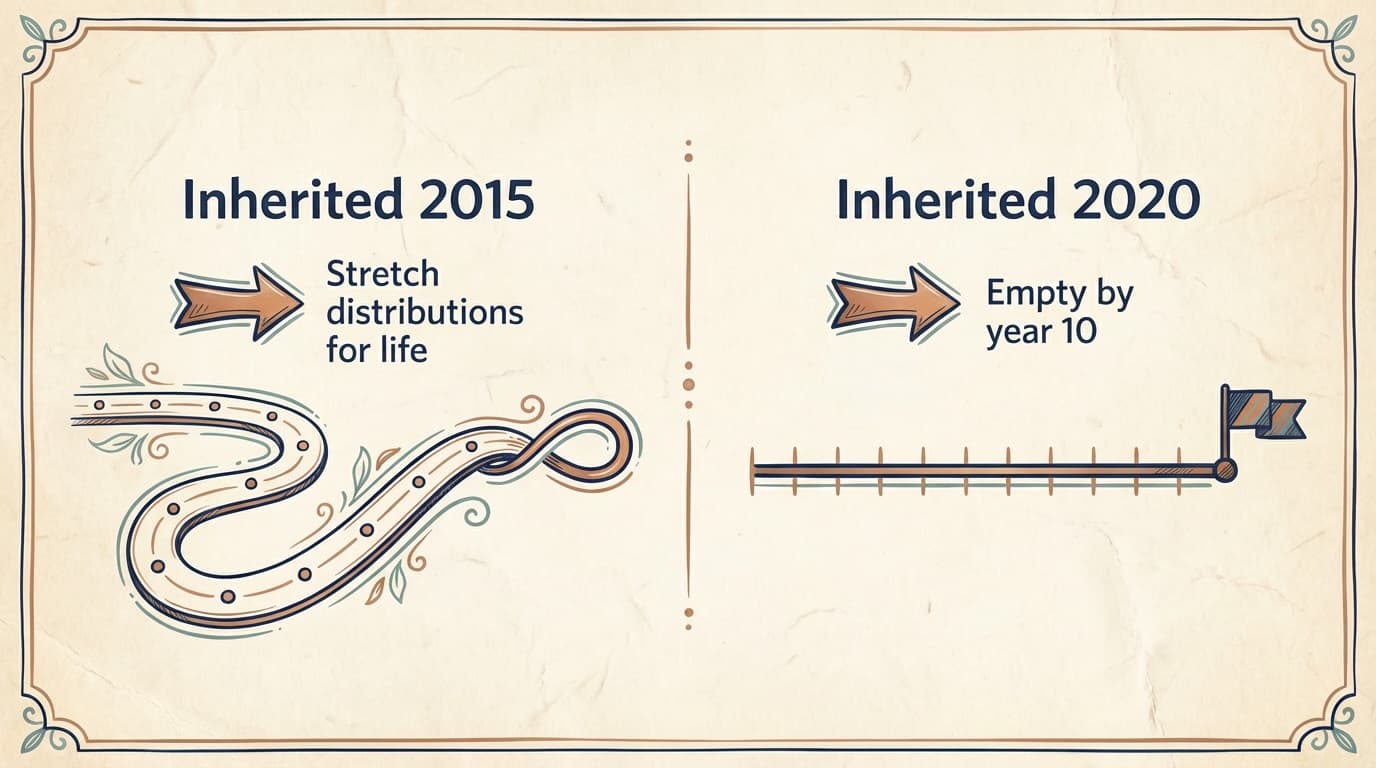
If you inherited an IRA before January 1, 2020, different rules may still apply to you. (For the current rules, see the full inherited IRA RMD overview.)
Under the old "stretch IRA" rules, beneficiaries could spread distributions over their own life expectancy — sometimes for decades. The SECURE Act of 2019 eliminated this option for most new inheritances. But if you were already using the stretch method before the law changed, you're generally grandfathered in and can continue on your original schedule.
In short: Beneficiaries who inherited before January 1, 2020 and were already taking life expectancy distributions may continue under the pre-SECURE stretch rules. The 10-year rule does not apply to them. Annual distributions are required, calculated using the IRS Single Life Expectancy Table (Table I) with the subtract-1 method.
What Was the Stretch IRA?
Before the SECURE Act, most designated beneficiaries could stretch distributions from an inherited IRA over their own life expectancy.
A younger beneficiary — say, a 40-year-old who inherited from a parent — could take relatively small annual distributions for 40+ years. This allowed the account to keep growing tax-deferred for a long time.
The strategy was known as the "stretch IRA." It was widely used in estate planning and was considered one of the most valuable features of IRA inheritance.
What the SECURE Act Changed
The SECURE Act, effective January 1, 2020, eliminated the stretch IRA for most non-spouse beneficiaries inheriting after that date.
For deaths occurring after December 31, 2019, most designated beneficiaries must now empty the inherited account within 10 years. Annual distributions may also be required within that window depending on whether the original owner had started their own RMDs.
The 10-year rule does not apply retroactively to people already receiving stretch distributions.
Who Is Still on the Legacy Schedule?
You are likely grandfathered under the pre-SECURE rules if:
- You inherited the IRA before January 1, 2020
- You were taking (or were required to take) life expectancy distributions under the old rules
- You are an individual designated beneficiary — not a trust, estate, or charity
Eligible designated beneficiaries who inherited after 2019 may also use life expectancy distributions — but they are operating under SECURE Act rules, not the legacy stretch. The distinction matters for how factors are calculated at the start. See: Inherited IRA RMD rules
How the Calculation Works
The legacy stretch calculation uses the same table and the same subtract-1 method as current inherited IRA distributions — but the starting point was set years ago.
How your initial factor was established
Your life expectancy factor was looked up once, in the year after the original owner died, based on your age that year. You use Table I — the Single Life Expectancy Table — from IRS Publication 590-B.
That initial factor has been declining by 1.0 every year since.
Worked example
Robert inherited a Traditional IRA from his father in 2015. He was 45 years old in 2016 — his first distribution year.
His initial factor in 2016: 40.7 (age 45 from the pre-2022 Table I)
Each year, Robert subtracts 1.0:
| Year | Factor | Prior Dec. 31 Balance | RMD |
|---|---|---|---|
| 2023 | 32.7 | $285,000 | $8,716 |
| 2024 | 31.7 | $276,000 | $8,706 |
| 2025 | 30.7 | $264,000 | $8,599 |
| 2026 | 29.7 | $251,000 | $8,451 |
Robert does not use the 10-year rule. He is not required to empty the account by any specific year — he continues taking annual distributions for the rest of his life expectancy.
The 2022 Table Update: Did Your Factor Change?
The IRS updated Table I in 2022 — the first revision since 2002. The new factors are slightly larger, which means slightly smaller RMDs.
Beneficiaries already using the stretch method were allowed a one-time reset when the new tables took effect in 2022.
Here's how it worked: rather than continuing to subtract 1 from your old factor, you could look up your age in the new 2022 table to establish a fresh starting factor — then continue subtracting 1 from that new number going forward.
If you or your tax professional made this adjustment in 2022, your current factor reflects the new table.
If you didn't, and continued subtracting from the old table's starting point, confirm with a tax professional whether a correction is needed. The difference is small in dollar terms, but using the wrong table could result in taking slightly more than required — or slightly less, which creates a shortfall.
Annual Distributions Are Still Required
Being on the legacy stretch schedule does not mean distributions are optional.
You must take a distribution every year, by December 31. Missing one triggers the same 25% excise tax on the shortfall as any other missed RMD — reducible to 10% if corrected within two years.
The IRS penalty waiver that covered missed inherited IRA distributions from 2021–2024 applied specifically to beneficiaries subject to the 10-year rule under SECURE Act. It did not apply to legacy stretch beneficiaries.
For correction steps: Late RMD distribution · IRS waiver for a missed RMD
What Happens When a Stretch Beneficiary Dies?
If you're receiving stretch distributions and you die, the account passes to your successor beneficiary.
Under the SECURE Act, successor beneficiaries generally do not inherit your remaining stretch schedule. Instead, they are typically subject to the 10-year rule from the date of your death — regardless of when the original owner died.
This is a significant estate planning consideration. If you're a stretch beneficiary with a sizable inherited IRA, it's worth discussing successor beneficiary planning with a financial advisor.
Frequently Asked Questions
I inherited in 2019. Am I on the legacy schedule?
If the original owner died before January 1, 2020, yes — you were subject to pre-SECURE rules. As long as you established life expectancy distributions in 2020 (the year after the 2019 death), you should be grandfathered under the stretch method. If you haven't started distributions yet, consult a tax professional — the window to establish the stretch may have implications.
I inherited in 2019 but haven't taken any distributions. What now?
This is a situation that needs professional guidance. Depending on the circumstances, you may have missed required distributions — which carries penalty exposure — or there may be correction options available. Don't wait to address it.
My factor seems too low compared to what the table says for my age. Why?
Because you don't look up your current age — you look up the age you were in your first distribution year and subtract 1 for every year since. If you're now 58 but your first distribution year was at age 45, your factor has been declining for 13 years. It should be well below what Table I shows for age 58.
Can I switch to the 10-year rule to simplify things?
Generally, no. Once life expectancy distributions are established, you're on that schedule. If simplification is a goal, a tax advisor can help you think through options — but there's no straightforward "switch."
What if I inherited from a spouse before 2020?
Surviving spouses have always had more options than other beneficiaries — including rolling over the inherited IRA into their own IRA, which resets the distribution timeline entirely. If you inherited from a spouse and haven't reviewed your options, it's worth doing. See: Inherited IRA RMD rules
What to do next
- Run the inherited IRA calculator — free, no account required
- Inherited IRA RMD table explained — how the factor lookup and subtract-1 method works
- Inherited IRA RMD rules — full overview including SECURE Act changes
- The 10-year rule explained — rules for post-2019 inheritances
- RMD deadlines and penalties — what happens if you miss a distribution
This article is for informational purposes only and does not constitute tax, legal, or financial advice. IRS rules and tax laws are subject to change. Consult a qualified tax professional or financial advisor for guidance specific to your situation. SimpleRMD is a calculation and tracking tool — not a financial advisory service.
Sources: IRS Publication 590-B (2025), Appendix B — Table I (Single Life Expectancy); SECURE Act of 2019 (Pub. L. 116-94); SECURE 2.0 Act of 2022 (Pub. L. 117-328); IRS.gov — Required Minimum Distributions for IRA Beneficiaries. Rules confirmed current as of 2026.