The 10-Year Rule for Inherited IRAs: Explained

The 10-year rule requires most inherited IRA beneficiaries to empty the account within 10 years. Learn how the timeline works, when annual RMDs apply, and what to watch for.

Trigg Thorstenson

Trigg Thorstenson

Having struggled with this problem myself, my goal is to help you understand RMD rules clearly and confidently.

6 min read
Listen
Share
The 10-Year Rule for Inherited IRAs: Explained

The 10-year rule is the centerpiece of inherited IRA rules for anyone who inherited an account from someone who died after 2019. In plain language: you have 10 years from the year after the original owner's death to empty the entire account.

That part is straightforward. What trips people up is everything underneath — whether you need to take annual distributions during those 10 years, what happened during the waiver years, and how the timeline actually counts. This page walks through all of it.


In short: If you inherited an IRA from someone who died after 2019 and you're a designated beneficiary (most adult children, siblings, friends), the entire account must be emptied within 10 years. Whether you must take annual RMDs during those 10 years depends on whether the original owner had started their own RMDs before they died. If they had, annual distributions are required in years 1–9. If they hadn't, you have full flexibility on timing — but the year-10 deadline is firm. The IRS finalized these rules in July 2024, and penalty enforcement began in 2025.


The deadline is firm. December 31 of year 10 — no extensions, no exceptions. The IRS penalty waivers that covered 2021–2024 have ended. Starting in 2025, missed distributions are enforced with a 25% excise tax.


On this page


Who Does the 10-Year Rule Apply To?

The 10-year rule applies to designated beneficiaries — individuals named on the account who don't qualify for one of the five exemptions. The most common example: an adult child who inherits a parent's IRA.

If you're any of the following, you're on the 10-year clock:

  • Adult children of the deceased
  • Siblings (unless not more than 10 years younger than the deceased)
  • Friends, partners, or other named individuals
  • Minor children of the deceased — after they reach age 21

The 10-year rule does not apply to Eligible Designated Beneficiaries (EDBs): surviving spouses, minor children (until age 21), disabled or chronically ill individuals, and beneficiaries not more than 10 years younger than the deceased. These groups may use life expectancy-based distributions instead.

It also does not apply to non-designated beneficiaries (estates, charities, certain trusts) — they follow a separate 5-year or "ghost" life expectancy rule.

For the full beneficiary classification: Inherited IRA RMD rules


How the 10-Year Clock Works

The clock starts the year after the original owner's death — not the year of death.

  • Owner died in 2022 → clock starts 2023 → account must be empty by December 31, 2032
  • Owner died in 2024 → clock starts 2025 → account must be empty by December 31, 2034
  • Owner died in 2025 → clock starts 2026 → account must be empty by December 31, 2035

The deadline is always December 31 of the year containing the 10th anniversary. There are no extensions and no exceptions to this deadline — regardless of your beneficiary type, the account balance, or whether annual RMDs were required along the way.

The clock was not paused during the IRS waiver years (2021–2024). The IRS waived penalties for missed annual distributions during those years, but it did not extend the 10-year window. Those years still count.

Your 10-year clock — timeline from owner's death through year 10, showing when annual RMDs are required versus optional


The Key Question: Did the Owner Start RMDs?

This is the single most important fact in inherited IRA planning. It determines whether you simply need to empty the account by year 10 or whether you must take annual distributions every year along the way.

Original Owner Died...Annual RMDs Required in Years 1–9?Year 10
Before their Required Beginning Date (hadn't started RMDs)No — withdraw as much or as little as you want each yearMust empty the account by Dec. 31 of year 10
After their Required Beginning Date (had started RMDs)Yes — annual distributions required, based on your life expectancyMust empty the account by Dec. 31 of year 10
Roth IRA (any age at death)No — Roth owners are always treated as dying before their RBDMust empty the account by Dec. 31 of year 10

What Is the Required Beginning Date (RBD)?

The RBD is April 1 of the year after the original owner reached RMD age — currently age 73 (or 75 for those born in 1960 or later). If the owner died before that date, they hadn't started RMDs. If they died on or after that date, they had.

A practical shortcut: if the original owner was 73 or older when they died, assume post-RBD unless the custodian tells you otherwise. If they were under 72, they almost certainly hadn't reached their RBD. The gray zone is narrow — and the custodian can confirm in one phone call.

If you don't know whether the original owner had started RMDs, call the custodian. This isn't something to guess about. The answer determines your entire distribution schedule for the next decade.

Get rule-change alerts (inherited IRAs only)

We'll only email you if inherited IRA rules or enforcement materially change.

You can unsubscribe anytime.


Scenario A: Owner Died Before Their RBD

This is the simpler path. You have maximum flexibility.

The rules:

  • The account must be fully emptied by December 31 of year 10.
  • No annual RMDs are required in years 1–9.
  • You can take as much or as little as you want in any given year.
  • You can take nothing for 9 years and withdraw everything in year 10.

Worked example — Sarah:

Sarah inherited a Traditional IRA from her father, who died in January 2024 at age 68 — well before his RBD. Sarah is 42 and works full-time.

Sarah's Timeline
Owner's death2024
10-year clock starts2025
Deadline to empty accountDecember 31, 2034
Annual RMDs required?No

Sarah can take distributions in any amount, in any year, through 2034. She might choose to take larger distributions in years when her income is lower — or spread them evenly. The only hard rule: the balance must be zero by December 31, 2034.

Even though annual distributions aren't required, the tax planning question starts now. Spreading distributions over the 10-year window may produce a better tax outcome than taking everything at once. See: Tax on inherited IRA RMDs


Scenario B: Owner Died After Their RBD

This is the more complex path. Annual distributions are required.

The rules:

  • The account must be fully emptied by December 31 of year 10.
  • Annual RMDs are required in years 1 through 9.
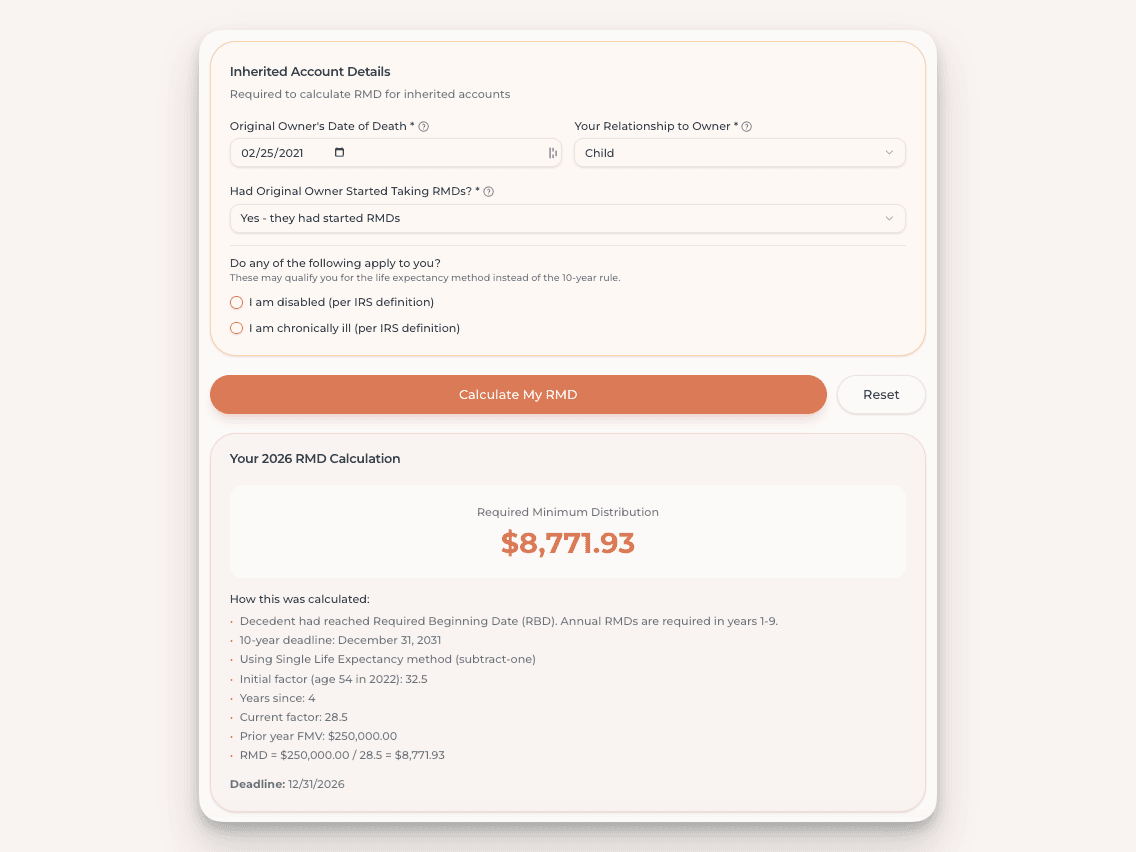
  • Each annual RMD is calculated using the IRS Single Life Expectancy Table, based on your age.
  • The life expectancy factor is looked up once (in year 1) and reduced by 1.0 each subsequent year.
  • Missing an annual RMD triggers a 25% excise tax on the shortfall (starting in 2025).

Worked example — Kevin:

Kevin inherited a Traditional IRA from his mother, Linda, who died in March 2022 at age 79 — well past her RBD.

YearWindow YearAnnual RMD Required?Notes
2023Year 1Yes (penalty waived)IRS Notice 2023-54
2024Year 2Yes (penalty waived)IRS Notice 2024-35
2025Year 3Yes — enforcedPenalty waiver ended
2026Year 4Yes — enforced
2027Year 5Yes — enforced
2028Year 6Yes — enforced
2029Year 7Yes — enforced
2030Year 8Yes — enforced
2031Year 9Yes — enforced
2032Year 10Full balance must be withdrawnAccount must be empty by Dec. 31

Kevin must take annual distributions in years 1–9 based on his life expectancy, then drain the remaining balance by year 10. He can always take more than the minimum in any year — but he cannot take less.

For how the annual RMD is calculated: Inherited IRA RMD tables explained

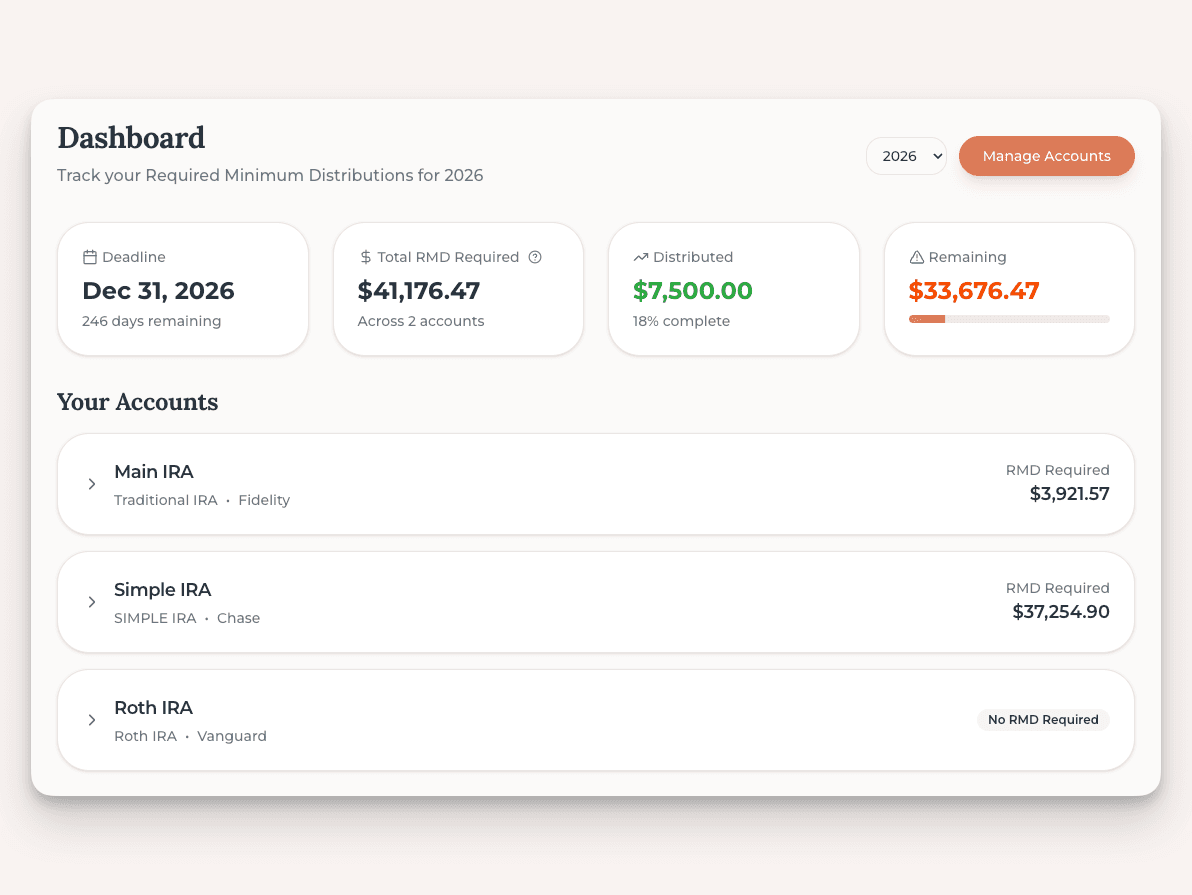
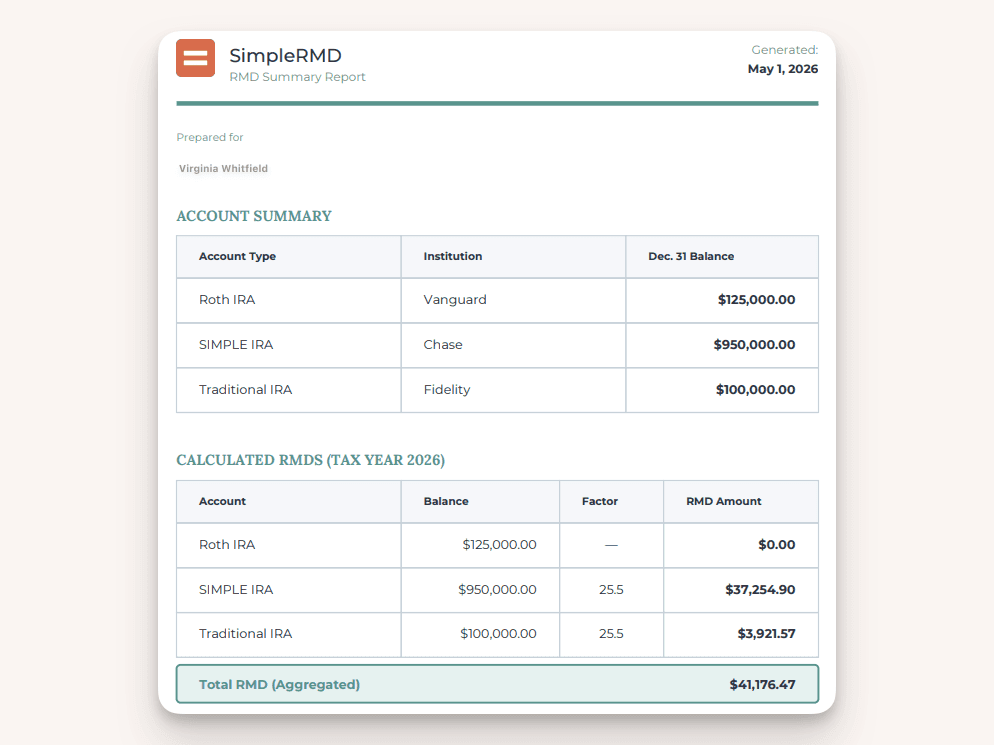
Want to see your number? Run the SimpleRMD inherited IRA calculator — free, no account required. With a SimpleRMD account, you can export your 10-year timeline and annual RMDs as a CPA-ready PDF.


The Waiver Years (2021–2024): What They Mean Now

The IRS spent four years clarifying the 10-year rule after the SECURE Act passed in 2019. During that time, it issued a series of notices waiving penalties for beneficiaries who missed annual distributions:

  • IRS Notice 2022-53 — waived penalties for 2021 and 2022
  • IRS Notice 2023-54 — extended the waiver through 2023
  • IRS Notice 2024-35 — extended the waiver through 2024

The final regulations (T.D. 10001) were issued in July 2024 and took effect for distributions beginning in 2025.

What the waivers did: Excused the 25% excise tax for beneficiaries who didn't take annual distributions during those years.

What the waivers did not do: Pause or extend the 10-year clock. If the original owner died in 2020, your deadline is still December 31, 2030 — even though you weren't penalized for missing distributions in years 1–4. If you missed annual distributions from 2021–2024, there's no penalty for those years — but those years still count toward your 10.

Starting in 2025, the full penalty structure applies. If annual RMDs are required (because the owner died after their RBD) and you miss one, the 25% excise tax kicks in. See: Penalties for missed inherited IRA RMDs

If you inherited an IRA in 2020–2023 and haven't taken any distributions yet, the clock has been running. Check where you stand now.


What Happens in Year 10

Year 10 is the hard deadline. Whatever remains in the account must be withdrawn by December 31.

  • If annual RMDs were required (Scenario B), the year-10 withdrawal is whatever balance is left after 9 years of distributions.
  • If annual RMDs were not required (Scenario A), the year-10 withdrawal could be the entire account — or very little, if you've been taking distributions along the way.
  • For inherited Roth IRAs, year 10 works the same way — but qualified distributions are tax-free.

The excise tax applies to any balance remaining after December 31 of year 10. If you miss this deadline, the 25% penalty is assessed on the amount that should have been withdrawn. There is no year-11 option.

Plan ahead for processing time. Custodians can take days or weeks to process distributions, especially in November and December. Don't wait until the last week of December to request your final withdrawal — November is the safest window to initiate it.


Common Mistakes

Assuming you can wait until year 10 if the owner started RMDs. If the original owner died after their RBD, annual distributions are required in years 1–9. The IRS confirmed this in final regulations. Missing them triggers a 25% excise tax starting in 2025.

Thinking the waiver years paused the clock. They didn't. We've seen beneficiaries assume they have "extra time" because penalties were waived from 2021–2024. The waivers covered penalties only — the 10-year deadline never moved.

Not finding out whether the owner had started RMDs. This is the fork in the road, and too many beneficiaries walk past it without checking. The difference between Scenario A and Scenario B is the difference between full flexibility and mandatory annual distributions. Call the custodian.

Forgetting about the tax impact of year-10 lump sums. Even if you're not required to take annual distributions, waiting until year 10 to withdraw a large balance creates a single-year income spike. See: Tax on inherited IRA RMDs

Missing the December 31 deadline for the final year. Custodian processing times matter. If your distribution request doesn't settle by December 31 of year 10, you've missed the deadline. Start early.

Assuming inherited Roth IRAs have no 10-year rule. They do. Distributions are tax-free (if the 5-year rule is met), but the 10-year deadline applies just like a Traditional inherited IRA. Missing it triggers the same 25% excise tax — on money you could have taken tax-free.


Frequently Asked Questions

Does the 10-year rule apply to inherited Roth IRAs?

Yes. The 10-year deadline applies regardless of account type. The difference: inherited Roth IRAs don't require annual RMDs during years 1–9 (because Roth owners are treated as dying before their RBD), and qualified distributions are tax-free. But the account must still be emptied by year 10. See: Inherited Roth IRA rules

What if I inherited the IRA before 2020?

The 10-year rule doesn't apply. Pre-2020 inherited IRAs follow the original "stretch" rules — life expectancy distributions over the beneficiary's lifetime. Those rules were not changed retroactively. See: Legacy stretch IRA schedules

Can I take more than the annual RMD?

Yes. You can always withdraw more than the minimum in any year. Excess withdrawals reduce the remaining balance but do not reduce your required distribution for the next year (the factor still drops by 1.0).

What if the original owner died in 2025?

Your 10-year clock starts in 2026. If the owner had reached their RBD, your first required annual distribution is due by December 31, 2026. Your deadline to empty the account is December 31, 2035.

What happens if I miss an annual RMD?

Starting in 2025, a 25% excise tax applies to the shortfall. If corrected within 2 years, the penalty automatically reduces to 10%. In some cases, the IRS may waive the penalty entirely for reasonable cause. See: IRS waiver for missed RMDs


What to do next


This article is for informational purposes only and does not constitute tax, legal, or financial advice. IRS rules and tax laws are subject to change. Consult a qualified tax professional or financial advisor for guidance specific to your situation. SimpleRMD is a calculation and tracking tool — not a financial advisory service.

Sources: IRS Final Regulations T.D. 10001 (July 2024). IRS Notices 2022-53, 2023-54, 2024-35. IRS.gov (Publication 590-B · PDF). SECURE Act of 2019 (Pub. L. 116-94). Rules confirmed current as of February 2026.

Share this article

Found this helpful? Share it with your network.