

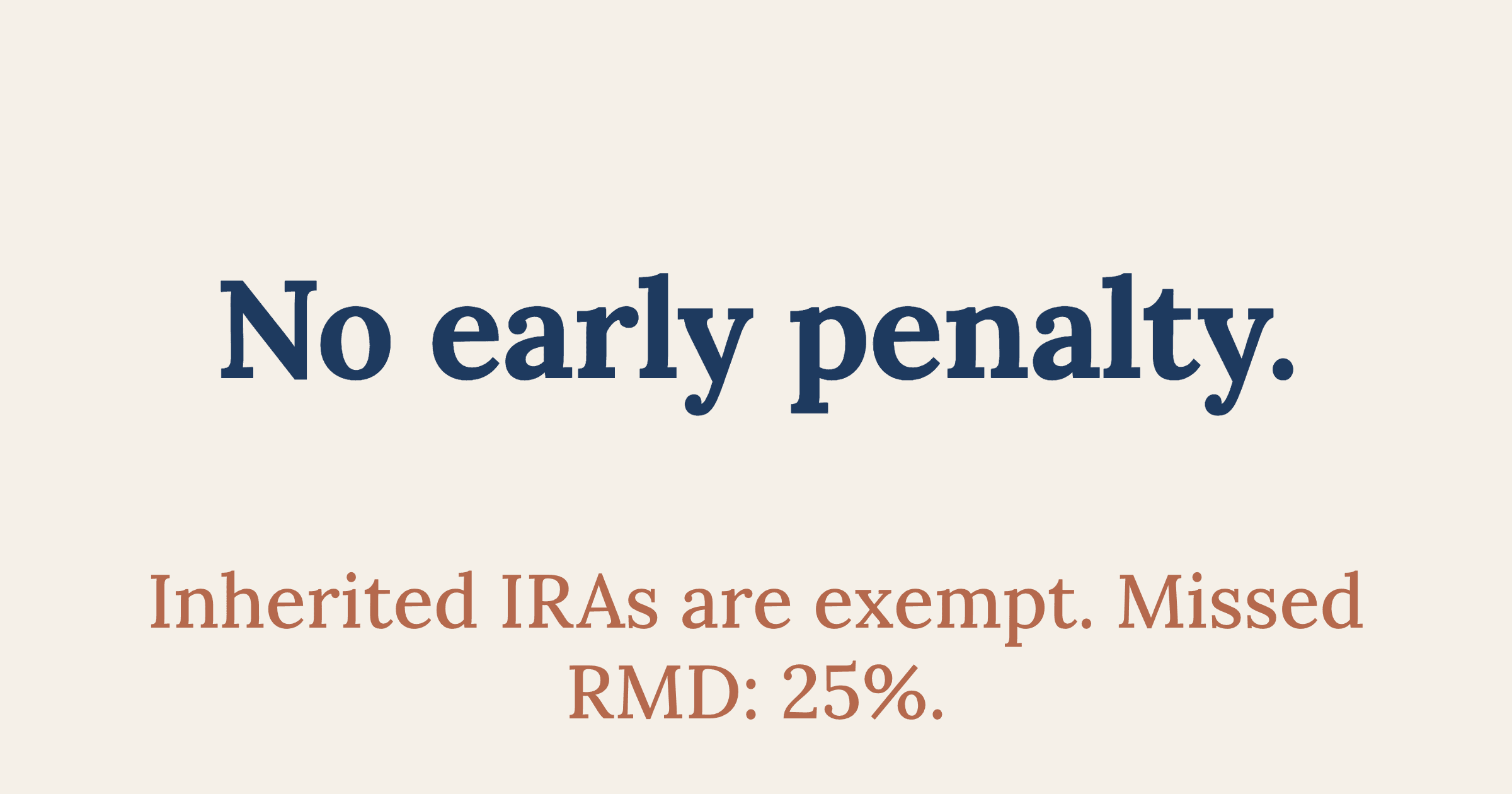
Two different penalties live in the inherited-IRA rules and they apply to different mistakes. The 10% early-withdrawal penalty that hits most owned-IRA withdrawals before age 59½ does not apply to inherited IRA distributions at any age. The 25% excise tax on missed Required Minimum Distributions does apply to inherited IRAs — and can be reduced to 10% with timely correction.
The exemption from the 10% penalty is tied to the inherited-IRA titling, not to the beneficiary's age. Keeping the account titled as an inherited IRA preserves the exemption indefinitely.
Try the Free Inherited IRA RMD CalculatorThe 10% early-withdrawal penalty does not apply
Distributions from an inherited IRA are exempt from the 10% early-withdrawal penalty under IRC §72(t)(2)(A)(ii). The exemption applies regardless of the beneficiary's age, the type of inherited account (Traditional or Roth), or whether the original owner had reached their required beginning date.
This is one of the few cases where a beneficiary's tax position is more flexible than the original owner's. A 35-year-old who inherits from a parent can withdraw the full balance in year one and pay only ordinary income tax — no 10% surcharge. The beneficiary's age never matters for the early-withdrawal penalty on an inherited IRA.
Distributions are still taxed as ordinary income for a Traditional inherited IRA. For a Roth inherited IRA, the original owner's 5-year clock on earnings governs whether earnings come out tax-free. Penalty and income-tax treatment are two separate questions.
The 25% excise tax applies to missed RMDs
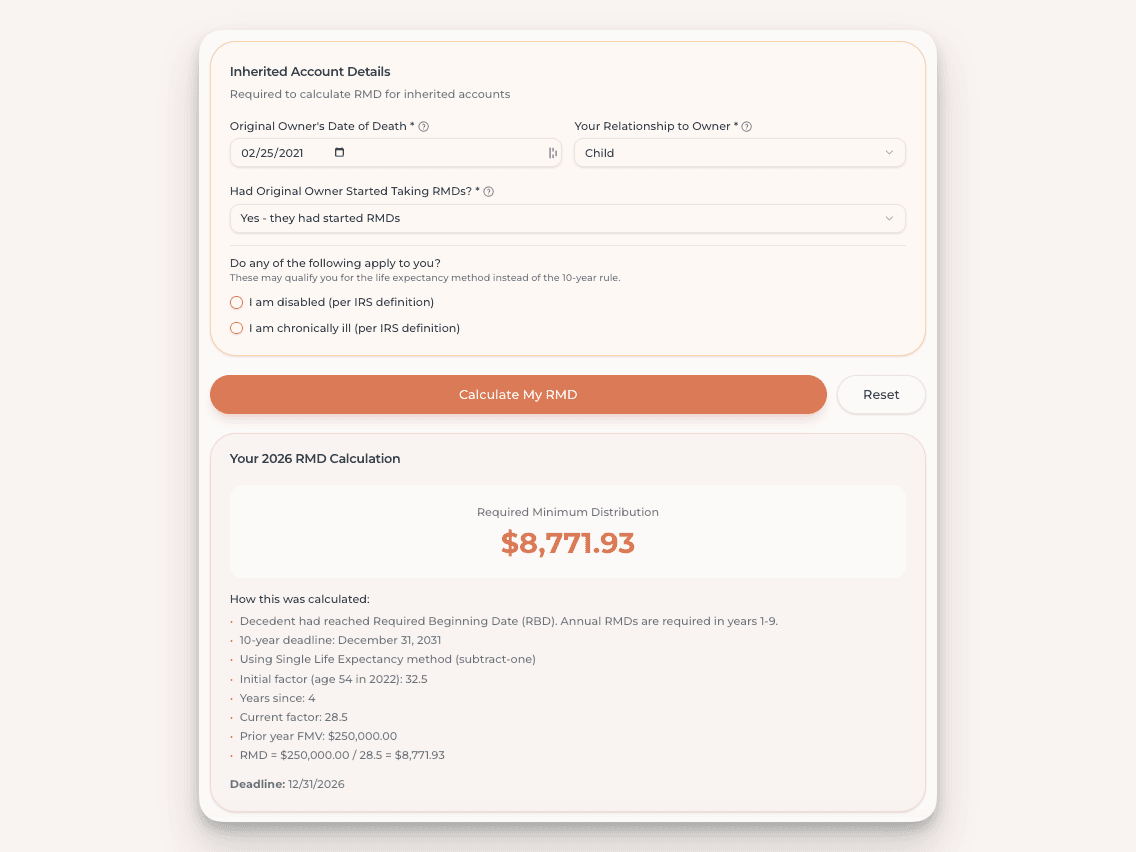
Missing a required annual RMD or the year-10 deadline triggers the IRS excise tax under IRC §4974. SECURE 2.0 reduced the rate from 50% to 25% effective for tax years 2023 and later. The tax is calculated on the missed amount, not on the account balance.
Two timing rules drop the rate further to 10%. The beneficiary must take the missed RMD within roughly two years of the original deadline (specifically by the end of the second tax year after the year the RMD was due), and file Form 5329 with that year's return. The 10% reduced rate is automatic when both conditions are met.
The IRS will sometimes waive the penalty entirely on request. Form 5329 has a section for requesting a waiver with attached explanation. Waivers are granted when the missed RMD was due to "reasonable error" and steps have been taken to correct it. The most common successful claim is a custodian or transfer-related mistake the beneficiary did not cause.
Year-10 cleanups that miss the deadline are subject to the same excise tax. The penalty is calculated on whatever balance remains in the account after December 31 of year 10.
The spousal trap that brings the 10% penalty back
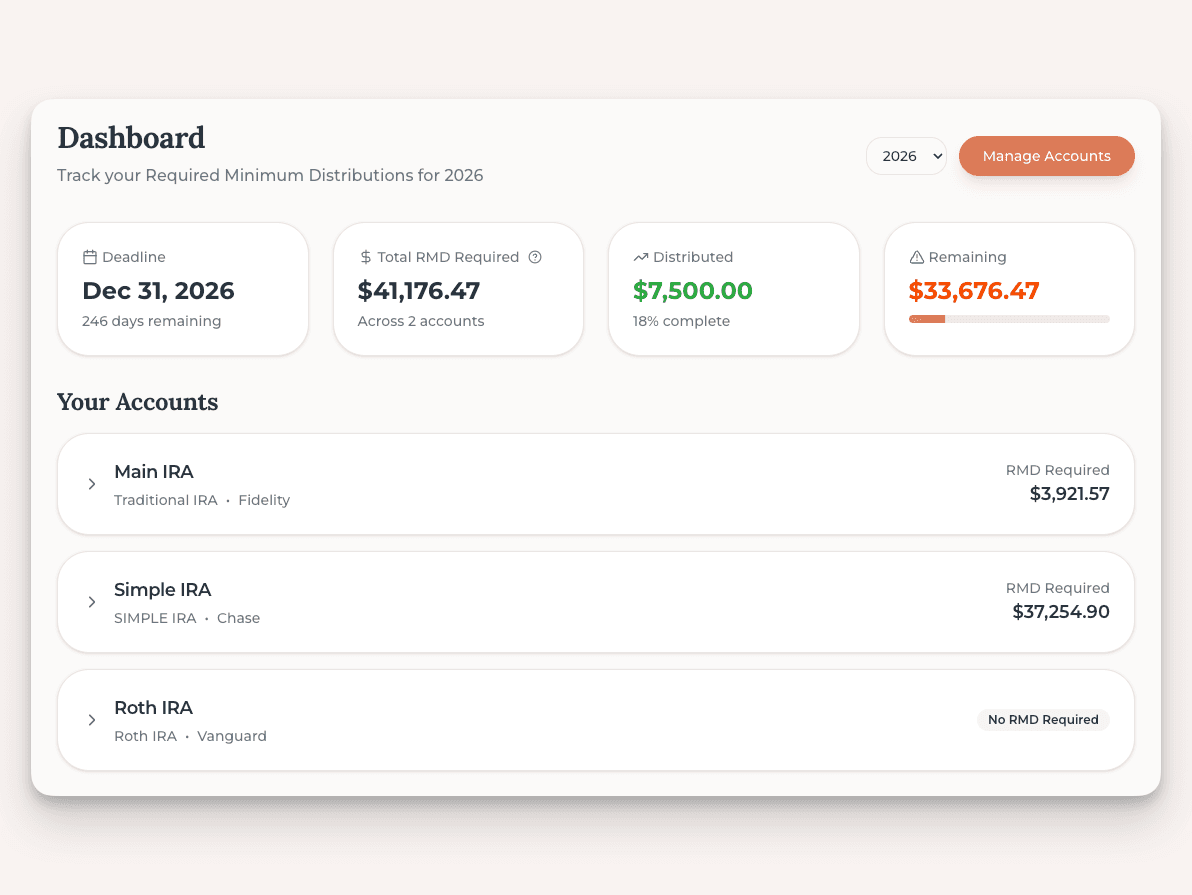
A surviving spouse who elects to treat the inherited IRA as their own — converting it from a beneficiary-titled account into the spouse's own IRA — loses the inherited-IRA penalty exemption. The account moves under the spouse's own withdrawal rules, including the 10% early-withdrawal penalty before age 59½.
This matters when the surviving spouse is under age 59½ and might need to take distributions. Keeping the account as a beneficiary-titled inherited IRA preserves the no-penalty path. Switching to "treat as own" makes sense after age 59½ or when the spouse does not anticipate withdrawals before that age. The election is irrevocable once made.
The spouse can defer the election. A surviving spouse can hold the account as an inherited IRA initially, take distributions penalty-free, and elect to treat it as their own years later when crossing age 59½ becomes the bigger consideration than penalty exposure.
For the related question of how much you actually have to take from an inherited IRA, see how much do I have to withdraw from an inherited IRA. The inherited-IRA pillar hub covers the broader beneficiary framework, the main RMD hub covers RMD rules across all account types, and How It Works walks through what SimpleRMD does at each step.
This article is for informational purposes only and does not constitute tax, legal, or financial advice. IRS rules and tax laws are subject to change. Consult a qualified tax professional or financial advisor for guidance specific to your situation. SimpleRMD is a calculation and tracking tool — not a financial advisory service.
Sources: IRS Final Regulations T.D. 10001 (July 2024). IRS.gov (Publication 590-B, "Beneficiaries"). Internal Revenue Code §72(t)(2)(A)(ii) and §4974. IRS Notices 2022-53, 2023-54, 2024-35. SECURE Act of 2019 (Pub. L. 116-94). SECURE 2.0 Act of 2022 (Pub. L. 117-328). Rules confirmed current as of May 2026.