

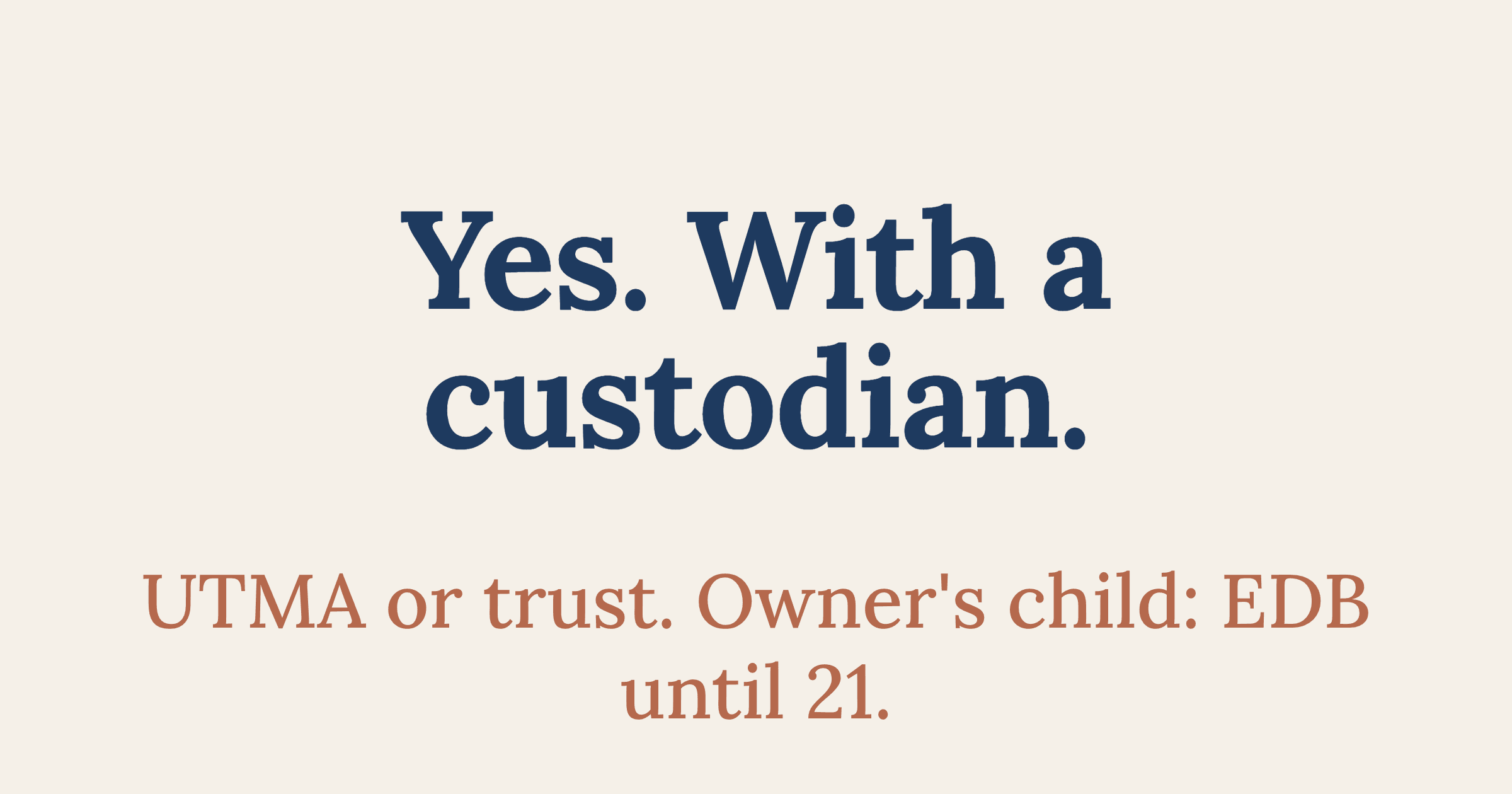
Yes. An IRA owner can name a minor as a beneficiary on the account. The complication is that minors cannot directly hold financial property — a custodian under the Uniform Transfers to Minors Act (UTMA) or a trust has to be in place to administer the inherited IRA until the minor reaches the age of majority in their state.
The RMD rules then split based on whether the minor is the original owner's child or a different minor relative. Only the owner's own children qualify as eligible designated beneficiaries with stretch treatment. Grandchildren, nieces, and other minor relatives fall under the standard 10-year rule.
Try the Free Inherited IRA RMD CalculatorNaming the minor and the custodian
The IRA beneficiary form has space for the minor's name, date of birth, and the custodian or trustee who will manage the inherited account. Most custodians require this information up front and will not accept a minor's name alone.
Two paths are common. A UTMA designation names an adult custodian (typically a parent, family member, or trusted advisor) who administers the inherited IRA until the minor reaches the age of majority. The age of majority varies by state, generally 18 or 21, and sometimes extends to 25 under UTMA-equivalent statutes. The custodian holds legal authority over distributions, investment choices, and tax reporting during that period.
The other path is a trust. Naming a see-through trust for the minor's benefit as the beneficiary can extend the adult oversight past the age of majority and add control over how distributions are used. See can a trust be the beneficiary of an IRA for the see-through requirements. Trusts that do not qualify as see-through accelerate the inherited-IRA timeline.
RMD treatment splits on relationship to the owner
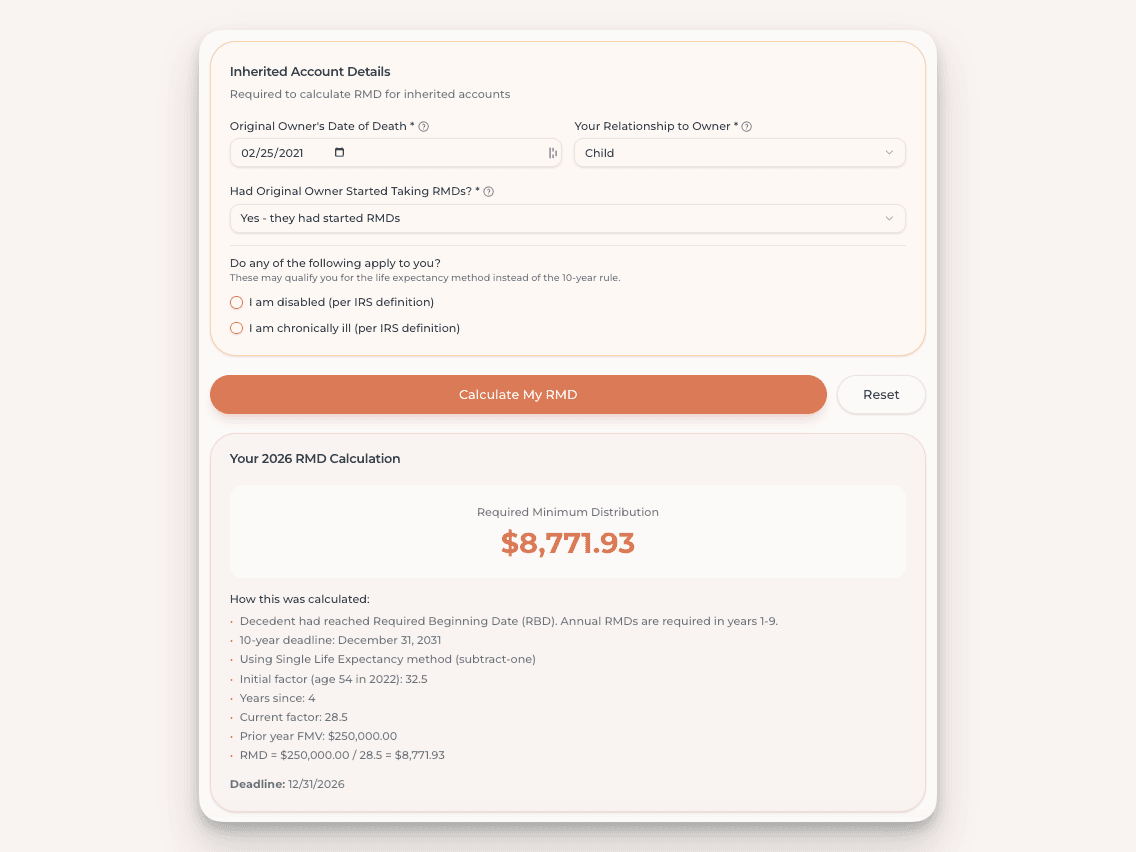
A minor child of the original IRA owner is an eligible designated beneficiary under the SECURE Act. Annual RMDs are calculated using the child's single life expectancy from the IRS Single Life Table until the child reaches age 21. At age 21, the EDB status ends and a 10-year clock starts — the account must be fully distributed by December 31 of the tenth year after the child's 21st birthday.
A minor who is not the original owner's child, such as a grandchild, niece, or nephew, does not qualify as an eligible designated beneficiary under current law. The 10-year rule applies from the date of inheritance, the same as it would for an adult non-spouse beneficiary. The minor's status is functionally irrelevant to the RMD clock; the custodian administers the account, but the deadline is December 31 of the tenth year after the original owner's death.
Whether annual RMDs are required during that 10-year window for a non-child minor follows the standard before-vs-after-RBD rule. If the original owner died on or after their required beginning date, annual RMDs apply in years one through nine. If before, no annual minimum.

Tax and practical considerations
Distributions from an inherited IRA into a UTMA account are taxable to the minor as ordinary income on a Traditional inherited IRA. The custodian files the minor's return — or includes the income on the parent's return under the kiddie-tax rules when applicable. Roth inherited IRA distributions follow Roth rules: tax-free principal anytime, earnings tax-free after the original owner's 5-year clock matures.
The 10% early-withdrawal penalty does not apply to inherited IRA distributions at any age, including a minor's. The exemption is tied to the inherited-IRA titling.
Naming a minor without a custodian designation is the most common mistake. If no custodian is named on the beneficiary form, the IRA passes to the minor through the state probate process, which may appoint a court-supervised guardian and add delay and cost. A clean custodian designation on the beneficiary form avoids that path.
For the related question of what happens when a minor does inherit and how the age-21 transition works in practice, see minor inherited IRA. The inherited-IRA pillar hub covers the broader beneficiary framework, the main RMD hub covers RMD rules across all account types, and How It Works walks through what SimpleRMD does at each step.
This article is for informational purposes only and does not constitute tax, legal, or financial advice. IRS rules and tax laws are subject to change. Consult a qualified tax professional or financial advisor for guidance specific to your situation. SimpleRMD is a calculation and tracking tool — not a financial advisory service.
Sources: IRS Final Regulations T.D. 10001 (July 2024). IRS.gov (Publication 590-B, "Beneficiaries"). IRS Notices 2022-53, 2023-54, 2024-35. SECURE Act of 2019 (Pub. L. 116-94). SECURE 2.0 Act of 2022 (Pub. L. 117-328). Uniform Transfers to Minors Act (state law). Rules confirmed current as of May 2026.