

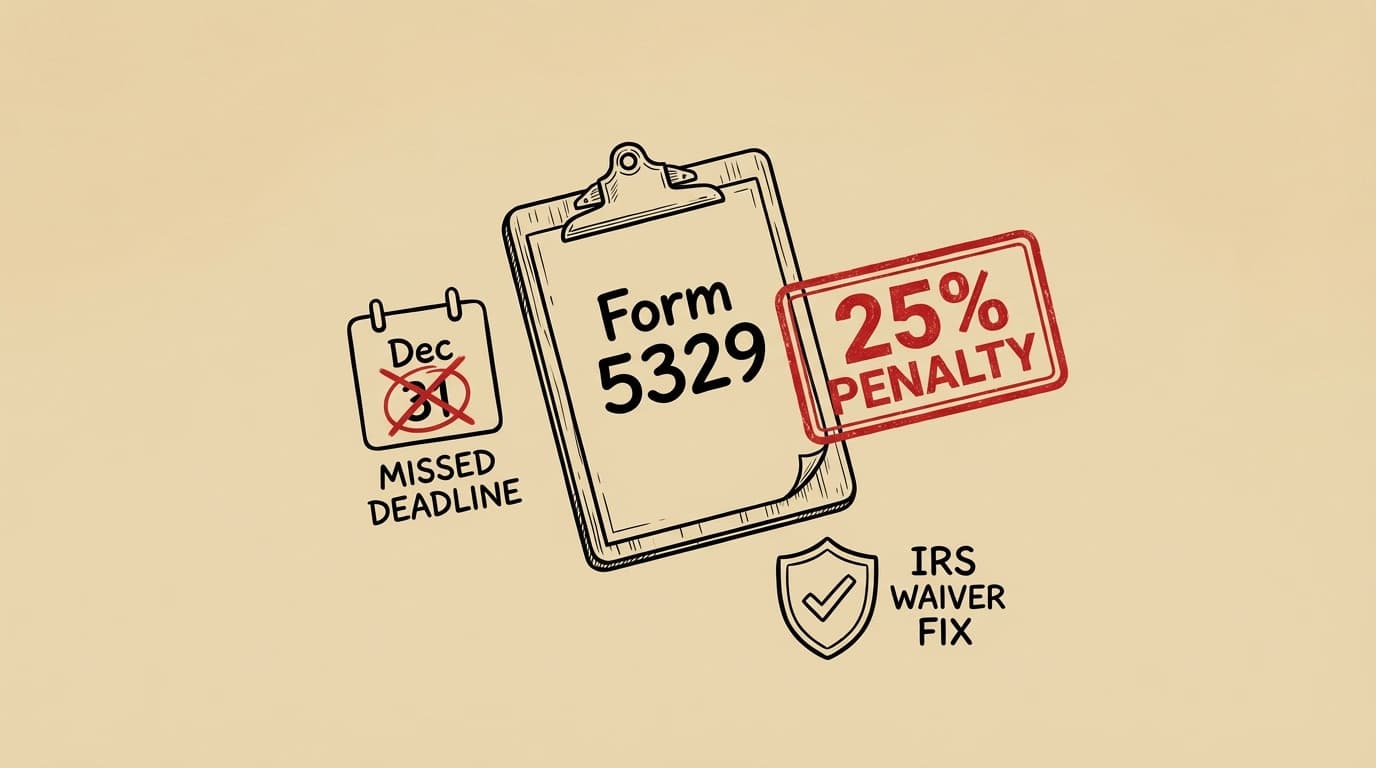
If you missed a Required Minimum Distribution — or didn't withdraw enough — the IRS may waive the excise tax penalty entirely. You'll need to take the missed distribution as soon as possible, then file Form 5329 with a short letter explaining what happened and how you've corrected it. The IRS has historically been generous with these waivers when the mistake was honest and the fix was prompt.
This is the most common panic moment we see — and it's almost always more fixable than people expect.
In short: The standard penalty for a missed RMD is 25% of the shortfall. If you correct the error within two years, it drops automatically to 10%. If you file Form 5329 with a reasonable cause explanation, the IRS can waive the penalty to $0. Take the distribution first, then file the paperwork.
On this page
- How the Penalty Works (and Why It's Not as Scary as It Sounds)
- What Counts as Reasonable Cause
- How to Request the Waiver: Step by Step
- What to Include in Your Letter
- When to Involve a CPA
- What to Do Next
How the penalty shrinks: 25% uncorrected, 10% if corrected within 2 years, $0 with reasonable cause waiver, plus 5-step waiver request flowchart
How the Penalty Works (and Why It's Not as Scary as It Sounds)
The excise tax on a missed or insufficient RMD is steep on paper — but the IRS built in two layers of relief.
| Situation | Penalty |
|---|---|
| Missed or insufficient RMD (uncorrected) | 25% excise tax on the shortfall |
| Corrected within 2 years | Automatically reduced to 10% — no waiver letter needed |
| Reasonable cause waiver approved | $0 — IRS waives the penalty entirely |
The 25% rate (reduced from 50% by the SECURE 2.0 Act in 2023) applies to the amount you should have withdrawn but didn't. So if your RMD was $15,000 and you withdrew $10,000, the penalty applies to the $5,000 shortfall — not your entire RMD.
The two-year correction window is automatic. If you take the missed distribution within two years of the original deadline, the penalty drops to 10% without any special filing. But most people want to aim for the full waiver — and the IRS grants it more often than you'd think.
Source: IRS Form 5329 Instructions
What Counts as Reasonable Cause
The IRS doesn't publish a checklist, but the Form 5329 instructions say the penalty may be waived if you can show the shortfall was "due to reasonable error" and that you are "taking reasonable steps to remedy the shortfall." In practice, the bar is lower than most people fear.
Situations the IRS has commonly accepted include:
| Reasonable Cause Category | Examples |
|---|---|
| Health | Serious illness, hospitalization, cognitive decline, incapacity |
| Advisor/custodian error | Broker miscalculated the RMD, custodian failed to process a timely request, accountant gave incorrect guidance |
| Administrative confusion | Inherited IRA rules were unclear, account transfer was in progress, you didn't know RMDs were required (first year) |
| Death in the family | You were handling an estate, grieving, or managing the financial aftermath of a spouse's passing |
| Natural disaster or disruption | Federally declared disaster that affected access to accounts or financial services |
The common thread: you weren't trying to avoid the distribution, something got in the way, and you fixed it once you realized the error.
I've seen people get full waivers for reasons as simple as "I turned 73 in December, didn't realize my first RMD was due that year, and took it as soon as I learned." The IRS is looking for good faith, not perfection.
How to Request the Waiver: Step by Step
Step 1: Take the missed distribution immediately. Contact your account custodian and withdraw at least the shortfall amount. Don't wait for tax season — the sooner you correct it, the stronger your waiver case.
Step 2: File Form 5329 with your tax return. Form 5329, "Additional Taxes on Qualified Plans," is where you report the missed RMD and request the waiver. You'll complete Part IX (Additional Tax on Excess Accumulations in Qualified Retirement Plans).
Step 3: Enter $0 on the penalty line. On the line where you'd normally calculate the excise tax, enter zero. This signals to the IRS that you're requesting a waiver rather than paying the penalty.
Step 4: Attach a letter of explanation. This is the reasonable cause statement. It goes with your return as a separate attachment. Keep it short, factual, and specific.
Step 5: Wait. If the IRS accepts your explanation, you'll hear nothing — the waiver is granted by not assessing the penalty. If they disagree, they'll send a notice, and you'll have a chance to respond.
If you're filing for a prior year you've already submitted, you'll need to file an amended return (Form 1040-X) with the Form 5329 and letter attached.
Source: IRS — Retirement Plan and IRA RMD FAQs
What to Include in Your Letter
Your reasonable cause letter doesn't need to be long. One page is typical. It should include:
- Your name, Social Security number, and the tax year in question
- The account type and custodian (e.g., "Traditional IRA held at Fidelity")
- The RMD amount that was missed or short
- The date you took the corrective distribution
- A clear, honest explanation of why the error occurred
- A statement that you've taken steps to prevent it from happening again
You don't need legal language or a CPA's letterhead. A straightforward, factual explanation in your own words is what the IRS expects.
When to Involve a CPA
For a single missed RMD with a clean explanation, many people handle this themselves. But consider involving a tax professional if:
- The shortfall is large (five figures or more)
- Multiple years were missed
- You're dealing with an inherited IRA where the rules themselves are in dispute
- You've already received an IRS notice about the penalty
- You're unsure whether your situation qualifies as reasonable cause
Your CPA can also help you determine whether the two-year automatic reduction to 10% is sufficient or whether pursuing the full waiver is worth the additional filing.
If you use SimpleRMD, the CPA-ready PDF export gives your accountant the exact numbers they need — account balances, distribution factors, and calculated RMDs — without reconstructing everything from scratch.
Remind me in November
We'll send one reminder in November. No newsletters.
You can unsubscribe anytime.
What to Do Next
- Run the calculator — free, no account required. Confirm your correct RMD amount before contacting your custodian.
- RMD deadlines and penalties — full overview of deadlines, penalty tiers, and how to stay on track going forward.
- Set up a November reminder — one email, once a year, so this doesn't happen again.
This article is for informational purposes only and does not constitute tax, legal, or financial advice. IRS rules and tax laws are subject to change. Consult a qualified tax professional or financial advisor for guidance specific to your situation. SimpleRMD is a calculation and tracking tool — not a financial advisory service.
Sources: IRS.gov (Form 5329 Instructions, Publication 590-B, RMD FAQs). SECURE 2.0 Act of 2022 (Pub. L. 117-328). Rules confirmed current as of February 2026 per IRS Pub 590-B (2025) and IRS Notices.