

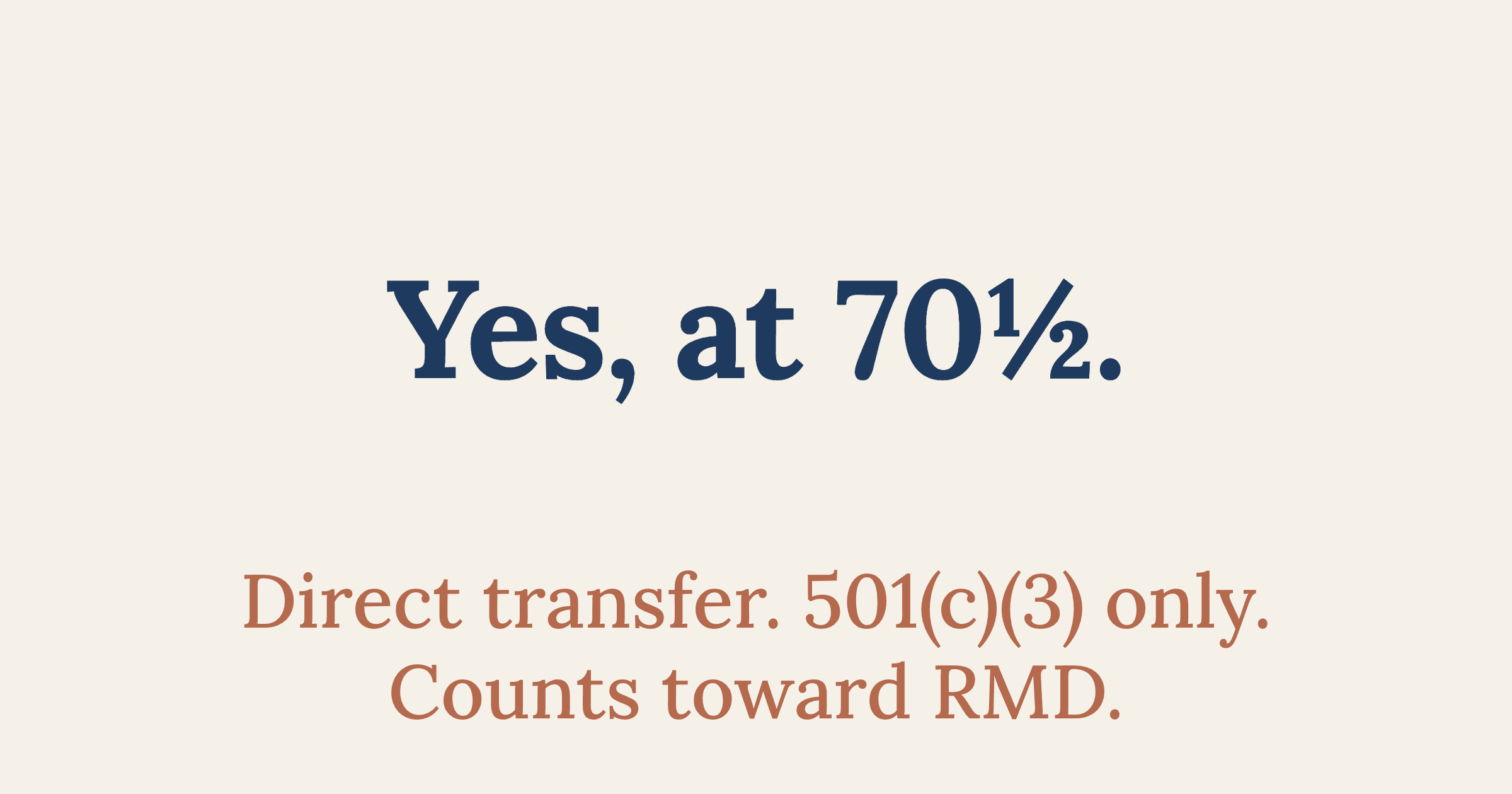
Yes, a Qualified Charitable Distribution (QCD) from an inherited IRA is allowed — if the beneficiary is at least 70½ years old at the time of the distribution. The original owner's age is irrelevant, and so is the beneficiary's age at the time of the decedent's death. What matters is the beneficiary's age on the day the QCD is made.
The mechanics are the same as a QCD from any IRA. The 2026 annual limit is $111,000 per individual. The distribution must go directly from the IRA custodian to a qualifying 501(c)(3) charity. And it can count toward the beneficiary's annual RMD if one is required.
Calculate Your Inherited IRA RMDWho qualifies
Three conditions must all be true on the date of the QCD.
The beneficiary must be 70½ or older. This is the same age threshold that governs QCDs from any IRA. Note that this is older than the current RMD-start age of 73 — beneficiaries who are 70½ to 72 can make a QCD even before they're required to take RMDs from the inherited account (though most inherited-IRA beneficiaries are already taking annual distributions under the 10-year rule).
The account must be an IRA (Traditional, Rollover, or Inherited). Spousal beneficiaries qualify whether they kept the account as an inherited IRA or rolled it into their own name (a spousal rollover produces a Traditional IRA in the beneficiary's name, which is QCD-eligible). Non-spouse beneficiaries qualify with the account as an inherited IRA. QCDs are not allowed from inherited 401(k) plans or other inherited employer plans — if the inherited account is currently a 401(k), the beneficiary would need to roll it to an inherited IRA first.
The distribution must go directly from the IRA custodian to the charity. The beneficiary cannot take the money first and then donate it — that would convert the distribution into taxable income, and the deduction-if-itemized path is generally worse than the QCD path for retirees who take the standard deduction.
How it counts toward the RMD
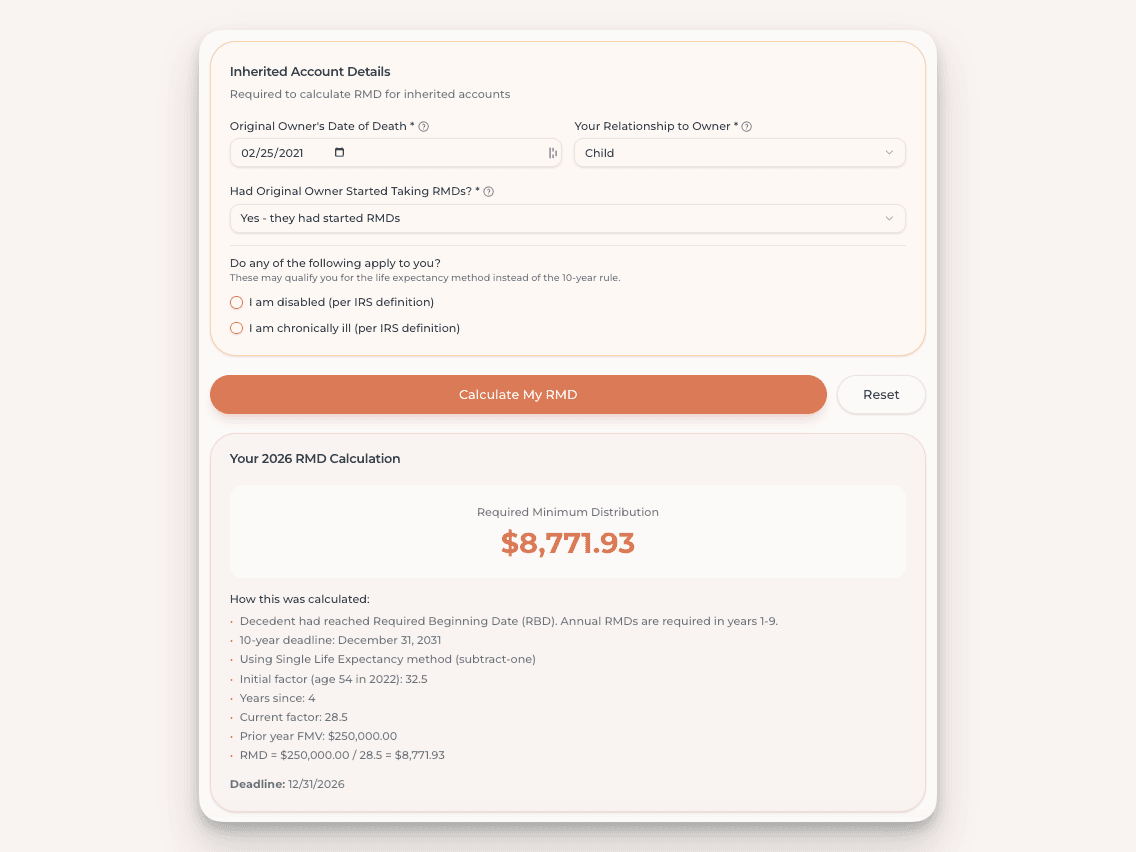
If the beneficiary is required to take an annual RMD from the inherited IRA — which applies to most non-spouse beneficiaries during the 10-year window when the original owner died on or after the required beginning date — the QCD amount counts toward satisfying that RMD.
A worked example. Carol, 72, inherited a Traditional IRA from her brother who died at age 78 (after his RBD). Her annual RMD for the year is $18,000, calculated using the Single Life Expectancy Table. Carol directs $10,000 of that distribution to a qualifying charity as a QCD. Her remaining RMD obligation is $8,000, which she takes as a regular distribution. The $10,000 QCD is excluded from her taxable income; the $8,000 is taxed as ordinary income. Carol has satisfied the full $18,000 annual RMD.
Eligible charities are public 501(c)(3) organizations. Private foundations, donor-advised funds, and supporting organizations are excluded. If the QCD accidentally goes to an ineligible recipient, it loses its tax-free treatment and counts as a regular taxable distribution. For the full set of inherited IRA RMD rules, see Inherited IRA RMDs: rules, deadlines, and what you need to know.
Reporting on your tax return
A QCD from an inherited IRA is reported the same way as a QCD from an original-owner IRA. The 1099-R you receive from the custodian will show the full distribution in Box 1 with no special QCD coding (Box 7 will typically show a Code 4 for "death" because the account is inherited).
Starting in 2025, the IRS introduced Code Y in Box 7 of Form 1099-R to identify QCD distributions explicitly. Many custodians have not yet adopted Code Y at scale, so the beneficiary is still typically responsible for self-reporting the QCD on Form 1040.
On Form 1040, the gross distribution from Box 1 goes on line 4a. The non-QCD portion (if any) goes on line 4b. The word "QCD" is written next to line 4b. The acknowledgement letter from the charity must be obtained before the tax return is filed — it should state the amount, the date, that the organization is a qualified 501(c)(3), and that no goods or services were provided in return.
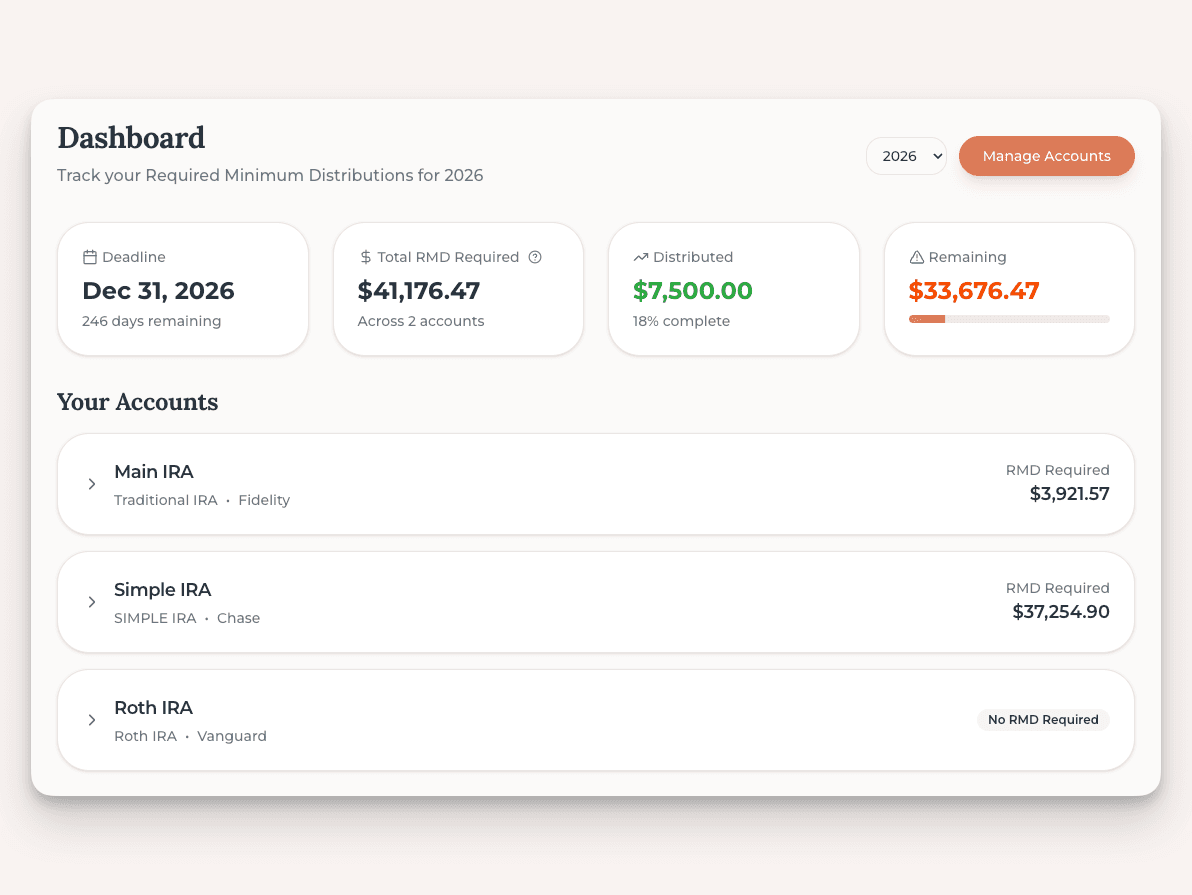
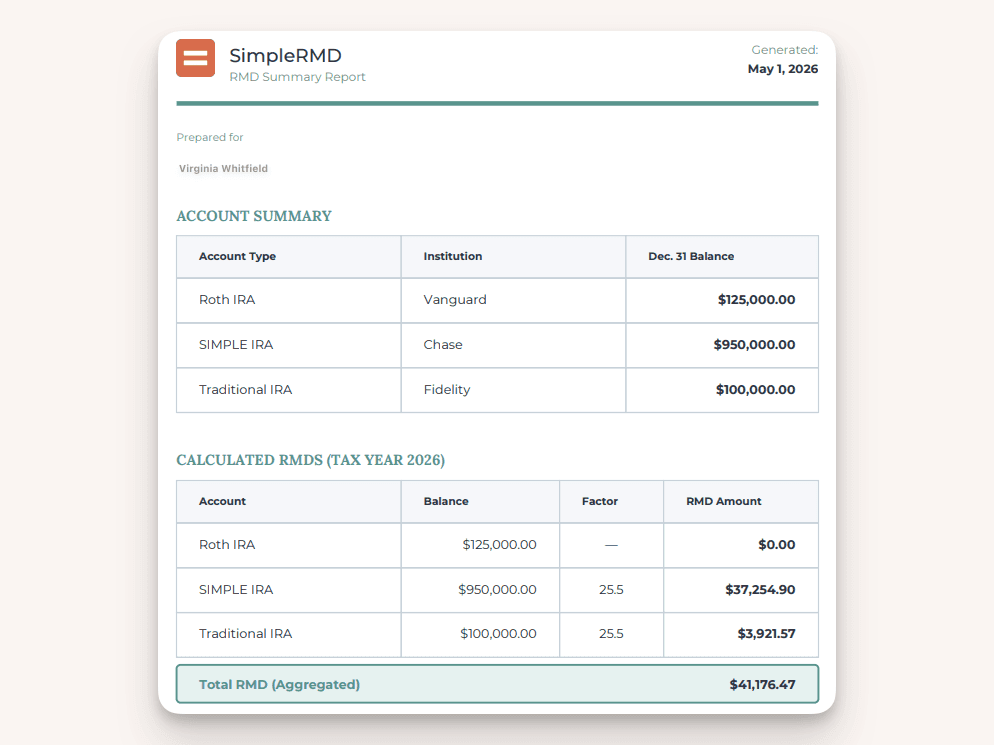
For the broader reporting walkthrough, see How to report a QCD on your tax return. How SimpleRMD works walks through how the calculator and tracking tools handle inherited-IRA distributions across multiple years.
This article is for informational purposes only and does not constitute tax, legal, or financial advice. IRS rules and tax laws are subject to change. Consult a qualified tax professional or financial advisor for guidance specific to your situation. SimpleRMD is a calculation and tracking tool — not a financial advisory service.
Sources: IRS.gov (Publication 590-B, Retirement Plans FAQs regarding IRAs Distributions, Form 1099-R Instructions, Form 1040 Instructions). IRC §408(d)(8). SECURE 2.0 Act of 2022 (Pub. L. 117-328), Section 307 (QCD indexing). Rules confirmed current as of May 2026.