

If you're required to take annual distributions from an inherited IRA, your calculation uses a different IRS table than the one original account owners use.
You'll use Table I — the Single Life Expectancy Table from IRS Publication 590-B. This page walks through how to find your factor, how to apply it, and what changes each year.
In short: Inherited IRA RMDs use the IRS Single Life Expectancy Table (Table I). You look up your factor once — in the year after the owner's death, based on your age that year. Every year after, you subtract 1.0 from the prior year's factor. You never look it up again. Your RMD = prior December 31 balance ÷ current year's factor.
Why a Different Table?
Original IRA owners use the Uniform Lifetime Table (Table III), which is based on a joint life expectancy — you and a hypothetical beneficiary 10 years younger. It produces relatively generous (smaller) RMDs.
As a beneficiary, you use the Single Life Expectancy Table (Table I). Factors here are smaller, which means larger required withdrawals relative to the balance.
The logic: the IRS designed these rules to ensure inherited accounts are distributed — and taxed — within a reasonable window.
Step 1: Find Your Initial Factor
You look up your factor exactly once.
When: In the first distribution year — the year after the original owner died.
Which age to use: Your age as of December 31 of that first distribution year.
Example: The owner died in 2024. Your first distribution year is 2025. You turn 54 in 2025. Look up age 54 in Table I. Your factor is 32.5.
That's your starting number. You won't look it up again.
Table I — Single Life Expectancy (selected ages)
| Age | Factor | Age | Factor |
|---|---|---|---|
| 40 | 45.7 | 65 | 22.9 |
| 52 | 34.3 | 70 | 18.8 |
| 54 | 32.5 | 75 | 14.8 |
| 56 | 30.6 | 80 | 11.2 |
| 60 | 27.1 | 85 | 8.1 |
| 62 | 25.4 | 90 | 5.7 |
| 64 | 23.6 | 95 | 4.0 |
| 100 | 2.8 |
Source: IRS Publication 590-B (2025), Appendix B — Table I (Single Life Expectancy). This table was last updated for 2022 distributions and remains unchanged. Full table at IRS.gov/publications/p590b.
Step 2: Subtract 1 Every Year After
This is the part that trips people up.
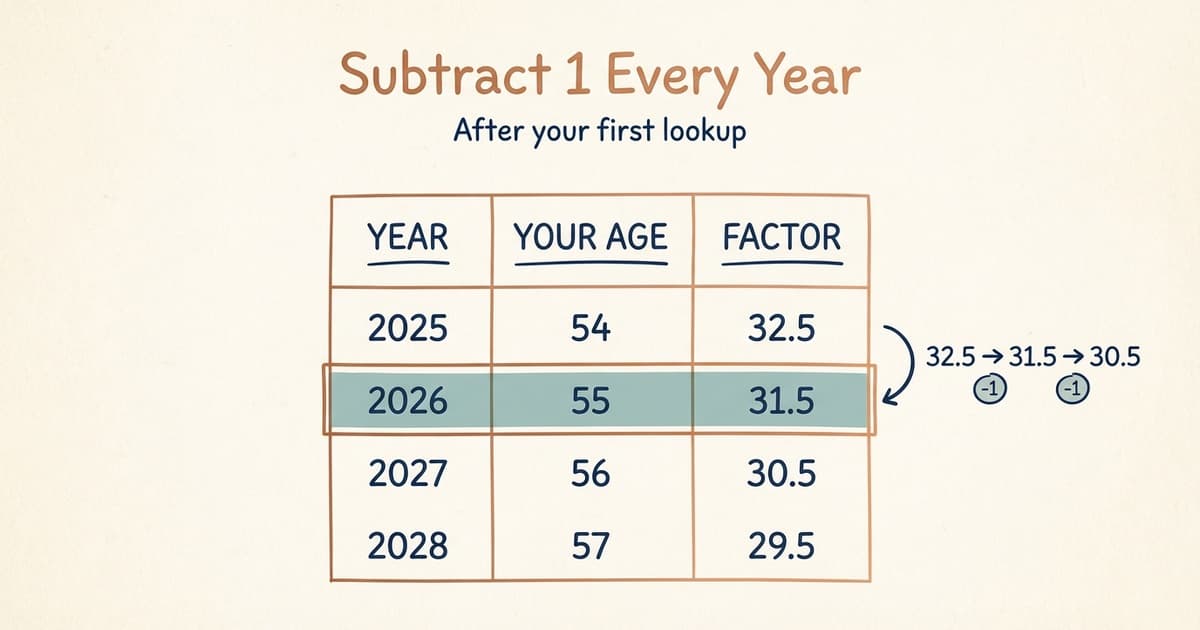
After that first lookup, you never return to the table. Each year, you simply subtract 1.0 from the prior year's factor.
Continuing the example:
| Year | Your Age | Factor | Prior Dec. 31 Balance | RMD |
|---|---|---|---|---|
| 2025 | 54 | 32.5 | $320,000 | $9,846 |
| 2026 | 55 | 31.5 | $310,000 | $9,841 |
| 2027 | 56 | 30.5 | $298,000 | $9,770 |
| 2028 | 57 | 29.5 | $285,000 | $9,661 |
Notice: even if you look up age 55 in Table I, you'll get a slightly different number than 29.5. That's intentional — you're not supposed to do a fresh lookup. The reduction method is what the IRS requires for designated beneficiaries under the 10-year rule.
The Formula
Inherited IRA RMD = Prior year-end balance (Dec. 31) ÷ Current year's factor
The balance is always from December 31 of the prior year — reported on your year-end statement or IRS Form 5498.
The factor decreases by 1 each year, so the required withdrawal percentage rises gradually over time.
Worked Example: Sandra
Sandra's mother passed away in September 2023 at age 78, having already started her own RMDs.
Sandra is 52 in 2024 — her first distribution year (year after death).
She looks up age 52 in Table I: 34.3
Her December 31, 2023 balance: $340,000
2024 RMD: $340,000 ÷ 34.3 = $9,913
In 2025, Sandra uses a factor of 33.3 (not a fresh lookup — just 34.3 minus 1).
2025 RMD (assuming Dec. 31, 2024 balance of $332,000): $332,000 ÷ 33.3 = $9,970
Each year the factor shrinks, so the required distribution percentage gradually increases — even as the account balance may be declining.
Who Uses This Table?
Table I applies to designated beneficiaries who are required to take annual RMDs under the 10-year rule.
That means you must:
- Be a non-spouse designated beneficiary who inherited after 2019
- Have inherited from someone who had already reached their Required Beginning Date (i.e., they had started or were required to start RMDs before they died)
If both are true, annual distributions are required in years 1–9, and the account must be emptied by year 10.
If the owner died before their Required Beginning Date, annual distributions are generally not required — you have flexibility on timing within the 10-year window, and Table I doesn't apply year-to-year.
Not sure which situation applies to you? The full decision tree is in: Inherited IRA RMD rules · The 10-year rule explained
Eligible Designated Beneficiaries: Different Rules
Surviving spouses and certain other eligible designated beneficiaries (minor children, disabled or chronically ill individuals, beneficiaries within 10 years of the owner's age) may use life expectancy distributions rather than the 10-year rule.
For these beneficiaries, the initial factor lookup and reduction method still apply — but over their own life expectancy rather than a 10-year window.
One important exception for minor children: the life expectancy stretch ends when the child reaches age 21. At that point, the 10-year rule takes over for the remaining balance — the account must be emptied within 10 years of the child's 21st birthday.
Surviving spouses have additional options, including treating the inherited IRA as their own. See: Inherited IRA RMD rules
Common Mistakes
Doing a fresh table lookup every year. The most frequent error. Once you have your starting factor, subtract 1 each year. A fresh lookup gives you the wrong number.
Using the wrong table. Original account owners use Table III (Uniform Lifetime). Beneficiaries use Table I. Using the wrong table understates your required distribution, which creates a shortfall — and a penalty.
Using the wrong age. Your factor is based on your age in the first distribution year (the year after death), not the year of death and not your current age.
Using the decedent's age instead of your own. Table I is based on the beneficiary's life expectancy — yours, not the original owner's. Using the owner's age will produce an incorrect factor.
Using the wrong balance for the first year. Your first RMD uses the December 31 balance from the year the owner died — not the date of death balance, and not today's balance.
Forgetting the year-of-death RMD. If the original owner hadn't yet taken their RMD in the year they died, that distribution is still required — and you're responsible for taking it. Your own annual distribution schedule begins the following year. See: RMDs after death
Frequently Asked Questions
What if I inherited before 2020?
Pre-SECURE Act rules may still apply. You may be eligible for life expectancy distributions using the stretch method. Your initial factor was set in the year after the owner's death — the same reduction method applies going forward. See: Legacy stretch IRA schedule
What if I inherited before 2022 (when the tables were updated)?
When the IRS updated Table I in 2022, there was a one-time transition adjustment for beneficiaries already using the old table. If you started distributions before 2022 and haven't confirmed your factor was reset correctly, check with a tax professional — the transition rules were specific and easy to miss.
What if I inherited multiple IRAs from the same person?
You calculate each RMD separately using the same factor (since it's based on your age, not the account). You can then aggregate inherited IRAs from the same decedent and take the combined total from just one account. Note: this only works for IRAs from the same decedent — inherited IRAs from different people cannot be combined.
Does the table change year to year?
The underlying table doesn't change frequently. The IRS updated Table I in 2022 — the first revision since 2002. There's no scheduled update at this time. The table you used when you looked up your initial factor is the right one going forward; you don't need to re-verify the table itself each year.
I want to see my actual number.
The SimpleRMD inherited IRA calculator handles the factor lookup and year-to-year reduction automatically — free, no account required.
What to do next
- Run the inherited IRA calculator — see your factor and RMD amount, free
- Inherited IRA RMD rules — full overview of the 10-year rule and beneficiary types
- The 10-year rule explained — when annual RMDs are required
- RMDs after death — year-of-death rules and what happens next
- RMD tables explained — all three IRS tables compared
This article is for informational purposes only and does not constitute tax, legal, or financial advice. IRS rules and tax laws are subject to change. Consult a qualified tax professional or financial advisor for guidance specific to your situation. SimpleRMD is a calculation and tracking tool — not a financial advisory service.
Sources: IRS Publication 590-B (2025), Appendix B — Table I (Single Life Expectancy); IRS.gov — Required Minimum Distributions for IRA Beneficiaries; Retirement Plan and IRA RMD FAQs. Rules confirmed current as of 2026.