

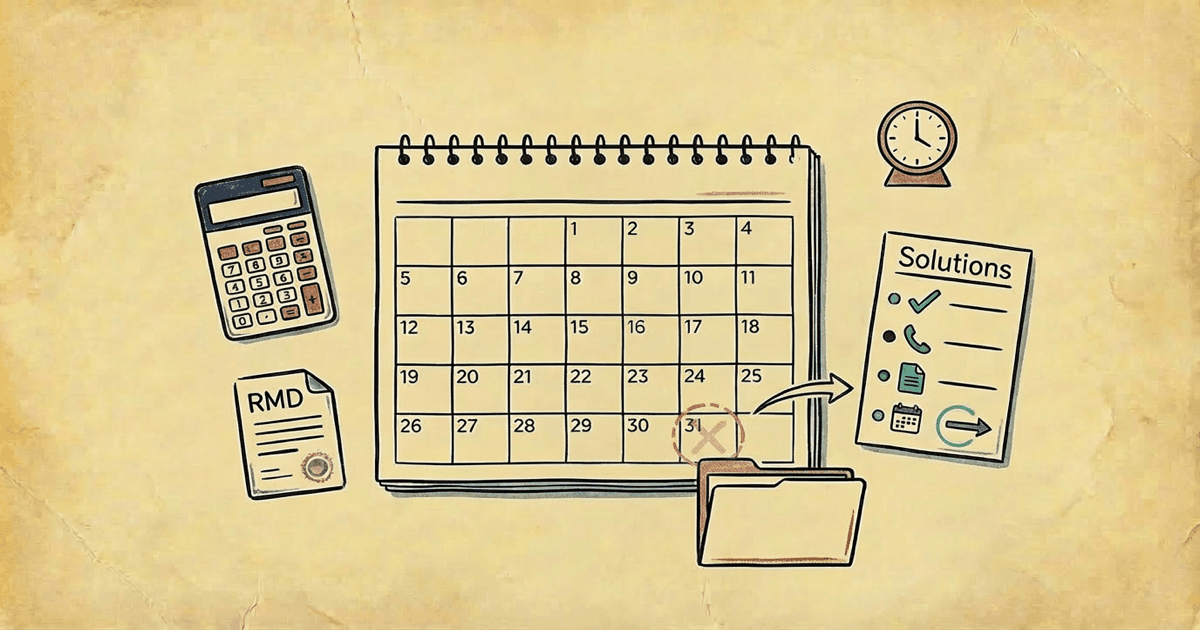
If you missed your RMD deadline, the most important thing you can do is take the distribution as soon as possible. The longer you wait, the more the penalty compounds — and the narrower your correction options become.
The good news: the IRS has a clear correction path, the penalty is often reducible or waivable entirely, and missing an RMD is more common than most people realize. We've seen this come up repeatedly — sometimes a statement arrived late, sometimes a brokerage change created confusion, sometimes life simply got in the way. Whatever the reason, there's a process and it works. This page walks through exactly what to do, based on your situation.
In short: A missed or insufficient RMD triggers a 25% excise tax on the shortfall. If you correct the mistake within two years, the penalty drops automatically to 10%. In many cases, the IRS will waive the penalty entirely if you have a reasonable explanation and correct promptly. The steps are: take the distribution now, then file Form 5329 with your tax return.
Flowchart showing what to do if you missed your RMD — decision tree covering penalty tiers, correction timelines, and Form 5329 filing
On this page
- Step 1: Take the Distribution Immediately
- Step 2: Understand Your Penalty Situation
- Step 3: File Form 5329
- Common Scenarios
- When to Call a Tax Professional
- Frequently Asked Questions
Step 1: Take the Distribution Immediately
Don't wait until tax season. Contact your account custodian — the brokerage or institution that holds your IRA or 401(k) — and request the distribution today. Most custodians can process a distribution within a few business days.
Take the full amount you should have withdrawn. If you're unsure what that number is, the SimpleRMD calculator will calculate your exact RMD based on your year-end balance and age. Use the prior December 31 balance for the year you missed, not today's balance.
Taking the distribution quickly matters for two reasons:
- The IRS penalty clock is running. Correcting within two years gets you automatic penalty relief.
- Demonstrating prompt correction is the strongest argument for a full penalty waiver, if you pursue one.
Step 2: Understand Your Penalty Situation
Once you've taken the distribution, figure out which penalty tier applies. There are three, depending on how long ago the deadline passed.
| Situation | Penalty | What's Required |
|---|---|---|
| Corrected within 2 years | 10% (automatic reduction from 25%) | Take the distribution, file Form 5329 |
| Corrected after 2 years | 25% | Take the distribution, file Form 5329 |
| Reasonable cause waiver approved | $0 | Take the distribution, file Form 5329 with explanation letter |
The two-year window starts from the date the missed distribution was originally due — December 31 of the year it should have been taken (or April 1 for a delayed first-year RMD).
The 10% reduction is automatic. You do not need to write a letter or request it. Simply taking the distribution and filing Form 5329 within the two-year correction window qualifies — specifically, by the end of the second taxable year after the year the missed distribution was due.
The waiver is discretionary, but common. The IRS frequently approves waivers for first-time, promptly corrected misses — particularly when the cause was illness, oversight, or reliance on incorrect advice. Approval is not guaranteed, but a well-documented letter with specific dates, distribution amounts, and corrective actions taken significantly improves the outcome. See IRS waiver for missed RMDs for the full process and what to include in your explanation.
Step 3: File Form 5329
Form 5329 (Additional Taxes on Qualified Plans) is how you report a missed RMD and calculate the excise tax owed — or formally request a waiver.
You file it with your federal tax return for the year the RMD was missed. If the missed RMD was from a prior tax year, you may need to file an amended return or a standalone Form 5329 for that year.
For the waiver route: Fill out Part IX of Form 5329, enter "RC" (reasonable cause) and the amount on the appropriate line, and attach a brief written explanation. If the IRS approves the waiver, you owe nothing. If they deny it, you'll owe the standard penalty — but you'll have already taken the distribution, so nothing further is required beyond payment.
Your tax professional can handle this process if the amounts are significant or the situation is complicated. For straightforward cases — a first-time miss, corrected quickly — many people handle it themselves.
Source: IRS Form 5329 Instructions
Common Scenarios
You caught it before December 31
If you realize mid-year that you haven't taken your RMD yet — or haven't taken enough — you still have time. Take the distribution before December 31 and there's no penalty at all. Nothing to file, no Form 5329 required. This is the cleanest resolution.
One caution: Processing distributions takes time, especially in November and December when custodians get busy. Don't wait until the last week of the year. Submitting a distribution request is not the same as completing it — the withdrawal must actually settle in your account by December 31. See RMD deadline: December 31 for details on processing timelines.
You missed the December 31 deadline and it's been less than two years
This is the most common scenario, and the correction path is well-established.
Example: Margaret is 76. She forgot to take her 2024 RMD of $14,200 before the December 31, 2024 deadline. She realizes the mistake in March 2025.
Here's what Margaret does:
- Contacts her custodian and takes the $14,200 distribution immediately.
- Calculates the 10% penalty: $14,200 × 10% = $1,420.
- Files Form 5329 with her 2024 federal tax return (or an amended return).
- Optionally writes a short explanation letter requesting a full waiver, citing the first-time mistake and prompt correction.
If the IRS approves the waiver, Margaret owes $0 in excise tax. If not, she owes $1,420 — not the $3,550 she would have owed at the full 25% rate.
You missed it and it's been more than two years
The automatic 10% reduction no longer applies. The full 25% excise tax is on the table. However, the IRS can still waive the penalty entirely if you have reasonable cause, so it's still worth filing Form 5329 with an explanation rather than simply paying.
Take the distribution immediately regardless. The longer the missed amount sits undistributed, the harder it is to make a compelling case for waiver.
You have multiple years of missed RMDs
Each missed year is handled separately. You'll need to calculate the RMD shortfall for each year, take the cumulative distributions, and file Form 5329 for each affected tax year.
This situation benefits most from a tax professional's involvement. The paperwork compounds quickly, and getting the penalty calculations right across multiple years — plus making the waiver argument coherently — is worth the cost of an hour with a CPA. See When to call a tax professional below.
You inherited an IRA and missed annual distributions
Inherited IRA beneficiaries subject to the 10-year rule were given penalty relief for missed annual distributions from 2021 through 2024. That relief has ended. Starting in 2025, the full 25% excise tax applies to missed inherited IRA distributions, and the same correction path applies: take the distribution and file Form 5329.
See Inherited IRA RMD rules for a full breakdown of which beneficiaries must take annual distributions and which have more flexibility.
When to Call a Tax Professional
Most single-year, promptly-corrected misses are straightforward enough to handle on your own or with a tax preparer's help at filing time. But a CPA or enrolled agent is worth the call if:
- Multiple years of RMDs are missed, especially across multiple accounts
- The penalty amounts are large (anything above a few thousand dollars warrants professional review)
- You're an inherited IRA beneficiary with complex 10-year rule questions
- You're unsure whether your situation qualifies for reasonable cause
- You receive any correspondence from the IRS about the missed distribution
A tax professional familiar with retirement accounts can make the strongest possible waiver argument, ensure Form 5329 is filed correctly, and help you avoid the same mistake in future years.
Frequently Asked Questions
What if the IRS sends me a notice about the missed RMD?
It can happen. If your custodian filed a 1099-R that doesn't match what you reported, the IRS may send a notice — most commonly a CP2000 — flagging the discrepancy. Don't ignore it. Respond promptly with documentation: proof of the distribution you took (distribution records or the 1099-R), a copy of Form 5329 if you've already filed it, and your waiver request if you haven't submitted one yet. A tax professional can help you respond clearly and request penalty abatement if appropriate.
Does missing an RMD affect next year's distribution?
No. A missed RMD does not reduce or carry over to the following year. Next year's RMD is calculated the same way — prior December 31 balance divided by your IRS life expectancy factor — regardless of what happened this year. You still owe the missed amount from the prior year (plus any applicable penalty), and you owe the new year's RMD separately.
Will my broker notify me if I'm about to miss my deadline?
Some custodians send reminders, and a few will estimate your RMD. But they are not required to guarantee you take the correct amount on time, and many don't follow up if you ignore the reminder. The legal responsibility to take the correct RMD by the deadline is yours. See Does my accountant calculate my RMD?
Can I take a distribution from a different account to cover a missed RMD?
For IRAs, yes — you can take RMDs from any combination of your traditional IRAs to satisfy the total. So if you missed the distribution from one IRA, you can take a larger distribution from a different IRA to cover the shortfall. This aggregation option does not apply to 401(k)s, which must each satisfy their own RMD separately. See RMD rules by account type.
What if the account lost value and I can't take the full original RMD amount?
Your RMD is calculated on the prior December 31 balance — so if the account has since declined, the required distribution amount stays the same. You still owe the original amount. If the account no longer has enough to cover it, take everything remaining. Talk to your tax professional about the best approach given the account's current state.
Does the 25% penalty apply to the full account or just the shortfall?
Just the shortfall — the amount you should have withdrawn but didn't. If your RMD was $12,000 and you took $8,000, the penalty applies only to the $4,000 difference.
Ready to check your numbers?
Before you call your custodian, make sure you have the right amount to take.
Calculate your RMD — free, no account required
Remind me in November
We'll send one reminder in November. No newsletters.
You can unsubscribe anytime.
Related: RMD deadlines and penalties · IRS waiver for missed RMDs · RMD December 31 deadline
This article is for informational purposes only and does not constitute tax, legal, or financial advice. IRS rules and tax laws are subject to change. Consult a qualified tax professional or financial advisor for guidance specific to your situation. SimpleRMD is a calculation and tracking tool — not a financial advisory service.
Sources: IRS Form 5329 and Instructions · IRS Publication 590-B · IRS — Retirement Plan and IRA RMD FAQs · SECURE 2.0 Act of 2022 (Pub. L. 117-328). Rules confirmed current as of 2026 per IRS Publication 590-B (2025) and Form 5329 Instructions (2025).