

Inheriting an IRA often happens during one of the hardest times in your life. And almost immediately, you're expected to understand a set of rules that trips up even experienced financial professionals. The short version: if you inherited an IRA from someone who died after 2019, you're most likely on a 10-year clock to empty the account — and depending on the circumstances, you may need to take annual withdrawals along the way.
Full disclosure: I'm in this category myself, and it's the most confusing scenario I've encountered in years of managing RMDs.
This page walks through the decision tree step by step. The rules depend on three things: when the original owner died, whether they had already started taking their own RMDs, and what type of beneficiary you are. Once you know those answers, the path forward is clear.
In short: If you inherited an IRA from someone who died after 2019, you're most likely subject to the 10-year rule — the entire account must be emptied within 10 years of the original owner's death. Whether you must take annual withdrawals during those 10 years depends on whether the original owner had already started taking their own RMDs. The IRS finalized these rules in 2024, and the penalty waiver that covered 2021–2024 has ended. Missing a required distribution in 2025 or later can trigger a 25% excise tax.
On this page
- What Is an Inherited IRA?
- What Type of Beneficiary Are You?
- The 10-Year Rule
- Do You Need to Take Annual RMDs?
- Eligible Designated Beneficiaries: The Exceptions
- Spouse Beneficiaries: Your Unique Options
- Inherited Roth IRAs
- How Inherited IRA RMDs Are Calculated
- Penalties for Missed Inherited IRA RMDs
- Common Mistakes with Inherited IRAs
- Frequently Asked Questions
What Is an Inherited IRA?
An inherited IRA is an individual retirement account you receive from someone who has died. It must be retitled in your name as a beneficiary — for example, "Jane Doe, beneficiary of John Doe, deceased." You cannot make new contributions to it. You can only take money out.
The rules for how quickly you must take money out changed dramatically in 2020 when the SECURE Act took effect, and the IRS spent four years clarifying how those changes work. The final regulations were issued in July 2024 and are now fully in effect.
If you inherited an IRA before January 1, 2020, the original "stretch" rules still apply to your account. Those rules allowed distributions over your own lifetime. See: Pre-2020 inherited IRA rules
For everyone else — and that's most people reading this page — the rules below apply.
Related: What happens to RMDs after someone dies?
What Type of Beneficiary Are You?
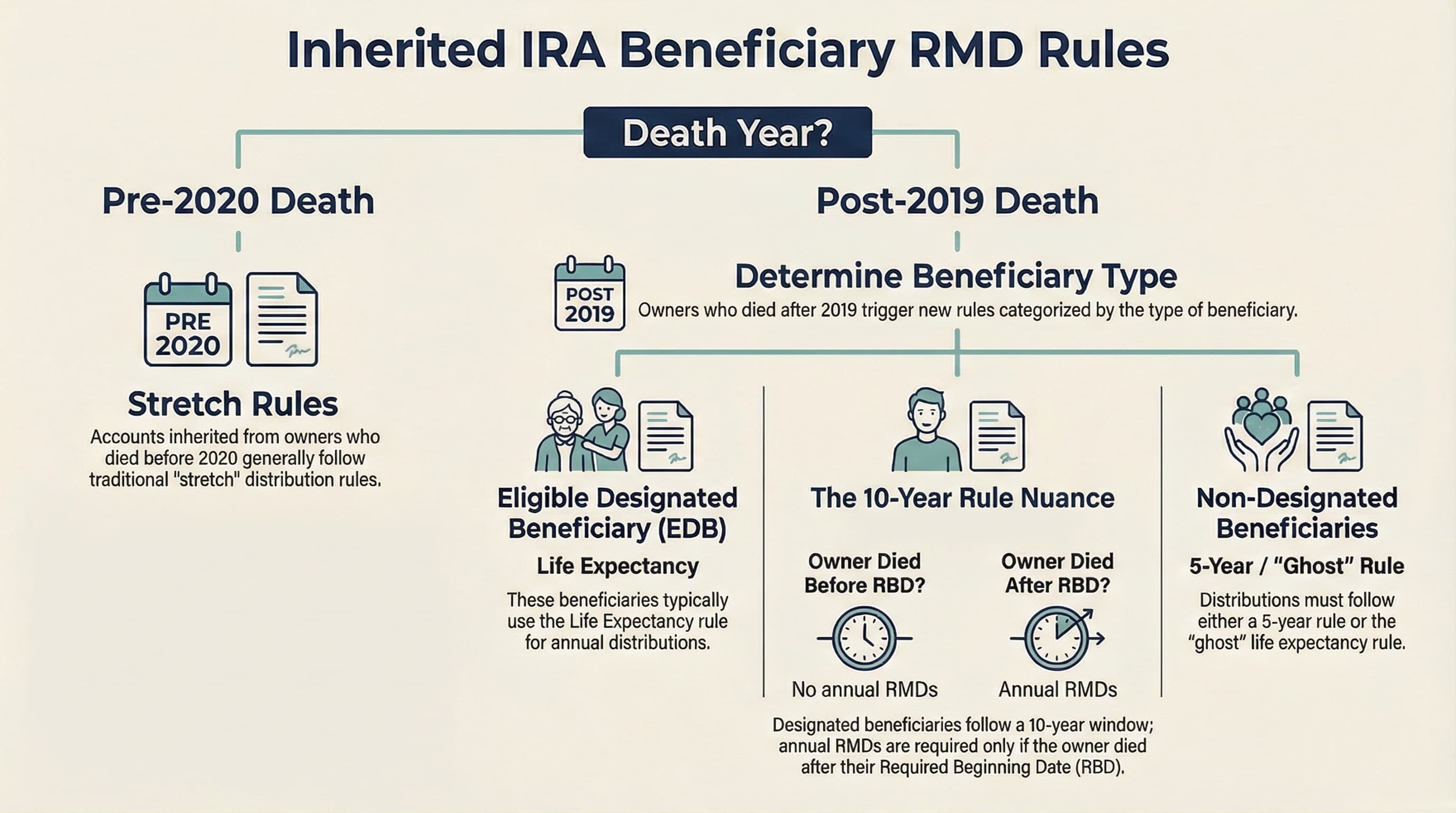
This is the first question to answer. The entire set of rules branches from here.
The IRS defines three categories of beneficiaries. Which one you fall into determines how — and how fast — you must take distributions.
Inherited IRA decision tree flowchart showing beneficiary types, the 10-year rule, and annual RMD requirements
| Beneficiary Type | Who Qualifies | Common Examples | Distribution Rule |
|---|---|---|---|
| Eligible Designated Beneficiary (EDB) | Surviving spouse, minor child of the deceased, disabled or chronically ill individual, person not more than 10 years younger than the deceased | Spouse, kid under 21, disabled sibling | Life expectancy stretch (similar to old rules) |
| Designated Beneficiary | Any individual who does not qualify as an EDB — adult children, siblings, friends, etc. | Adult son or daughter, friend, non-spouse partner | 10-year rule (account must be emptied within 10 years) |
| Non-Designated Beneficiary | Estates, charities, certain trusts | The deceased's estate, a charity, a non-see-through trust | 5-year rule or "ghost" life expectancy rule, depending on timing |
If you're an adult child who inherited from a parent — the most common scenario — you're a Designated Beneficiary subject to the 10-year rule.
Your beneficiary status is determined at the time of the original owner's death. It doesn't change later, with one exception: minor children transition to the 10-year rule once they reach age 21.
If the IRA was left to multiple beneficiaries, each person's share can be split into a separate inherited IRA — and the rules apply independently to each beneficiary based on their own classification.
Related: Non-spouse beneficiary RMD rules
The 10-Year Rule
The 10-year rule is the centerpiece of post-2019 inherited IRA rules. Here's how it works:
- The entire inherited IRA must be emptied by December 31 of the year containing the 10th anniversary of the owner's death.
- The clock starts the year after the owner's death.
- The clock was not paused during the IRS waiver years (2021–2024). Those years still count toward the 10.
Example: Kevin's Timeline
Kevin inherited a Traditional IRA from his mother, Linda, who died in March 2022 at age 79. Linda had already started taking her own RMDs.
Kevin's 10-year clock started in 2023. His deadline to fully empty the account is December 31, 2032. Here's what his timeline looks like:
| Year | Window Year | Annual RMD Required? | Notes |
|---|---|---|---|
| 2023 | Year 1 | Yes (penalty waived) | IRS Notice 2023-54 |
| 2024 | Year 2 | Yes (penalty waived) | IRS Notice 2024-35 |
| 2025 | Year 3 | Yes — enforced | Penalty waiver ended |
| 2026 | Year 4 | Yes — enforced | |
| 2027–2031 | Years 5–9 | Yes — enforced | |
| 2032 | Year 10 | Full balance must be withdrawn | Account must be empty by Dec. 31 |
Note: Waived penalties for 2023–2024 mean no tax hit for those years, but they still count toward the 10-year deadline.
Kevin must take annual RMDs in years 1–9 and fully drain the account by year 10. Because Linda had already started taking her own RMDs before she died, annual distributions are required — not optional.
But how did we know annual RMDs are required? That depends on one critical fact.
For the full walkthrough: The 10-year rule explained
Do You Need to Take Annual RMDs?
This is the question that confused beneficiaries, advisors, and the IRS itself for four years. The answer is now settled.
It depends on whether the original owner died before or after their Required Beginning Date (RBD).
| Original Owner Died... | Annual RMDs During Years 1–9? | Year 10 |
|---|---|---|
| Before their RBD (hadn't started RMDs yet) | No — flexible timing, withdraw as much or as little as you want | Must empty the account by Dec. 31 of year 10 |
| After their RBD (had already started RMDs) | Yes — annual RMDs required in years 1–9, based on your life expectancy | Must empty the account by Dec. 31 of year 10 |
| Roth IRA (any age at death) | No — Roth owners are always treated as dying before RBD | Must empty the account by Dec. 31 of year 10 |
What Is the RBD?
The Required Beginning Date is April 1 of the year after the original owner reached RMD age (73 under current rules). If the owner died before that date, they hadn't started RMDs. If they died on or after that date, they had.
In Kevin's case: Linda was 79 when she died — well past her RBD. So Kevin must take annual RMDs in years 1 through 9.
Example: Sarah's Pre-RBD Path
Sarah inherited a Traditional IRA from her father, who died in January 2024 at age 68 — well before his Required Beginning Date. Sarah is 42 and works full-time.
Sarah's 10-year clock started in 2025. Her deadline to fully empty the account is December 31, 2034. Because her father had not started his own RMDs, no annual distributions are required along the way. Sarah can take nothing for nine years and withdraw everything in 2034, spread distributions evenly across the window, or take more in low-income years and less in high-income ones.
The flexibility is real. The deadline is firm.
This distinction — before vs. after the RBD — is the single most important fact in inherited IRA planning. Everything flows from it.
Eligible Designated Beneficiaries: The Exceptions
Five categories of beneficiaries are exempt from the 10-year rule. If you qualify, you may be able to take distributions over your own life expectancy — similar to the old pre-2020 "stretch" rules.
- Surviving spouse — the most flexible options of any beneficiary type (see the next section)
- Minor child of the deceased — life expectancy stretch until age 21, then the 10-year clock starts
- Disabled individual (as defined by IRC §72(m)(7))
- Chronically ill individual (as defined by IRC §7702B(c)(2))
- Person not more than 10 years younger than the deceased — a sibling close in age, for example
Your status as an Eligible Designated Beneficiary is determined at the time of the original owner's death. It doesn't change later — with one exception: when a minor child reaches age 21, they lose their EDB status and the 10-year clock begins. The 10 years run from the year they turn 21, not from the year the original owner died.
Spouse Beneficiaries: Your Unique Options
Surviving spouses have the most flexibility of any beneficiary type. Three main paths:
Option 1: Treat the IRA as your own. Roll it into your own IRA or simply redesignate it. You begin taking RMDs when you reach age 73 (or 75 if born 1960 or later). You can make new contributions. For many spouses, this is the simplest choice.
Option 2: Keep it as an inherited IRA. This lets you delay RMDs until the year your deceased spouse would have reached RMD age. It's also useful if you're under 59½ and need access to the funds — distributions from an inherited IRA are not subject to the 10% early withdrawal penalty.
Option 3: Elect the 10-year rule. Available, but rarely the best choice for a spouse.
If your spouse died after their Required Beginning Date and you keep the account as an inherited IRA, you can calculate RMDs using the more favorable Uniform Lifetime Table (Table III) rather than the Single Life Table — a meaningful difference that results in smaller required distributions.
You don't have to decide immediately. But understanding all three paths before choosing is worth the time.
Inherited Roth IRAs
There's an important distinction here. Roth IRA original owners never have to take RMDs during their lifetime. Because of this, the IRS treats all Roth owners as having died before their Required Beginning Date — regardless of their actual age at death.
What this means for beneficiaries:
- The 10-year rule still applies. You must empty the account by the end of year 10.
- Annual RMDs are not required during years 1–9. Because the owner is treated as dying before their RBD, you have full flexibility on timing.
- Qualified distributions are tax-free — if the Roth IRA was open for at least 5 years before the owner's death.
This makes inherited Roth IRAs the most flexible inherited account. You can let the balance grow tax-free for up to 10 years, then withdraw everything tax-free. The deadline is firm, but the path to it is yours to choose.
How Inherited IRA RMDs Are Calculated
If you're required to take annual RMDs from an inherited IRA, the calculation uses the IRS Single Life Expectancy Table (Table I) from Publication 590-B.
Inherited IRA RMD = Prior year-end balance (Dec. 31) ÷ Beneficiary's life expectancy factor
The life expectancy factor is looked up once — in the year after the owner's death, based on your age that year — and then reduced by 1.0 each subsequent year. You don't look up a new factor each year; you subtract 1 from last year's number. This means the factor gets smaller over time, and the required withdrawal gets larger.
Worked Example
Kevin is 52 years old in 2025 — the first year the IRS will enforce a required distribution from the IRA he inherited from Linda.
| Inherited IRA balance on Dec. 31, 2024: | $280,000 |
| Kevin's age in 2023 (year after Linda's death): | 50 |
| Initial Single Life Expectancy factor at age 50: | 36.2 |
| Subtract 1.0 for each year since (2 years): | 36.2 − 2.0 = 34.2 |
| 2025 RMD: $280,000 ÷ 34.2 = | $8,187 |
For 2026, Kevin uses the December 31, 2025 balance and a factor of 33.2 (34.2 minus 1.0). Each year the factor drops by 1, so the required withdrawal gradually increases — even as the account balance may be declining.
Want to see your number? Try the SimpleRMD inherited IRA calculator — no signup required.
Source: IRS Publication 590-B — Single Life Expectancy Table
Related: Inherited IRA RMD tables explained
Penalties for Missed Inherited IRA RMDs
From 2021 through 2024, the IRS waived penalties for beneficiaries who missed annual distributions under the 10-year rule. That grace period is over. Starting in 2025, the standard penalty structure applies.
| Situation | Penalty |
|---|---|
| Missed or insufficient inherited IRA RMD (2025+) | 25% excise tax on the shortfall |
| Corrected within 2 years | Automatically reduced to 10% — withdraw the shortfall and file Form 5329 (no waiver letter needed) |
| Reasonable cause waiver | Potentially $0 — file Form 5329 with a letter explaining the circumstances; IRS may waive the penalty entirely |
If you inherited an IRA in 2020–2023 and haven't taken any distributions yet, you're not starting from zero — the 10-year clock has been running. Check where you stand now, and consult a tax professional about catching up.
If you've already missed a distribution, don't panic. Take it as soon as possible, file Form 5329, and explain the situation. The IRS has historically been reasonable when errors are corrected promptly.
Source: IRS — RMD FAQs (beneficiary distributions)
Related: RMD deadlines and penalties · IRS waiver for missed RMDs
Common Mistakes with Inherited IRAs
-
Assuming you can wait until year 10 to withdraw everything. If the original owner had started their own RMDs, annual distributions are required in years 1–9. The IRS confirmed this in final regulations issued July 2024.
-
Not knowing whether the original owner had started RMDs. This single fact determines your entire distribution schedule. Ask the custodian, or check whether the owner had reached their Required Beginning Date (April 1 of the year after turning 73).
-
Missing the retitling requirement. An inherited IRA must be retitled in your name as beneficiary. If you're not a spouse and you roll it into your own IRA, you may trigger a full taxable distribution.
-
Forgetting the waiver years still count toward the 10-year clock. The IRS waived penalties from 2021–2024, but it did not pause the timeline. If the owner died in 2020, your deadline is still December 31, 2030.
-
Ignoring inherited Roth IRA deadlines. Roth distributions are tax-free, but the 10-year deadline still applies. Missing it triggers the same 25% excise tax.
-
Taking the entire balance in a single year without considering the tax impact. Larger withdrawals push you into a higher bracket. Spreading distributions over the 10-year window — even when annual RMDs aren't required — may reduce your total tax bill. Talk to your tax professional about a distribution plan.
-
Not knowing you can aggregate inherited IRAs from the same person. If you inherited multiple IRAs from the same individual, you can calculate each RMD separately but take the combined total from just one of those accounts. I didn't learn this for years, and it cost me — I liquidated positions I didn't need to touch. (Note: this only works for inherited IRAs from the same decedent. Inherited IRAs from different people cannot be aggregated.)
Frequently Asked Questions
Do I have to take an RMD from my inherited IRA this year?
If the original owner died after 2019 and had already reached their Required Beginning Date, yes — annual distributions are required starting in 2025. If the owner died before their RBD, annual RMDs are not required, but you must empty the account within 10 years. See: The 10-year rule explained
How do I calculate my inherited IRA RMD?
Use the IRS Single Life Expectancy Table (Table I) from Publication 590-B. Divide the prior year-end account balance by your life expectancy factor. The factor is looked up once and reduced by 1.0 each year. See: Inherited IRA RMD tables explained
Can I roll an inherited IRA into my own IRA?
Only if you're a surviving spouse. Non-spouse beneficiaries must keep the account titled as an inherited IRA. Rolling it into your own IRA as a non-spouse can trigger a full taxable distribution. See: Non-spouse beneficiary rules
What happens if I miss an inherited IRA RMD?
The IRS charges a 25% excise tax on the shortfall, automatically reducible to 10% if corrected within 2 years by filing Form 5329. In some cases, the penalty can be waived entirely for reasonable cause. See: IRS waiver for missed RMDs
Do inherited Roth IRAs require RMDs?
The 10-year rule applies, but annual RMDs during years 1–9 are not required. Because Roth owners are treated as dying before their Required Beginning Date, you have full flexibility on timing. Qualified distributions are tax-free if the account was open at least 5 years.
What if I inherited an IRA before 2020?
Pre-2020 inherited IRAs follow the original "stretch" rules — life expectancy-based distributions over the beneficiary's lifetime. These rules still apply to those accounts and were not changed by the SECURE Act. See: Legacy stretch IRA schedules
What if the original owner died in 2025?
Your 10-year clock starts in 2026. If the owner had reached their Required Beginning Date, your first annual RMD is due by December 31, 2026. Your deadline to fully empty the account is December 31, 2035.
Can a Qualified Charitable Distribution (QCD) satisfy an inherited IRA RMD?
No. QCDs can only be made from your own IRA — not from an inherited IRA. The one exception: if you're a surviving spouse who has rolled the inherited IRA into your own IRA, you can then make QCDs from it (assuming you meet the age requirement of 70½ or older).
Get rule-change alerts (inherited IRAs only)
We'll only email you if inherited IRA rules or enforcement materially change.
You can unsubscribe anytime.
Need to check your inherited IRA numbers?
- Run the inherited IRA calculator — free, no account required
- The 10-year rule explained
- Non-spouse beneficiary RMD rules
- What happens to RMDs after death?
- Tax on inherited IRA distributions
- See how SimpleRMD works
- Back to RMD basics
This article is for informational purposes only and does not constitute tax, legal, or financial advice. IRS rules and tax laws are subject to change. Consult a qualified tax professional or financial advisor for guidance specific to your situation. SimpleRMD is a calculation and tracking tool — not a financial advisory service.
Sources: IRS Final Regulations T.D. 10001 (July 2024). IRS.gov (Publication 590-B, RMD FAQs). IRS Notices 2022-53, 2023-54, 2024-35. SECURE Act of 2019 (Pub. L. 116-94). SECURE 2.0 Act of 2022 (Pub. L. 117-328). Rules confirmed current as of February 2026.