

The required amount comes from three inputs: which rule applies to you, your life expectancy factor from the IRS Single Life Table, and the December 31 balance of the account from the prior year. The math itself is straightforward — the work is figuring out which input goes where.
Three rules cover most cases. Eligible designated beneficiaries take an annual amount based on lifetime stretch. Non-eligible designated beneficiaries fall under the 10-year rule, with annual RMDs only if the original owner had reached their required beginning date. Roth inherited IRAs and pre-RBD Traditional inherited IRAs require nothing along the way, just zero in the account by year ten.
Try the Free Inherited IRA RMD CalculatorThe annual RMD formula
When an annual RMD applies, the amount is the prior-year-end balance divided by a life expectancy factor:
Annual RMD = December 31 prior-year balance ÷ life expectancy factor
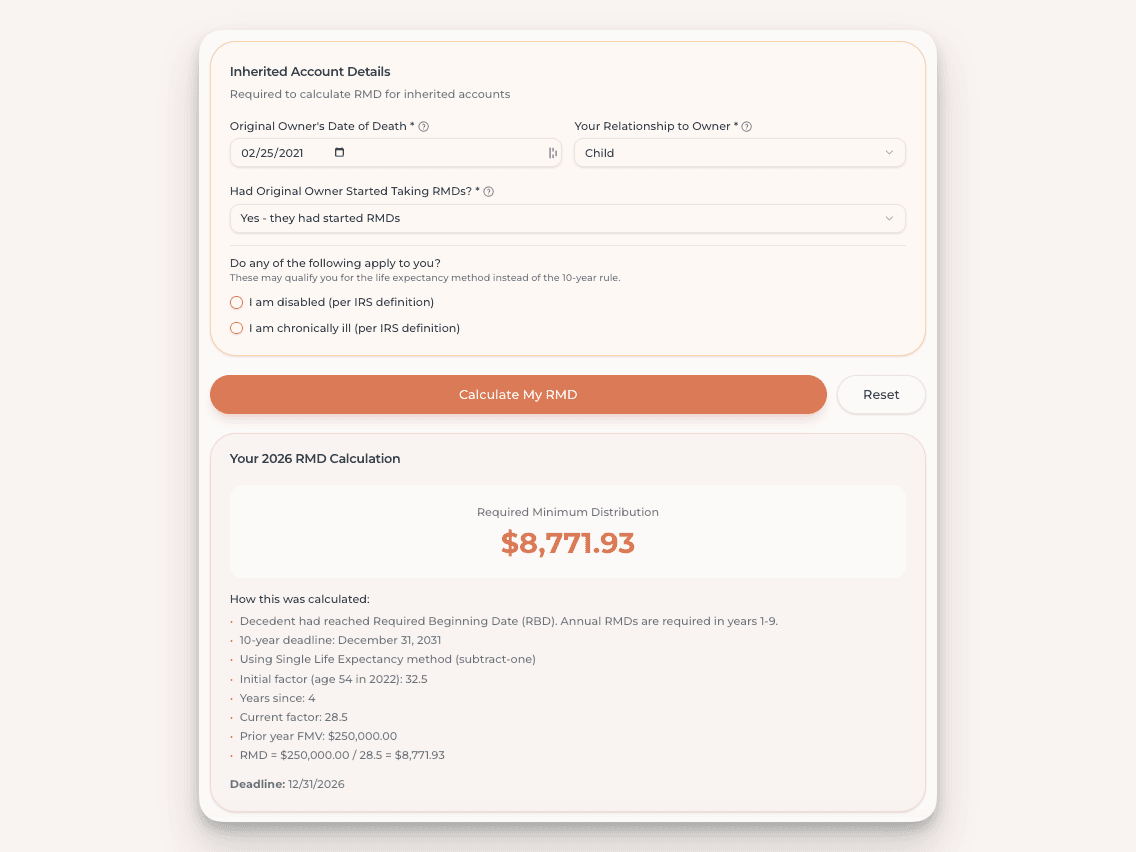
The factor comes from the IRS Single Life Table. For the first RMD year, look up the factor at the beneficiary's age as of December 31 of the year following the year of death. Each year after that, reduce the factor by one. The schedule is not recalculated annually against the table — it is fixed by the first-year lookup and steps down one year at a time.
An example. Carol inherits $200,000 from her father in 2025; he was 78 at death, past his required beginning date. Carol turns 53 in 2026, the year after death. The Single Life Table factor at age 53 is 33.4. Her 2026 RMD is $200,000 ÷ 33.4 = $5,988. Her 2027 RMD is the December 31, 2026 balance divided by 32.4 (the prior factor minus one). And so on through year 10, when whatever is left has to come out by December 31, 2035.
When annual RMDs apply, and when they do not
Annual RMDs during the 10-year window apply to non-eligible designated beneficiaries when the original IRA owner died on or after their required beginning date. The formula above runs every year through year nine. Year ten is a cleanup: whatever balance remains has to come out by December 31 of that year.
Annual RMDs do not apply during the 10-year window when the original owner died before their required beginning date. The beneficiary has no annual minimum — zero out the account by December 31 of year ten, with full flexibility on the schedule.
Inherited Roth IRAs always fall in the no-annual-RMD lane during the 10-year window, because the original owner had no required beginning date. The year-10 deadline still applies.
Eligible designated beneficiaries on lifetime stretch use the same formula as the annual-RMD calculation above, but they continue indefinitely instead of capping at year 10. A surviving spouse who treats the inherited IRA as their own follows the owner's own RMD schedule — no withdrawal required until age 73 (or 75 for those born 1960 or later).
Aggregation rules and the year-of-death RMD
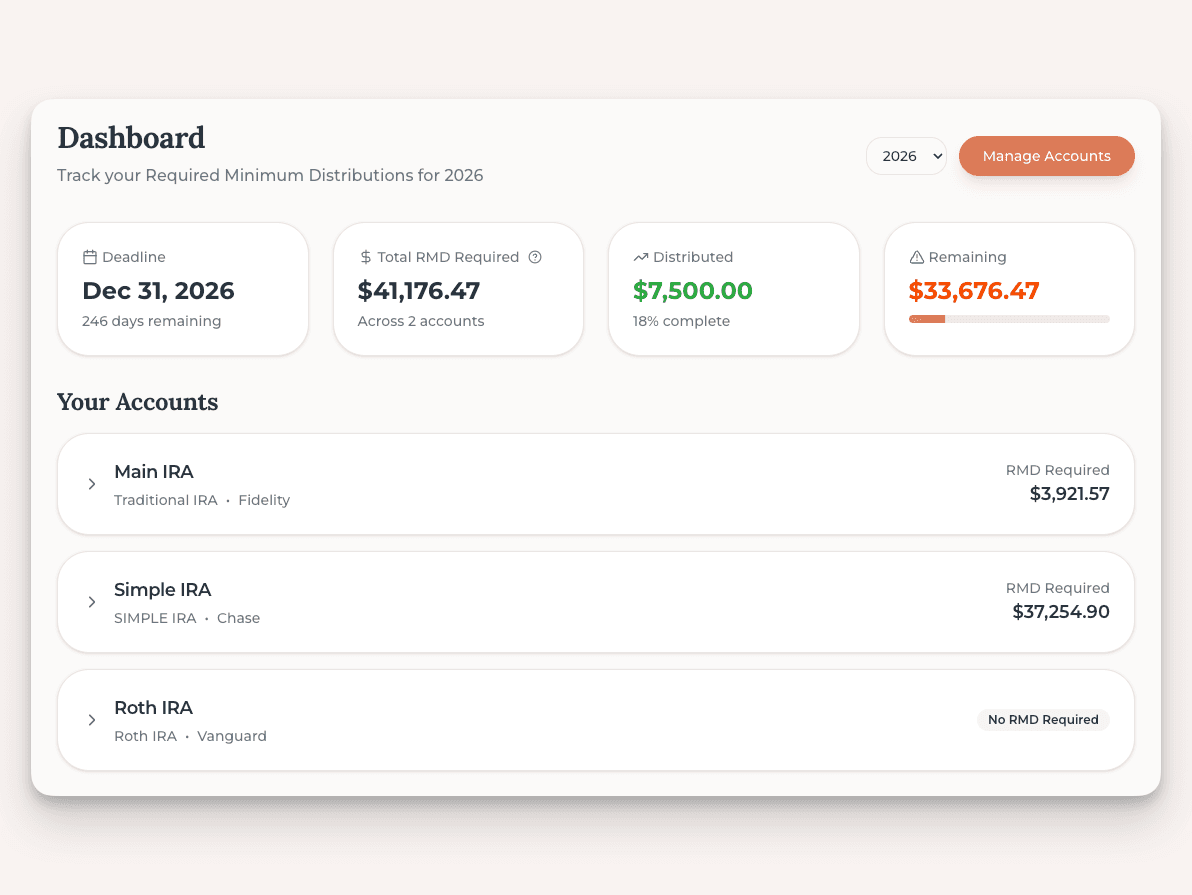
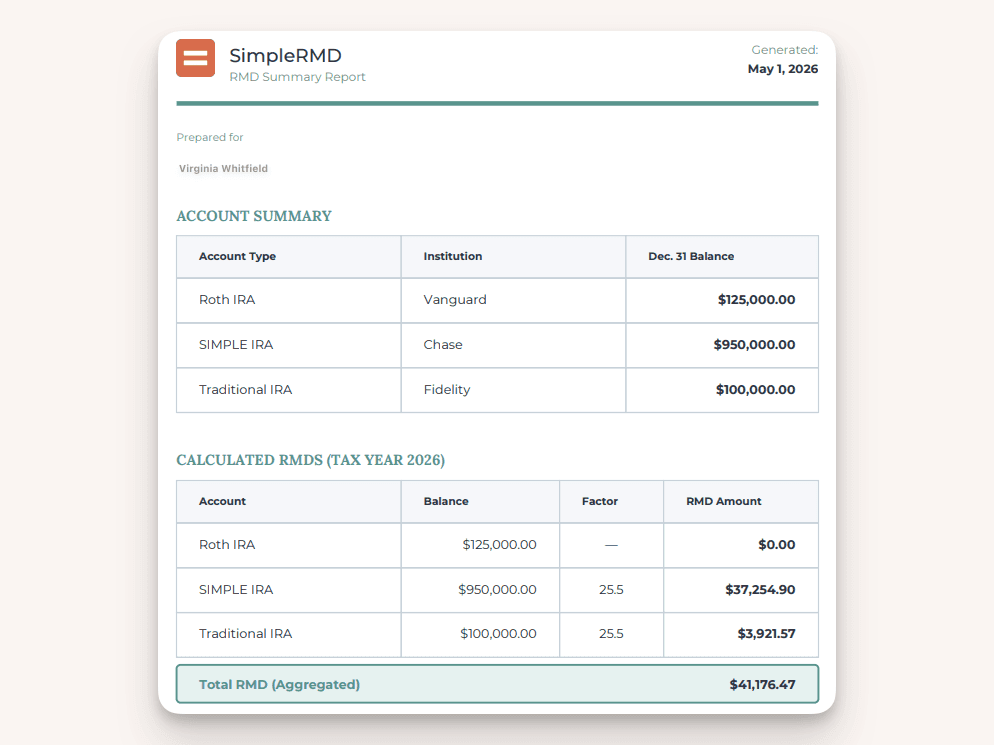
Multiple inherited IRAs do not aggregate the same way owned IRAs do. The IRS allows aggregation only for inherited IRAs from the same decedent and of the same type — multiple Traditional inherited IRAs from one parent can be totaled to satisfy a single RMD across the group. Inherited IRAs from different decedents must each take their own RMD separately. An inherited IRA and an owned IRA never aggregate.
Year-of-death RMD is a separate amount that comes up only once. If the original owner had reached their required beginning date and died before taking that year's RMD, the beneficiary is responsible for taking whatever amount the deceased still owed by December 31 of the year of death. It is calculated using the deceased's age and the IRS Uniform Lifetime Table (or the joint table if the deceased used it), not the beneficiary's age.
Missing an RMD triggers a 25% excise tax on the missed amount, reducible to 10% with timely correction via Form 5329. The same penalty applies to missing the year-10 deadline on the remaining balance.
For the broader inherited-IRA framework see the inherited-IRA pillar hub. The main RMD hub covers RMD rules across all account types. How It Works walks through what SimpleRMD does at each step. For the related question of what happens if you take more than the required amount, see can I withdraw more than the RMD from an inherited IRA.
This article is for informational purposes only and does not constitute tax, legal, or financial advice. IRS rules and tax laws are subject to change. Consult a qualified tax professional or financial advisor for guidance specific to your situation. SimpleRMD is a calculation and tracking tool — not a financial advisory service.
Sources: IRS Final Regulations T.D. 10001 (July 2024). IRS.gov (Publication 590-B, "Beneficiaries"), IRS Single Life Expectancy Table. IRS Notices 2022-53, 2023-54, 2024-35. SECURE Act of 2019 (Pub. L. 116-94). SECURE 2.0 Act of 2022 (Pub. L. 117-328). Rules confirmed current as of May 2026.