

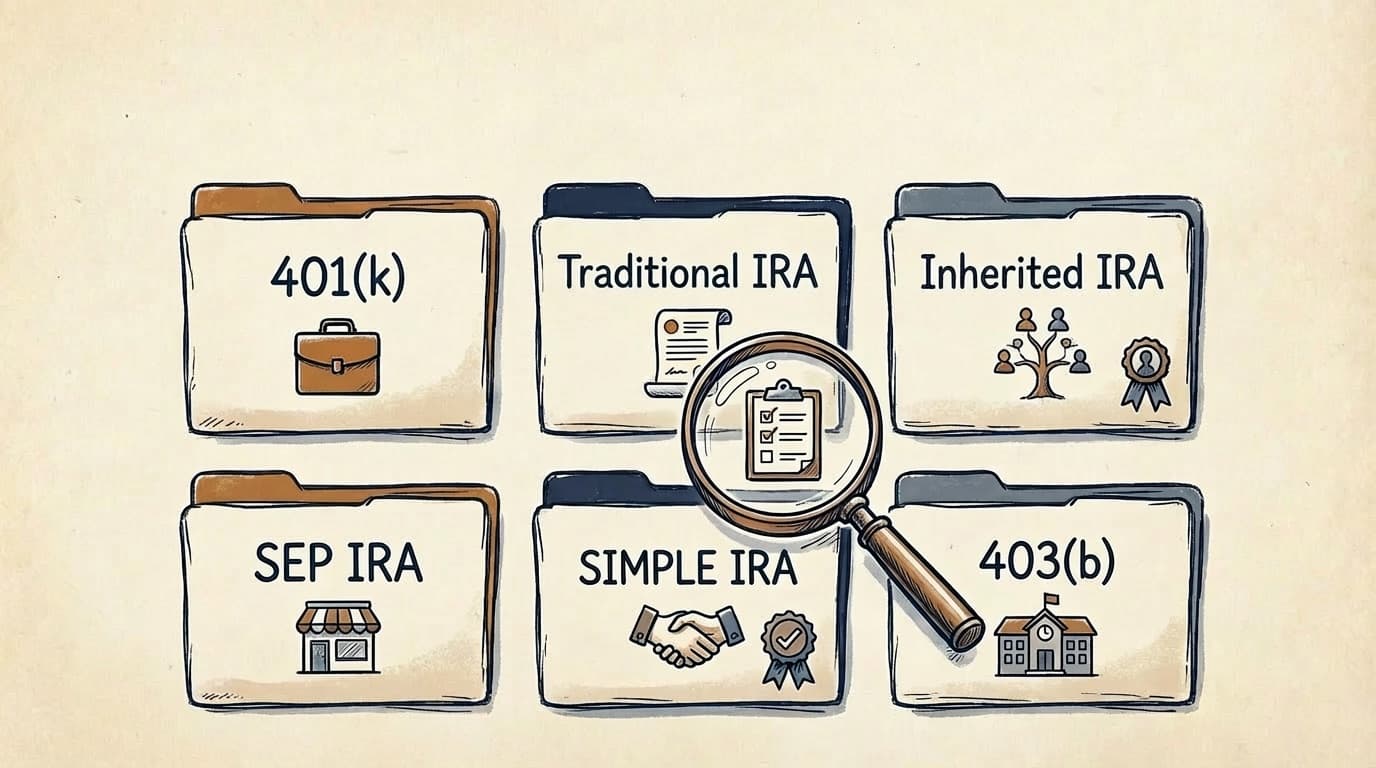
RMD rules aren't one-size-fits-all across retirement accounts. Some require annual withdrawals starting at a certain age, while others—such as Roth IRAs—impose no lifetime RMDs at all. Aggregation options also vary: you can often pool RMDs from multiple IRAs and take the total from one account, but employer plans like 401(k)s typically demand separate withdrawals for each. If you hold a mix of account types—as most people do—this guide helps clarify which rules govern each of your accounts.
Find your account type below, or start with the full comparison table.
In short: Traditional, SEP, and SIMPLE IRAs all require RMDs starting at age 73. So do 401(k)s and 403(b)s (with a still-working exception). Roth IRAs do not require RMDs during your lifetime — and as of 2024, neither do Roth 401(k)s. Qualified annuities follow the same rules as the account that holds them. Nonqualified annuities have no RMDs.
On this page
- Which Accounts Require RMDs?
- Traditional IRA
- 401(k) and Employer Plans
- SEP and SIMPLE IRAs
- Roth IRA
- Roth 401(k) and Roth 403(b)
- Annuities
- Aggregation: What You Can and Can't Combine
- Common Mistakes by Account Type
- Frequently Asked Questions
Which Accounts Require RMDs?
This is the table to bookmark. It covers every common retirement account type in one place.
| Account Type | RMDs Required? | Starting Age | Can Aggregate? | Key Notes |
|---|---|---|---|---|
| Traditional IRA | Yes | 73 | Yes — with other IRAs | Most common RMD scenario |
| Rollover IRA | Yes | 73 | Yes — with other IRAs | Same rules as Traditional IRA |
| SEP IRA | Yes | 73 | Yes — with other IRAs | Same rules as Traditional IRA for RMD purposes |
| SIMPLE IRA | Yes | 73 | Yes — with other IRAs | Same rules as Traditional IRA for RMD purposes |
| 401(k) | Yes | 73 | No — each plan separately | Still-working exception may apply |
| 403(b) | Yes | 73 | Yes — with other 403(b)s only | Cannot aggregate with IRAs |
| 457(b) (governmental) | Yes | 73 | No — each plan separately | Similar to 401(k) rules |
| Roth IRA | No | N/A | N/A | No RMDs during owner's lifetime. Beneficiaries do have RMDs. |
| Roth 401(k) / Roth 403(b) | No (as of 2024) | N/A | N/A | Changed by SECURE 2.0. Beneficiaries still have RMDs. |
| Qualified annuity (inside IRA or 401k) | Yes | 73 | Follows the account it's in | Annuity payments may satisfy the RMD |
| Nonqualified annuity (after-tax money) | No | N/A | N/A | No RMDs during owner's lifetime |
Age note: The RMD starting age increases to 75 for people born in 1960 or later, beginning in 2033.
Still-working note: If you're past 73 and still employed, you may be able to delay RMDs from your current employer's 401(k), 403(b), or similar plan — but only if the plan allows it, you own less than 5% of the business, and it's your current employer's plan. This exception does not apply to IRAs or former employer plans. Details below.
Check your numbers — SimpleRMD calculator (free, no account required)
Source: IRS — Retirement Topics: Required Minimum Distributions · IRS — RMD FAQs
Traditional IRA
The standard case. If you have a Traditional IRA, RMDs begin the year you turn 73. Your first RMD can be delayed until April 1 of the following year, but that creates a double-up in year two.
The calculation is straightforward: take your December 31 balance from the prior year and divide by the IRS life expectancy factor from the Uniform Lifetime Table (or the Joint Life table if your sole beneficiary is a spouse more than 10 years younger).
If you have multiple Traditional IRAs — including Rollover IRAs — you must calculate the RMD for each one separately, but you can take the total from any one or combination of your IRAs. This is the aggregation rule, and it only works within the IRA family (including SEP and SIMPLE IRAs).
Full RMD rules and calculation walkthrough · Run the calculator
401(k) and Employer Plans
401(k)s, 403(b)s, and 457(b) plans all require RMDs starting at age 73 — but with two important differences from IRAs.
You cannot aggregate. Each 401(k) RMD must be taken from that specific plan. If you have three old 401(k)s at former employers, you owe three separate RMDs from three separate accounts. You can't pull one big distribution from just one of them. (This is different from IRAs, which allow aggregation.)
The one exception: 403(b) plans can aggregate with other 403(b)s — but not with IRAs or 401(k)s.
The still-working exception. If you're past 73 but still employed, you may be able to delay RMDs from your current employer's plan until the year you retire. This applies only if:
- It's the plan of your current employer (not a former employer's plan)
- You do not own 5% or more of the business
- The plan document specifically allows the delay
This exception does not apply to IRAs. If you have a Traditional IRA, RMDs begin at 73 regardless of whether you're still working.
One more thing: your plan's own rules matter. Some plan documents require distributions at 73 even if you're still working. Check with your plan administrator.
Full 401(k) RMD rules · RMD deadlines and penalties
SEP and SIMPLE IRAs
For RMD purposes, SEP IRAs and SIMPLE IRAs follow the exact same rules as Traditional IRAs. Same starting age (73), same calculation, same deadlines, and — importantly — same aggregation group.
This means you can combine your SEP, SIMPLE, Traditional, and Rollover IRA RMDs and take the total from whichever IRA you choose. They're all part of the same pool.
A common point of confusion: employers can continue making SEP or SIMPLE contributions to your account even after you've started taking RMDs. Contributions and distributions operate independently.
Roth IRA
No RMDs during your lifetime. This is one of the Roth IRA's biggest advantages — your money can stay invested and grow tax-free for as long as you live.
But "no RMDs" comes with three important caveats that are easy to miss:
Beneficiaries do face RMDs. When someone inherits your Roth IRA, the 10-year rule applies (for most non-spouse beneficiaries). The account must be fully emptied by the end of the 10th year after your death. The distributions are generally tax-free, but the deadline penalty still applies if they miss it.
Roth conversions don't eliminate inherited obligations. Converting a Traditional IRA to a Roth removes your lifetime RMDs, but your beneficiaries will still face the 10-year distribution requirement.
QCDs can't come from Roth IRAs. Qualified Charitable Distributions — which let you satisfy an RMD by donating directly to charity — only work from Traditional IRAs. Since Roth IRAs don't have RMDs, QCDs don't apply.
Roth IRA and RMD rules · Inherited IRA rules
Roth 401(k) and Roth 403(b)
Before 2024, designated Roth accounts inside employer plans (Roth 401(k), Roth 403(b)) did require RMDs — unlike Roth IRAs. This was a source of confusion for years.
SECURE 2.0 fixed this. Starting with distributions required in 2024 and later, Roth accounts in employer plans are no longer subject to RMDs during the owner's lifetime. This brings them in line with Roth IRAs. (If you took Roth 401(k) RMDs before 2024, those were correctly required under the old rules — this change is not retroactive.)
If you previously rolled a Roth 401(k) into a Roth IRA specifically to avoid RMDs, that's no longer necessary — but the rollover itself wasn't harmful, and the money stays in the Roth family either way.
Beneficiaries still face RMDs on inherited Roth 401(k) and Roth 403(b) accounts, under the same 10-year rule that applies to inherited Roth IRAs.
Annuities
Annuity RMD rules depend entirely on how the annuity was funded.
| Annuity Type | RMDs Required? | Why |
|---|---|---|
| Qualified (inside IRA, 401k, 403b) | Yes | Follows the rules of the account that holds it |
| Nonqualified (purchased with after-tax money) | No | No tax deferral to recapture — IRS doesn't mandate distributions |
| QLAC (Qualified Longevity Annuity Contract) | Deferred | Premium (up to $210,000) is excluded from your RMD calculation. Payments must begin by age 85, at which point they are taxable. |
If your annuity is inside an IRA or 401(k), it's a qualified annuity and the standard RMD rules apply. In many cases, the annuity's income payments can satisfy part or all of the RMD for that account. Under SECURE 2.0, excess income from a qualified annuity can even be applied toward the RMD from the broader account that funded it.
If your annuity was purchased with after-tax money, it's nonqualified and has no RMDs during your lifetime. However, beneficiaries who inherit a nonqualified annuity do face distribution requirements.
QLAC note: A Qualified Longevity Annuity Contract (QLAC) lets you move up to $210,000 (2025 limit, indexed for inflation) from an IRA or employer plan into a deferred annuity. The QLAC premium is excluded from the balance used to calculate your RMDs — which can meaningfully reduce your annual distributions. Payments must begin no later than age 85.
Annuity RMD rules · How to calculate your RMD
Aggregation: What You Can and Can't Combine
This is one of the most commonly misunderstood RMD rules. "Aggregation" means calculating each account's RMD separately, then taking the combined total from one or more accounts in the same group.
Diagram showing RMD aggregation rules: Traditional, Rollover, SEP, and SIMPLE IRAs can combine RMDs. 403(b) plans can combine with other 403(b)s. 401(k) and 457(b) plans must each be taken separately. No mixing across groups.
| Account Group | Can Aggregate? | What This Means |
|---|---|---|
| Traditional + Rollover + SEP + SIMPLE IRAs | Yes | Calculate each RMD separately, then take the total from any one or more of these IRAs |
| 403(b) plans | Yes (with other 403(b)s) | Can combine 403(b) RMDs, but cannot mix with IRA or 401(k) RMDs |
| 401(k) plans | No | Each 401(k) RMD must come from that specific plan |
| 457(b) plans | No | Each plan's RMD must come from that plan |
| Across groups (e.g., IRA + 401k) | No | You cannot take a 401(k) RMD from your IRA, or vice versa |
Quick Example
Tom, age 76, has three accounts:
- Traditional IRA at Fidelity: RMD = $6,000
- SEP IRA at Schwab: RMD = $4,200
- Old 401(k) at a former employer: RMD = $3,500
Tom can combine his Traditional IRA and SEP IRA RMDs ($6,000 + $4,200 = $10,200) and take the full $10,200 from either account. But his 401(k) RMD of $3,500 must come from the 401(k) itself. He cannot pull $13,700 from one IRA and call it done.
Source: IRS — RMD FAQs
Common Mistakes by Account Type
-
Assuming all accounts can aggregate. IRAs can. 401(k)s can't. This trips up people with multiple employer plans who try to take one combined distribution.
-
Not knowing that Roth beneficiaries face RMDs. "Roth = no RMDs" is only true during the owner's lifetime. Inherited Roth IRAs are still subject to the 10-year rule.
-
Misunderstanding the still-working exception. It only applies to your current employer's plan, and only if you own less than 5% of the business. It doesn't apply to IRAs or plans from former employers.
-
Treating SEP or SIMPLE IRAs differently. For RMD purposes, they follow the same rules as a Traditional IRA. No special treatment.
-
Forgetting old 401(k)s at former employers. That account you haven't touched in 15 years still requires its own RMD. Consider consolidating old plans into an IRA to simplify. See: Does my accountant calculate my RMD?
-
Not knowing the Roth 401(k) change. As of 2024, Roth accounts in employer plans no longer require lifetime RMDs. Some plan administrators have been slow to update their guidance and communications — if your plan's materials still reference Roth 401(k) RMDs, verify directly with the IRS SECURE 2.0 provisions or your tax advisor.
Frequently Asked Questions
Can I take my 401(k) RMD from my IRA instead?
No. 401(k) RMDs must come from the 401(k) plan itself. You cannot satisfy a 401(k) RMD by withdrawing from an IRA, or vice versa. If managing multiple plans feels cumbersome, consider rolling old 401(k)s into an IRA — once consolidated, the IRA aggregation rules make things simpler.
Do I still need to take RMDs if I'm still working?
From your current employer's plan — possibly not. The still-working exception lets you delay RMDs from your current employer's 401(k) or 403(b) until the year you retire, as long as you own less than 5% of the business and the plan allows it. But this exception does not apply to IRAs, former employer plans, or any account outside your current employer's plan.
My Roth 401(k) used to require RMDs — did that change?
Yes. SECURE 2.0 eliminated lifetime RMDs from designated Roth accounts in employer plans, effective 2024. If you were taking Roth 401(k) RMDs before 2024, you no longer need to.
Does my pension count as an RMD?
Pension payments from a defined benefit plan do satisfy that plan's RMD requirements — the plan handles both the calculation and the distribution, so there's nothing for you to do on that side. But pension income does not count toward the RMD for your IRA, 401(k), or any other defined contribution plan. Those are separate obligations.
Can I roll old 401(k)s into an IRA to simplify things?
Yes, and this is one of the most practical things you can do. Once a 401(k) is rolled into a Traditional IRA, it becomes part of the IRA aggregation group — meaning you can combine that RMD with your other IRA RMDs and take the total from whichever account you choose. If you have multiple old employer plans sitting at former jobs, consolidating them into a single IRA can significantly simplify your annual RMD process.
What if I have accounts at multiple brokerages?
The rules are based on account type, not where the accounts are held. If you have Traditional IRAs at three different brokerages, calculate each IRA's RMD separately, then take the combined total from any one (or more) of them. The accounts don't need to be at the same institution.
I have a 403(b) and an IRA. Can I combine those RMDs?
No. 403(b) RMDs can only be aggregated with other 403(b) plans. They cannot be combined with IRA RMDs. You'll need to satisfy each group's RMD from within that group.
Find the right number for each account.
- Run the calculator — free, no account required
- 401(k) RMD rules
- Roth IRA RMD rules
- SEP IRA RMD rules
- Annuity RMD rules
- Can I take all RMDs from one account?
- See how SimpleRMD works
This article is for informational purposes only and does not constitute tax, legal, or financial advice. IRS rules and tax laws are subject to change. Consult a qualified tax professional or financial advisor for guidance specific to your situation. SimpleRMD is a calculation and tracking tool — not a financial advisory service.
Sources: IRS.gov (Retirement Topics: RMDs, Publication 590-B, RMD FAQs, Publication 575). FINRA RMD guidance. SECURE 2.0 Act of 2022 (Pub. L. 117-328). Rules confirmed current as of February 2026.