

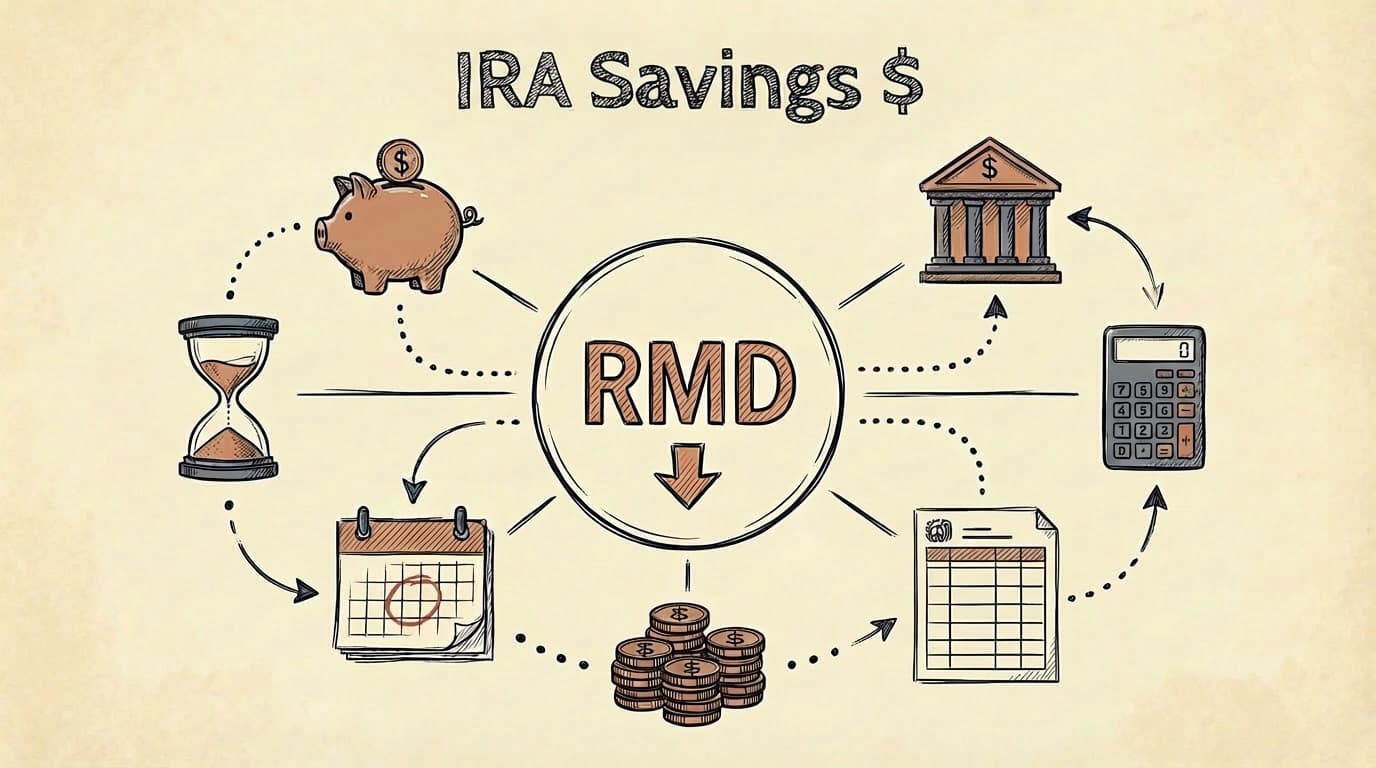
A Required Minimum Distribution — RMD — is the minimum amount the IRS requires you to withdraw each year from certain retirement accounts. If you have a Traditional IRA, a 401(k), a SEP IRA, or a similar tax-deferred account, the government will eventually require you to start taking money out, even if you don't need it.
The reason is straightforward: you got a tax break when the money went in. Contributions to these accounts were either tax-deductible or made with pre-tax dollars, which means you've never paid income tax on that money. RMDs are how the IRS makes sure those taxes eventually get paid.
Nobody wakes up excited to calculate their RMD. But understanding the basics keeps you on the right side of the IRS — and out of penalty territory.
In short: An RMD is the minimum amount you must withdraw each year from tax-deferred retirement accounts like Traditional IRAs and 401(k)s. It's calculated by dividing your prior year-end balance by an IRS life expectancy factor. RMDs begin at age 73 (75 if born in 1960 or later), the annual deadline is December 31, and missing it triggers a 25% excise tax on the shortfall.
On this page
- Why Do RMDs Exist?
- Which Accounts Require RMDs?
- When Do RMDs Start?
- How Is Your RMD Calculated?
- Example: Patricia's First RMD
- What Happens If You Don't Take Your RMD?
- Can You Take More Than the Minimum?
- What About Inherited IRAs?
- Frequently Asked Questions
Why Do RMDs Exist?
When you contribute to a Traditional IRA or 401(k), you're making a deal with the IRS: you don't pay taxes on that money now, but you will later. The account grows tax-deferred — no taxes on dividends, interest, or capital gains while the money is invested.
RMDs are the "later" part of that deal. Without them, you could theoretically leave money in a tax-deferred account indefinitely, passing it to heirs without the government ever collecting the income tax it deferred.
The IRS uses life expectancy tables to set the pace. When you're younger (in RMD terms — 73), the required percentage is small. As you age, the factor shrinks and the required withdrawal grows. The system is designed to gradually draw down the account over your remaining lifetime.
This is also why Roth IRAs don't require RMDs. Roth contributions are made with after-tax dollars — you already paid income tax on the money before it went in. Since the IRS already collected its share, there's no deferred tax to recoup.
It's worth knowing that RMDs are the minimum. You can always withdraw more. But you can't withdraw less — or skip a year — without facing a penalty.
Which Accounts Require RMDs?
Not every retirement account is subject to RMDs. The key distinction is whether the account holds pre-tax (tax-deferred) money.
| Account Type | RMDs Required? | Notes |
|---|---|---|
| Traditional IRA | Yes | The most common RMD scenario |
| SEP IRA | Yes | Same rules as Traditional IRA |
| SIMPLE IRA | Yes | Same rules as Traditional IRA |
| 401(k) / 403(b) | Yes | May be delayed if still working for that employer |
| Roth IRA | No | Not during the original owner's lifetime |
| Roth 401(k) / 403(b) | No | Exempt from lifetime RMDs starting in 2024 (SECURE 2.0) |
The Roth exception is significant. Because Roth contributions are made with after-tax dollars — you already paid income tax on that money — the IRS doesn't need to force withdrawals to collect taxes. Your Roth IRA can grow untouched for your entire life. See: Roth IRA RMD rules
One caveat: if you inherit any type of IRA — including a Roth — distribution rules apply to the beneficiary. That's a separate topic with its own set of rules. See: Inherited IRA RMD rules
For details on how specific account types handle RMDs: RMD rules by account type
When Do RMDs Start?
Your starting age depends on when you were born:
| Birth Year | RMDs Begin At Age |
|---|---|
| 1951–1959 | 73 |
| 1960 or later | 75 (starting in 2033) |
These ages were set by the SECURE 2.0 Act of 2022. If you were born before 1951, you've already been taking RMDs for years.
Your first RMD is due by December 31 of the year you reach RMD age — with one exception. You may delay your very first RMD until April 1 of the following year. But delaying creates a problem: you'll owe two RMDs in that second year (the delayed one plus the current year's), both taxable as income. For most people, taking the first RMD on time is the better move. See: First-year RMD rules
After your first year, every subsequent RMD is due by December 31. No extensions, no exceptions.
Still working? If you're still employed and participating in your current employer's 401(k) or 403(b), you may be able to delay RMDs from that specific plan until you retire. This exception does not apply to IRAs, accounts from previous employers, or if you own 5% or more of the business. See: When RMDs start
Source: IRS — Retirement Topics: Required Minimum Distributions
How Is Your RMD Calculated?
RMD = Prior year-end account balance (Dec. 31) ÷ IRS life expectancy factor
The formula is simple — two inputs, one division. The inputs are what trip people up.
The balance is your account's value as of December 31 of the previous year. If you have a Traditional IRA and you're calculating your 2026 RMD, you use the balance from December 31, 2025. Your custodian typically provides this on your year-end statement.
The life expectancy factor comes from IRS tables published in Publication 590-B. Most people use the Uniform Lifetime Table, which has a factor for each age. At 73, the factor is 26.5. At 80, it's 20.2. At 90, it's 12.2. The older you are, the smaller the factor — and the larger the required withdrawal as a percentage of your balance.
If your sole beneficiary is your spouse and they are more than 10 years younger than you, you use a different table (the Joint Life and Last Survivor Table) that produces a smaller RMD. Everyone else uses the Uniform Lifetime Table.
For a detailed walkthrough of the tables: RMD tables explained · How to calculate your RMD
Example: Patricia's First RMD
Patricia turned 73 in July 2026. She has one Traditional IRA.
| IRA balance on Dec. 31, 2025: | $390,000 |
| Patricia's age in 2026: | 73 |
| Uniform Lifetime Table factor at age 73: | 26.5 |
| 2026 RMD: $390,000 ÷ 26.5 = | $14,717 |
Patricia must withdraw at least $14,717 from her Traditional IRA by December 31, 2026. The withdrawal is taxable income — it will appear on her 2026 tax return as ordinary income, just like wages or pension income.
She can take it as a lump sum, in monthly installments, or in any other combination — the IRS doesn't care about the timing within the year, as long as the total is withdrawn by December 31.
If Patricia also had a second Traditional IRA with a balance of $150,000, she'd calculate a separate RMD for that account too. But here's one of the more useful rules: IRA RMDs can be aggregated. She can add the two RMD amounts together and withdraw the total from whichever IRA she prefers. This flexibility doesn't apply to 401(k)s — each 401(k) must satisfy its own RMD individually.
Want to run your own numbers? Try the SimpleRMD calculator — free, no signup required.
What Happens If You Don't Take Your RMD?
The IRS takes this seriously. If you withdraw less than the required amount — or miss the deadline entirely — you'll owe an excise tax on the shortfall.
| Situation | Penalty |
|---|---|
| Missed or insufficient RMD | 25% excise tax on the amount not withdrawn |
| Corrected within 2 years | Reduced to 10% — withdraw the shortfall and file Form 5329 |
| Reasonable cause waiver | Potentially $0 — file Form 5329 with an explanation; IRS may waive it |
Before 2023, this penalty was 50%. The SECURE 2.0 Act reduced it to 25%, with the further reduction to 10% if you self-correct within two years. The IRS has historically been reasonable about granting waivers when there's a legitimate reason and the error is corrected promptly.
If you've missed an RMD, the most important thing is to take the distribution as soon as possible. Don't wait until next year — take it now and work with your tax professional on Form 5329.
Related: What happens if you don't take your RMD · RMD deadlines and penalties · IRS waiver for missed RMDs
Can You Take More Than the Minimum?
Yes. You can always withdraw more than your RMD. There's no maximum.
Two things to know about excess withdrawals:
The full amount is taxable. Whether you take exactly the minimum or three times the minimum, the entire withdrawal is included in your taxable income for the year. Larger withdrawals push you further up the tax bracket ladder.
Excess withdrawals don't carry forward. If you withdraw $30,000 this year and your RMD was only $15,000, you don't get credit for the extra $15,000 next year. Your 2027 RMD is calculated fresh — new balance, new factor. Every year stands on its own.
For more on how RMDs affect your taxes: How much tax do you pay on an RMD?
What About Inherited IRAs?
If you inherited an IRA — from a parent, spouse, or anyone else — you're subject to a different set of distribution rules. The calculation is different, the tables are different, and the timelines are different.
The most important thing to know: if you inherited after 2019, you're most likely on a 10-year clock to empty the account. Whether you need to take annual withdrawals during those 10 years depends on the original owner's situation.
We have a full guide for this: Inherited IRA RMD rules
Frequently Asked Questions
What does RMD stand for?
Required Minimum Distribution. It's the smallest amount the IRS requires you to withdraw each year from tax-deferred retirement accounts once you reach a certain age.
Do I owe taxes on my RMD?
Yes. RMD withdrawals from Traditional IRAs and 401(k)s are taxed as ordinary income. The exception is Roth accounts — qualified Roth distributions are tax-free. More on RMD taxes
Does my broker or custodian calculate my RMD for me?
Some do, some don't. A few custodians will provide an estimate or even auto-calculate, but most don't verify the number or guarantee it's correct. The responsibility is yours. Does my accountant calculate my RMD?
Can I satisfy my RMD with a charitable donation?
Yes — if you're 70½ or older, you can make a Qualified Charitable Distribution (QCD) of up to $111,000 (2026 limit) directly from your IRA to a qualified charity. The QCD counts toward your RMD but is excluded from your taxable income. The transfer must go directly from your custodian to the charity. Learn more about QCDs
I have multiple IRAs. Do I take an RMD from each one?
You calculate an RMD for each IRA, but you can aggregate the total and withdraw it from any one (or combination) of your IRAs. This is one of the more useful flexibility rules. It does not apply to 401(k)s — each 401(k) must satisfy its own RMD individually.
What if I'm still working at 73?
You may delay RMDs from your current employer's plan until you retire — but only if the plan allows it, and only from that specific plan. IRAs and accounts from previous employers still require RMDs on schedule. When RMDs start
Ready to check your numbers?
- Run the calculator — free, no account required
- See how SimpleRMD works
- Full RMD guide
This article is for informational purposes only and does not constitute tax, legal, or financial advice. IRS rules and tax laws are subject to change. Consult a qualified tax professional or financial advisor for guidance specific to your situation. SimpleRMD is a calculation and tracking tool — not a financial advisory service.
Sources: IRS.gov (Publication 590-B, Pub 590-B PDF, Retirement Topics: RMDs, RMD FAQs). SECURE 2.0 Act of 2022 (Pub. L. 117-328). Rules confirmed current as of February 2026.