

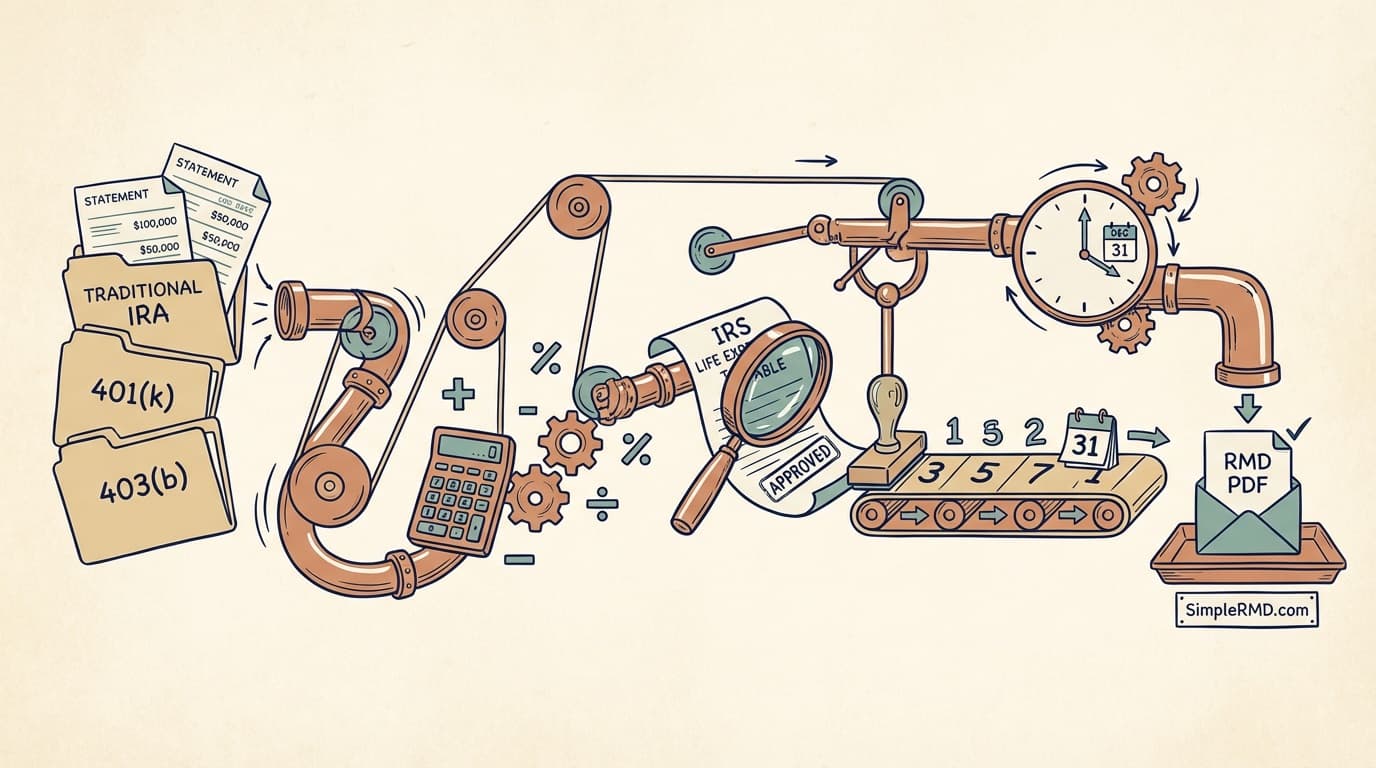
Knowing your Required Minimum Distribution (RMD) amount is only half the job. You also have to request it, choose how taxes are handled, and confirm the distribution actually cleared before December 31.
This page walks through each step in order.
Quick answer: Calculate your total RMD, decide which account(s) to take it from, contact your custodian (online or by phone), choose your withholding, and verify the distribution posts before year-end. Most custodians process same-day or next-day for online requests.
On this page
- Step 1: Calculate your total RMD
- Step 2: Decide which account to take it from
- Step 3: Contact your custodian
- Step 4: Choose your withholding
- Step 5: Confirm the distribution cleared
- Step 6: Keep a record
- Timing: when to start
- A worked example
- Common questions
Step 1: Calculate Your Total RMD
Before you contact anyone, know the number.
Your RMD is calculated using your prior year-end account balance and the factor from the IRS Uniform Lifetime Table for the age you'll be at the end of the distribution year. If you have multiple Traditional, Rollover, SEP, or SIMPLE IRAs, calculate each separately and add them together for an aggregated total.
The SimpleRMD calculator handles this across multiple accounts — free, no signup required.
If your custodian sends you a notice in January, use it as a cross-check — not the primary source. See why →
You can also take your RMD in installments — monthly, quarterly, or in a lump sum — as long as the total amount distributed by December 31 meets your annual requirement.
Step 2: Decide Which Account to Take It From
For Traditional, Rollover, SEP, and SIMPLE IRAs, you have flexibility.
You can take your total RMD from any one account, or split it across multiple accounts — as long as the combined total meets your requirement. You don't have to take a separate distribution from each IRA.
Common approaches:
| Approach | When it makes sense |
|---|---|
| Take it all from one account | Simplest to track; good if one account is large |
| Split across accounts | If you want to draw down multiple accounts evenly |
| Take from the account you want to spend | Avoids a separate transfer step |
Have a 401(k) or workplace plan? 401(k) RMDs cannot be aggregated with IRA RMDs. Each 401(k) must satisfy its own requirement separately — you can't cover it by taking extra from an IRA. See 401(k) RMD rules →
Roth IRAs have no lifetime RMD requirement. You're not required to take distributions from your own Roth IRA during your lifetime. Inherited Roth IRAs follow different rules. See Roth IRA rules →
Step 3: Contact Your Custodian
Most custodians offer three ways to request a distribution:
Online (fastest). Log into your account and look for "Distributions," "Withdrawals," or "RMD Center." You'll enter the amount, destination, and withholding preference. Most process same-day or next business day.
By phone. Call your custodian's main line and ask to speak with the distributions team. Have your account number and target amount ready. Processing time varies — typically 1–3 business days.
By form. Some custodians require a paper or PDF distribution request form, especially for first-time distributions or large amounts. Allow 5–10 business days after submission.
If the distribution is going to a bank account via ACH, add 1–5 business days on top of the custodian's processing time for the transfer to settle.
Don't wait until late December. Custodians get backed up in the final two weeks of the year. A request submitted December 28 may not post until January — which means a missed deadline. See processing time guidance →
Step 4: Choose Your Withholding
When you request a distribution, your custodian will ask how much federal (and possibly state) income tax to withhold.
Your RMD is taxable income. Withholding isn't required, but it helps you avoid a large tax bill — or underpayment penalties — at filing time.
Default withholding is 10% federal. You can increase it, decrease it, or waive it entirely (by electing 0%). Whatever you choose, the full RMD amount — including any withheld taxes — counts toward satisfying your requirement.
State withholding rules vary. Check your custodian's options for your state, or ask your accountant what's appropriate.
If you're unsure what to withhold: Ask your accountant before the distribution goes out. This is one place where a quick conversation is worth it.
For a deeper look at how RMDs are taxed: How much tax will I owe on my RMD? →
Step 5: Confirm the Distribution Cleared
Don't assume the distribution went through. Verify it.
Log into your account after the expected processing date and confirm:
- The correct dollar amount was distributed
- It came from the intended account(s)
- The transaction is dated on or before December 31
If you requested a transfer to a bank account, confirm it arrived and that the transaction is labeled as a "distribution" — not a "transfer" or "rollover."
Step 6: Keep a Record
Your custodian will issue a Form 1099-R in January showing the distribution amount. Hold onto it for your tax return.
It's also worth keeping a simple note — even a screenshot — showing:
- The amount you calculated
- Which account(s) you took it from
- The date the distribution posted
Your accountant will thank you. And if you're ever questioned by the IRS, you have documentation.
Timing: When to Start
Earlier is better — but how early depends on your situation.
| Timeline | What to do |
|---|---|
| January–February | Gather year-end statements, calculate your RMD |
| March–October | Any time works — low custodian volume, easy processing |
| November | Good target for most people — enough buffer for issues |
| December 1–15 | Still fine, but don't delay further |
| December 16–31 | Risk zone — processing delays can cause a missed deadline |
First RMD only: If this is your first RMD year — the year you turn 73 — you may delay that first distribution until April 1 of the following year. Be aware: if you delay, you'll owe two RMDs in the same calendar year (your delayed first RMD plus the current year's). Talk to your accountant about whether the delay makes sense for your situation. See first-year rules →
A Worked Example
Robert is 74 and taking his 2026 RMD. He has two Traditional IRAs:
| Account | Dec. 31 Balance | IRS Factor (age 74) | RMD |
|---|---|---|---|
| Fidelity IRA | $240,000 | 25.5 | $9,412 |
| Vanguard IRA | $60,000 | 25.5 | $2,353 |
| Total | $300,000 | $11,765 |
Robert decides to take the full $11,765 from his Fidelity account — simpler to track, and he's been drawing it down intentionally.
In October, he logs into Fidelity, requests an $11,765 distribution, elects 15% federal withholding, and directs the net amount to his checking account. The transaction posts in two business days.
In November, he logs back in to confirm the distribution shows on his account statement dated October. He screenshots it and files it with his tax documents.
In January, Fidelity sends a Form 1099-R showing $11,765 in distributions. His Vanguard account sends one showing $0 — which is correct, because he satisfied the full requirement from Fidelity.
Common Questions
Can I take more than my RMD?
Yes. The RMD is a minimum — you can always withdraw more. The excess is taxable but won't reduce next year's RMD requirement.
Can I reinvest my RMD?
Not back into a tax-advantaged account. Once the money comes out, it can go into a taxable brokerage account, a bank account, or anywhere else — but it can't be returned to an IRA or 401(k) as a contribution.
What if I take the wrong amount?
If you take too little, the shortfall is subject to a 25% excise tax. That penalty drops to 10% if you correct it within the allowed window — generally by taking the missed amount promptly and filing Form 5329 with a reasonable cause explanation. See the IRS waiver process →
If you take too much, the excess is taxable — but there's no penalty.
Can my spouse's RMD satisfy mine?
No. Each person calculates their own RMD based on their own accounts and their own age. A spouse's distribution cannot count toward yours.
Can my RMD go directly to charity?
Yes — this is called a Qualified Charitable Distribution (QCD). If you're 70½ or older, you can send up to $111,000 (2026 limit, indexed annually) directly from your IRA to a qualified charity. The amount counts toward your RMD and is excluded from taxable income. The check must go directly from your custodian to the charity — you cannot take possession of the funds first. Married couples can each make a QCD up to the annual limit from their own IRAs.
What to do next
- Run the calculator → — calculate your RMD before you call your custodian
- Is this calculator accurate? → — how SimpleRMD validates against IRS tables
- RMD deadlines and penalties → — what happens if the distribution doesn't clear in time
- How much tax will I owe? → — withholding guidance
- Does my accountant calculate my RMD? → — who's responsible for what
- Back to RMD basics →
This page is for informational purposes only and does not constitute tax, legal, or financial advice. IRS rules are subject to change. Consult a qualified tax professional for guidance specific to your situation. Rules confirmed current as of April 2026 per IRS Publication 590-B (2025).