

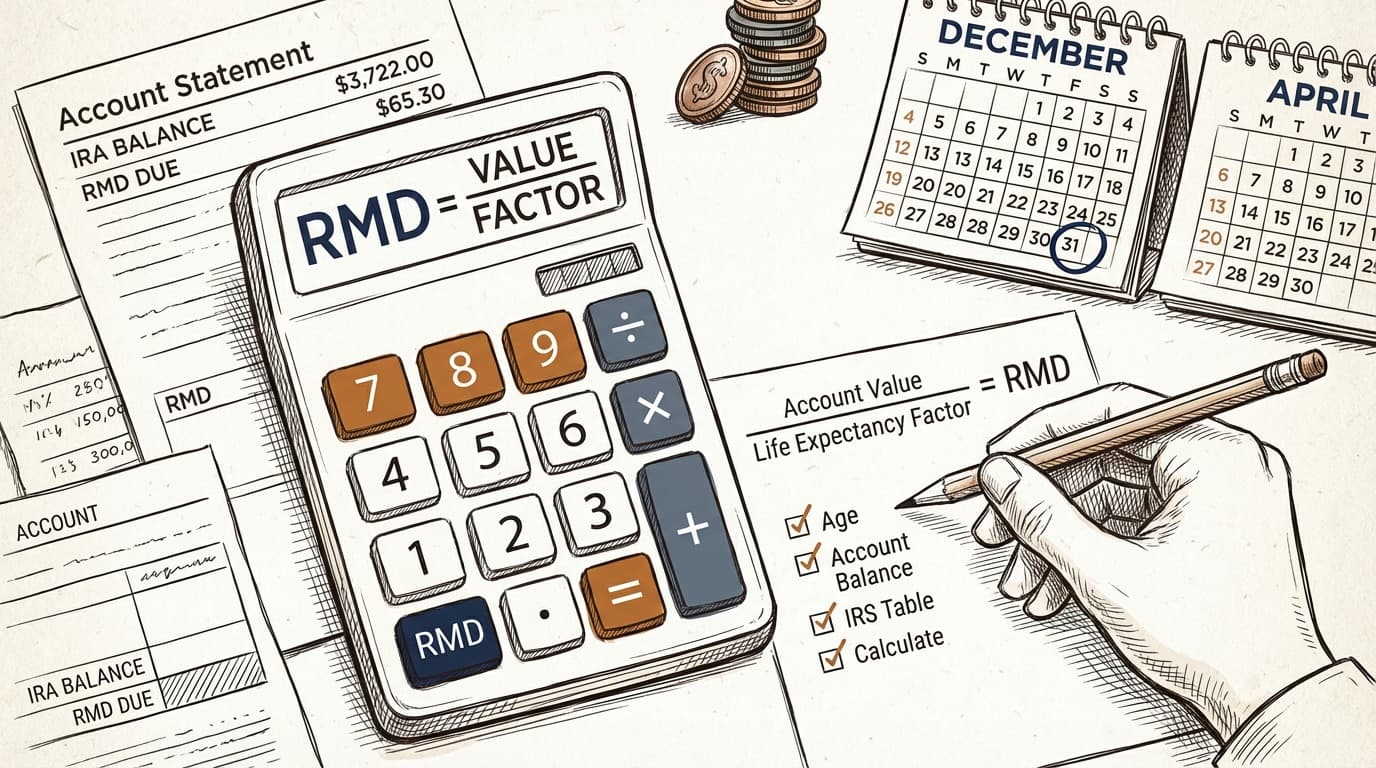
In short: Your RMD equals your prior year-end account balance (December 31) divided by your IRS life expectancy factor. Find the factor by looking up your age (as of December 31 of the distribution year) in the appropriate IRS table from Publication 590-B. Most people use the Uniform Lifetime Table. The whole calculation takes about two minutes once you have your balance.
On this page
- The Formula
- What You Need Before You Start
- Five Steps to Your RMD
- Example: Linda's Standard RMD
- Example: Younger Spouse (Joint Life Table)
- Example: Inherited IRA
- Multiple Accounts: Calculate Separately, Then Decide Where to Withdraw
- After You Have the Number
- Common Calculation Mistakes
- Frequently Asked Questions
Calculating a Required Minimum Distribution is one division problem. The formula is not complicated. What trips people up is gathering the right inputs and making sure they match — the right balance, from the right date, divided by the right factor, from the right table.
This page walks through the entire process from start to finish, with worked examples you can follow along with using your own numbers. If you'd rather skip the manual math, the SimpleRMD calculator handles all of this — free, no account required.
The Formula
Every RMD — for every account type, every age, every situation — uses this formula:
RMD = Prior year-end balance (Dec. 31) ÷ IRS life expectancy factor
The balance is a number you already have (or can get from your custodian). The factor comes from one of three IRS tables. That's the entire calculation.
What You Need Before You Start
You need two things. That's it.
1. Your account balance as of December 31 of the prior year.
This is the total fair market value of the account on the last day of the previous year. For your 2026 RMD, you need the balance from December 31, 2025.
Where to find it: your year-end account statement, your custodian's online portal, or Form 5498 (which your custodian sends to the IRS and may share with you, typically by January 31 or May 31).
If you have multiple accounts, you need the December 31 balance for each one. More on that below.
2. Your age as of December 31 of the distribution year.
Not your current age — your age on December 31 of the year you're calculating for. If you're calculating your 2026 RMD and you turn 77 in October 2026, your age for this calculation is 77, even if you take the distribution in March when you're still 76.
That's all you need for a standard RMD. If your sole beneficiary is your spouse and they're more than 10 years younger, you'll also need their age as of December 31. If you inherited the account, you'll need a few additional details — see the inherited IRA example below.
For the full checklist of inputs for every scenario: What information do you need to calculate your RMD?
Five Steps to Your RMD
Step 1: Get your prior year-end balance
Pull up the December 31 balance for the account. Use the total fair market value — not the cost basis, not a current balance, not an estimate. If you're looking at a statement dated late December, make sure it reflects the December 31 close, not an earlier date.
Step 2: Determine your age as of December 31
Use the age you will be on December 31 of the year you're calculating for. This is the age that drives the factor lookup.
Step 3: Identify the correct IRS table
Three tables, one choice:
| Your Situation | Use This Table |
|---|---|
| Own the account; spouse is not sole beneficiary or is less than 10 years younger | Uniform Lifetime Table (Table III) |
| Own the account; sole beneficiary is spouse who is more than 10 years younger | Joint Life and Last Survivor Table (Table II) |
| Inherited the account | Single Life Expectancy Table (Table I) |
Not sure? The Uniform Lifetime Table is correct for most people. For a detailed walkthrough of each table with representative factors: IRS RMD tables explained
Step 4: Look up your factor
Find your age in the table and read the corresponding life expectancy factor. For the Joint Life Table, find the intersection of your age and your spouse's age.
Here are the Uniform Lifetime factors for common ages:
| Age (as of Dec. 31) | Factor |
|---|---|
| 73 | 26.5 |
| 74 | 25.5 |
| 75 | 24.6 |
| 76 | 23.7 |
| 77 | 22.9 |
| 78 | 22.0 |
| 79 | 21.1 |
| 80 | 20.2 |
| 81 | 19.4 |
| 82 | 18.5 |
| 83 | 17.7 |
| 84 | 16.8 |
| 85 | 16.0 |
For the full table (ages 72–120+) and all three IRS tables, see RMD tables explained.
Step 5: Divide
Balance ÷ factor = your RMD.
That's the minimum amount you must withdraw from this account by December 31 of the distribution year. You can always take more. You cannot take less without triggering a penalty.
Example: Linda's Standard RMD
Linda is 78 years old — she turns 79 in August 2026. She has one Traditional IRA. Her December 31, 2025, balance was $295,000. Because Linda will be 79 on December 31, 2026, that's the age she uses for the factor lookup.
| Step | Detail |
|---|---|
| Balance (Dec. 31, 2025): | $295,000 |
| Age on Dec. 31, 2026: | 79 |
| Table: | Uniform Lifetime (Table III) |
| Factor at age 79: | 21.1 |
| RMD: $295,000 ÷ 21.1 = | $13,981 |
Linda must withdraw at least $13,981 by December 31, 2026.
She calls her custodian in September, requests a distribution of $14,000 (slightly above the minimum), chooses 15% federal tax withholding, and has the remaining amount deposited to her checking account. Done for the year.
SimpleRMD calculator showing Linda's inputs and resulting RMD
Want to see your number? Try the SimpleRMD calculator — free, no signup required.
Example: Younger Spouse (Joint Life Table)
Frank is 81 and his sole beneficiary is his wife, Diane, who is 68. Both ages are as of December 31, 2026. Frank has a Traditional IRA with a December 31, 2025, balance of $510,000.
Because Diane is Frank's sole beneficiary and she is more than 10 years younger, Frank uses the Joint Life and Last Survivor Table (Table II).
| Step | Detail |
|---|---|
| Balance (Dec. 31, 2025): | $510,000 |
| Frank's age on Dec. 31, 2026: | 81 |
| Diane's age on Dec. 31, 2026: | 68 |
| Table: | Joint Life (Table II) |
| Joint factor at 81/68: | 20.7 |
| RMD: $510,000 ÷ 20.7 = | $24,638 |
If Frank had used the Uniform Lifetime Table, his factor would have been 19.4, producing an RMD of $26,289. The Joint Life Table reduces his required distribution by about $1,651 this year.
The Joint Life Table only applies when the spouse is the sole beneficiary for the entire year and is more than 10 years younger. If Frank names his children as co-beneficiaries — even alongside Diane — he reverts to the Uniform Table.
Example: Inherited IRA
Jason, age 47, inherited a Traditional IRA from his father, Robert, who died in October 2024 at age 81. Robert had already been taking his own RMDs. The inherited IRA balance on December 31, 2025, was $340,000.
Jason is a designated beneficiary (adult child) subject to the 10-year rule. Because Robert had reached his required beginning date before death, Jason must take annual RMDs in years 1 through 9, with the full account emptied by the end of year 10.
Finding Jason's factor:
Jason's first RMD year is 2025 (the year after Robert's death). Jason was 46 in 2025. The Single Life Expectancy Table gives a factor of 40.0 at age 46. For 2026, Jason subtracts 1:
| Step | Detail |
|---|---|
| Balance (Dec. 31, 2025): | $340,000 |
| Table: | Single Life Expectancy (Table I) |
| Initial factor (age 46 in 2025): | 40.0 |
| 2026 factor (subtract 1): | 39.0 |
| 2026 RMD: $340,000 ÷ 39.0 = | $8,718 |
Jason must withdraw at least $8,718 by December 31, 2026. The entire inherited IRA must be empty by December 31, 2034.
Two important notes: Jason does not do a fresh table lookup at age 47 (that would give 39.0 — coincidentally the same in this case, but the method matters because it will diverge in future years if the factor-per-age progression isn't exactly 1.0 per year). And Jason cannot aggregate this inherited IRA RMD with RMDs from his own retirement accounts — inherited and owned accounts are separate.
For the full inherited IRA ruleset: Inherited IRA RMD rules · The 10-year rule explained
Multiple Accounts: Calculate Separately, Then Decide Where to Withdraw
If you have more than one retirement account, you must calculate the RMD for each account individually. But whether you can combine those withdrawals depends on the account type:
| Account Type | Calculate Separately? | Combine Withdrawals? |
|---|---|---|
| Multiple IRAs | Yes — each one | Yes — take the total from any one or more IRAs |
| Multiple 401(k)s | Yes — each one | No — must take from each plan individually |
| Multiple 403(b)s | Yes — each one | Yes — can combine across 403(b)s, but not with IRAs |
| Inherited IRAs | Yes — each one | No — cannot combine with your own IRA RMDs |
Example: Multiple IRAs
Diane has three Traditional IRAs:
| Account | Dec. 31, 2025 Balance | Age 75 Factor | RMD |
|---|---|---|---|
| IRA at Fidelity | $180,000 | 24.6 | $7,317 |
| IRA at Schwab | $95,000 | 24.6 | $3,862 |
| Rollover IRA at Vanguard | $225,000 | 24.6 | $9,146 |
| Total IRA RMD | $20,325 |
Diane owes $20,325 across her IRAs. She can take all $20,325 from the Fidelity account, split it between accounts, or take it in any combination — as long as the total distributed from her IRAs equals at least $20,325 by December 31.
If Diane also had a 401(k) from a former employer, that RMD would need to come from the 401(k) itself. She couldn't cover it by withdrawing extra from an IRA.
Related: RMD rules by account type
After You Have the Number
Once you know your RMD amount, here's what to do:
Contact your custodian. Call, go online, or submit a distribution request form. You'll specify the amount, any federal or state tax withholding, and where to send the funds (bank account, check, etc.). Most custodians can process this in a few business days, but during November and December, processing times can stretch. Don't wait until the last week.
Decide on withholding. Your custodian will ask how much federal tax to withhold. The default is often 10%, but your actual tax rate may be higher or lower. This is a conversation for your tax professional — the withholding choice doesn't change your RMD amount, but it affects your cash flow and whether you'll owe at tax time.
Keep a record. Save the confirmation of your distribution. If you're taking multiple withdrawals throughout the year, track your running total — the combined amount must meet or exceed your RMD by December 31. If you use SimpleRMD's paid plan, you can export a CPA-ready PDF showing the inputs, the math, and the result — useful at tax time and for your own records.
Mark next year's calendar. Your RMD recalculates every year based on a new balance and a new (smaller) factor. The deadline is December 31 — no extensions.
Related: RMD deadline: December 31 · What happens if you miss an RMD
Common Calculation Mistakes
Using the wrong balance. Your RMD is based on the December 31 balance of the prior year — not the current balance, not the balance when you take the distribution. Markets move. The number that matters is the one from last December 31.
Using the wrong age. This is the one we see most often. The IRS uses your age as of December 31 of the distribution year. If you turn 78 in November but take your RMD in June, your factor is based on age 78, not 77.
Using the wrong table. The Uniform Lifetime Table is the default. Use the Joint Life Table only if your sole beneficiary is a spouse more than 10 years younger. Use the Single Life Table only for inherited IRAs. Using the wrong table means the wrong factor — and an under-distribution triggers the same penalty as a missed RMD.
Forgetting to calculate each account separately. Even though you can aggregate IRA withdrawals, you must still calculate the RMD for each IRA individually first. We built the multi-account logic specifically because we kept seeing this one — people add their balances together and divide once, which gives you the wrong number if any account has different rules (like an inherited IRA mixed in).
Using pre-2022 factors. The IRS updated all three life expectancy tables effective January 1, 2022. Older references — spreadsheets, articles, even some broker tools that haven't been updated — may use the pre-2022 factors, which are smaller and produce larger RMDs. If your number doesn't match, check the publication date of whatever you're comparing against.
Frequently Asked Questions
What if this is my first year taking an RMD?
You get a one-time extension: your first RMD can be delayed until April 1 of the year after you reach age 73. But if you delay, you'll owe two RMDs in that second year — the delayed first one and the current year's. Both are taxable income. For most people, taking the first RMD in the year they turn 73 avoids this double-up. See: First-year RMD rules
Can I take my RMD in installments?
Yes. You can take a single lump distribution or spread it across multiple withdrawals throughout the year — monthly, quarterly, or any schedule you prefer. The only requirement is that the total distributed by December 31 equals or exceeds your RMD.
What if my account lost value this year?
Your RMD is based on last year's balance, not this year's. If the account dropped significantly, your RMD might feel disproportionate to the current value. Unfortunately, there is no adjustment — the IRS requires you to use the prior year-end balance regardless of what happened since.
Can I calculate my RMD before my custodian sends Form 5498?
Yes. Form 5498 isn't typically issued until May, which is well past the point where you'd want to plan. You can use your December 31 balance from your year-end account statement — that's the same number that will eventually appear on Form 5498. If you had any outstanding rollovers or recharacterizations in progress on December 31, those may require adjustment. For most people, the year-end statement is all you need.
What if I took too much? Does it reduce next year's RMD?
No. Excess withdrawals don't carry forward. If your 2026 RMD is $15,000 and you withdraw $25,000, the extra $10,000 does not reduce your 2027 RMD. Next year's calculation starts fresh with the new December 31 balance and the new factor.
Is there an easier way to do all of this?
That's why we built SimpleRMD. Enter your date of birth, your account balance, and a few details about your situation. The calculator selects the right table, looks up the right factor, and does the math — using the same IRS tables and same methodology described on this page.
Ready to run the numbers?
- Try the calculator — free, no account required
- IRS RMD tables explained
- Is this calculator accurate?
- RMD basics
This article is for informational purposes only and does not constitute tax, legal, or financial advice. IRS rules and tax laws are subject to change. Consult a qualified tax professional or financial advisor for guidance specific to your situation. SimpleRMD is a calculation and tracking tool — not a financial advisory service.
Sources: IRS.gov (Publication 590-B · Publication 590-B, PDF · Retirement Topics: RMDs). Life expectancy tables per T.D. 9930, effective January 1, 2022. Rules confirmed current as of February 2026.