

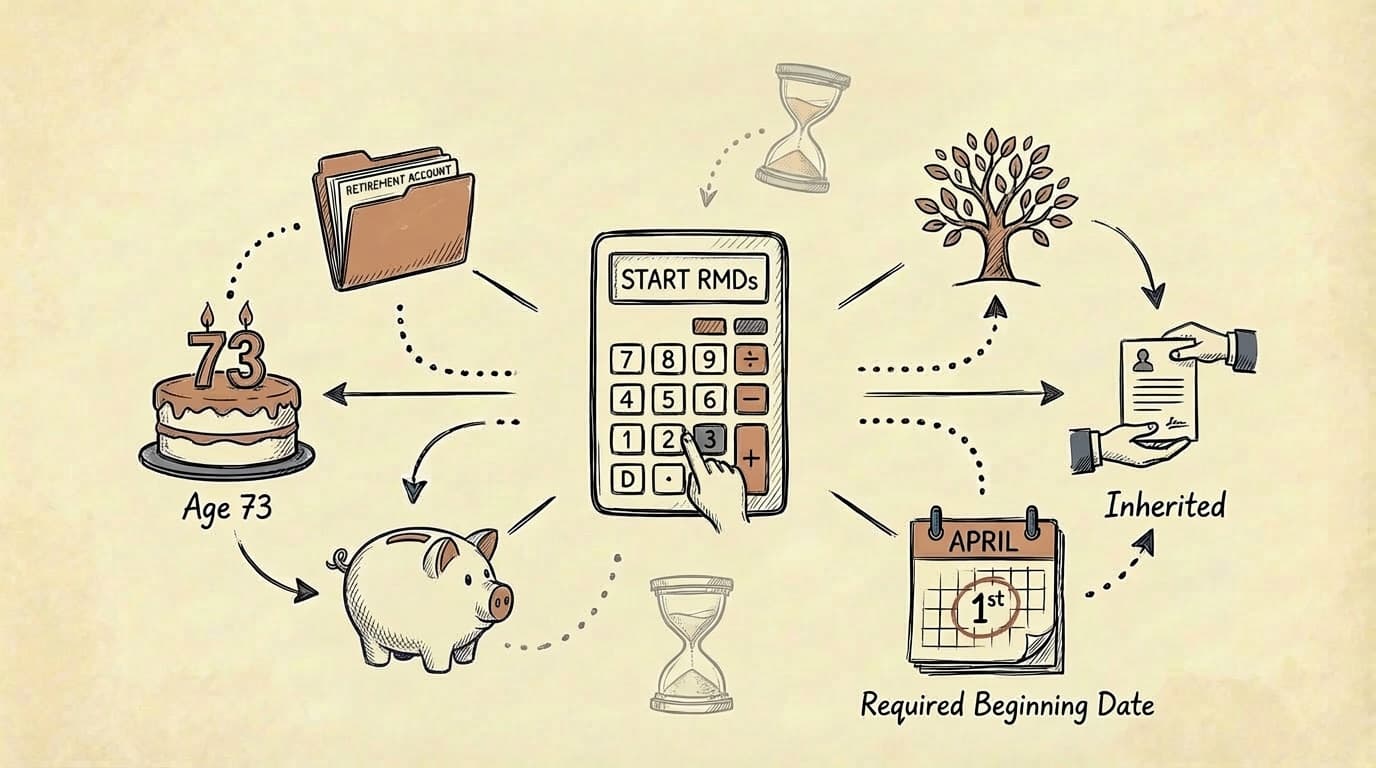
If you have a Traditional IRA, SEP IRA, SIMPLE IRA, or employer plan like a 401(k), Required Minimum Distributions begin at age 73 or 75, depending on when you were born. The SECURE 2.0 Act set these thresholds, and they're not changing again anytime soon. Your birth year determines everything — there's no election or opt-in.
This is the single most common question we get, and the answer is simpler than most people expect.
In short: Your RMD starting age is determined by your birth year — 73 if born 1951–1959, 75 if born 1960 or later. No one born 1960 or later needs to take an RMD yet — that window opens in 2035. The table below shows exactly when you start.
On this page
- Your Starting Age by Birth Year
- The First-Year Delay — and Why It's Usually a Trap
- The Still-Working Exception
- What About Roth Accounts?
- Inherited IRAs: Different Starting Rules
- What to Do Next
Your Starting Age by Birth Year
The SECURE Act of 2019 raised the RMD starting age from 70½ to 72. Then SECURE 2.0 (2022) raised it again — in two steps:
| Birth Year | RMD Starting Age | First Possible RMD Year | First RMD Due By |
|---|---|---|---|
| 1950 or earlier | 72 (already started) | 2022 or earlier | Already past |
| 1951–1959 | 73 | 2024–2032 | April 1 of the year after turning 73* |
| 1960 or later | 75 | 2035+ | April 1 of the year after turning 75* |
*This is the latest possible date for your first RMD only. All subsequent RMDs are due by December 31 each year. For 2026: if you were born 1951–1953 and haven't started, your RMDs are already in progress. Born 1953? You turned 73 in 2026 — first RMD is for 2026, with the option to delay until April 1, 2027. No one born 1960 or later owes an RMD until 2035 at the earliest.
Your RMD Starting Age — 72 (born 1950 or earlier, already started), 73 (born 1951–1959), 75 (born 1960 or later). Plus still-working decision fork.
"Starting age" means the year you turn that age. If you turn 73 in October 2026, your first RMD is for the 2026 tax year — regardless of your actual birthday within the year.
There is no partial-year proration. Your first RMD covers the full year, calculated using your December 31 prior-year account balance divided by the IRS life expectancy factor for your age on December 31 of the distribution year.
For details on how the math works: How to calculate your RMD
Source: SECURE 2.0 Act of 2022, Section 107
The First-Year Delay — and Why It's Usually a Trap
The IRS gives you a one-time option: you can delay your very first RMD until April 1 of the year after you reach your starting age. This is called the "required beginning date."
It sounds generous. In practice, it creates a problem.
If you delay your first RMD into the following year, you'll owe two distributions in that second year — the delayed first-year RMD (due by April 1) and the current year's RMD (due by December 31). Both count as taxable income in the same calendar year.
Worked Example
Robert turns 73 in August 2026. His Traditional IRA balance on December 31, 2025 was $420,000.
| Option A: Take in 2026 | Option B: Delay to 2027 | |
|---|---|---|
| 2026 taxable RMD income | $17,721 (one RMD) | $0 |
| 2027 taxable RMD income | ~$17,200 (one RMD) | ~$34,900 (two RMDs) |
| Risk | None | Could push into a higher bracket in 2027 |
The delay doesn't reduce the total amount you owe — it just stacks two distributions into one tax year. For many people, taking the first RMD in the year they turn 73 is the better move. But it depends on your income situation that year, so this is a good question for your CPA.
Beyond the bracket jump, the double-up can also trigger higher Medicare Part B and Part D premiums through IRMAA (Income-Related Monthly Adjustment Amount), which uses a two-year look-back. A single high-income year can mean higher premiums for two years afterward.
Delay your first RMD? Two taxable distributions in one year — often pushes you into a higher bracket and can increase Medicare surcharges.
I've seen people choose the delay thinking they're saving money, then get surprised by the bracket jump the following April. It's one of those rules that sounds like a favor but often isn't.
For a deeper look at first-year timing: First-year RMD rules
The Still-Working Exception
If you're past your RMD starting age but still employed, you may be able to delay RMDs from your current employer's retirement plan — but only under specific conditions.
The still-working exception applies when all of the following are true:
- You're still actively working for the employer that sponsors the plan
- The plan is a 401(k), 403(b), or similar qualified employer plan (not an IRA)
- You do not own 5% or more of the business
- The plan document itself permits this delay (not all plans do)
If you qualify, RMDs from that specific plan are deferred until April 1 of the year after you retire. But this exception is narrower than most people realize:
| Account Type | Still-Working Exception? |
|---|---|
| Current employer's 401(k)/403(b) | Yes — if plan allows and you're under 5% owner |
| Traditional IRA | No — RMDs start on schedule regardless of employment |
| Previous employer's 401(k) | No — only your current employer's plan qualifies |
| SEP or SIMPLE IRA | No — IRA rules apply |
If you have both a current 401(k) and IRAs from previous employers, you'd delay the 401(k) RMD but still take RMDs from the IRAs on schedule. These are separate buckets — the exception only applies to your current employer's plan. Former 401(k)s require RMDs regardless of your employment status.
Important: Check your plan document or call HR. Some employer plans require distributions at the RMD starting age regardless of employment status. The exception is permitted by law, but the plan has to adopt it.
Source: IRS — Retirement Topics: Required Minimum Distributions
What About Roth Accounts?
Roth IRAs do not require RMDs during the original owner's lifetime. No starting age, no distributions required. This is one of the key differences between Traditional and Roth IRAs.
Roth 401(k) and Roth 403(b) accounts are also now exempt from lifetime RMDs, thanks to SECURE 2.0 (effective starting in 2024). Previously, designated Roth accounts in employer plans did require RMDs — that rule was eliminated.
However, if someone inherits any Roth account — IRA or employer plan — RMD rules apply to the beneficiary. Inherited Roth accounts are still subject to the 10-year rule (for most non-spouse beneficiaries), even though the original owner had no lifetime RMD requirement. See: Roth IRA RMD rules
Inherited IRAs: Different Starting Rules
If you inherited an IRA, the rules above don't apply to you. Inherited IRA distribution requirements are based on when the original owner died, whether they had started RMDs, and your relationship to the owner — not your own age.
Most non-spouse beneficiaries who inherited after 2019 are subject to the 10-year rule. See: Inherited IRA RMD rules · The 10-year rule explained
What to Do Next
- Ready to check your number? Enter your birth year and account balance. The calculator shows whether you owe an RMD this year and how much. Free, no account required.
- How RMDs are calculated — the formula, the tables, and a worked example.
- RMD basics overview — the full picture: who, when, how much, and what happens if you miss one.
This article is for informational purposes only and does not constitute tax, legal, or financial advice. IRS rules and tax laws are subject to change. Consult a qualified tax professional or financial advisor for guidance specific to your situation. SimpleRMD is a calculation and tracking tool — not a financial advisory service.
Sources: IRS.gov (Retirement Topics: RMDs, Publication 590-B (PDF), Publication 590-B (HTML)). SECURE 2.0 Act of 2022, Section 107 (Pub. L. 117-328). Rules confirmed current as of February 2026 per IRS Pub 590-B (2025).