

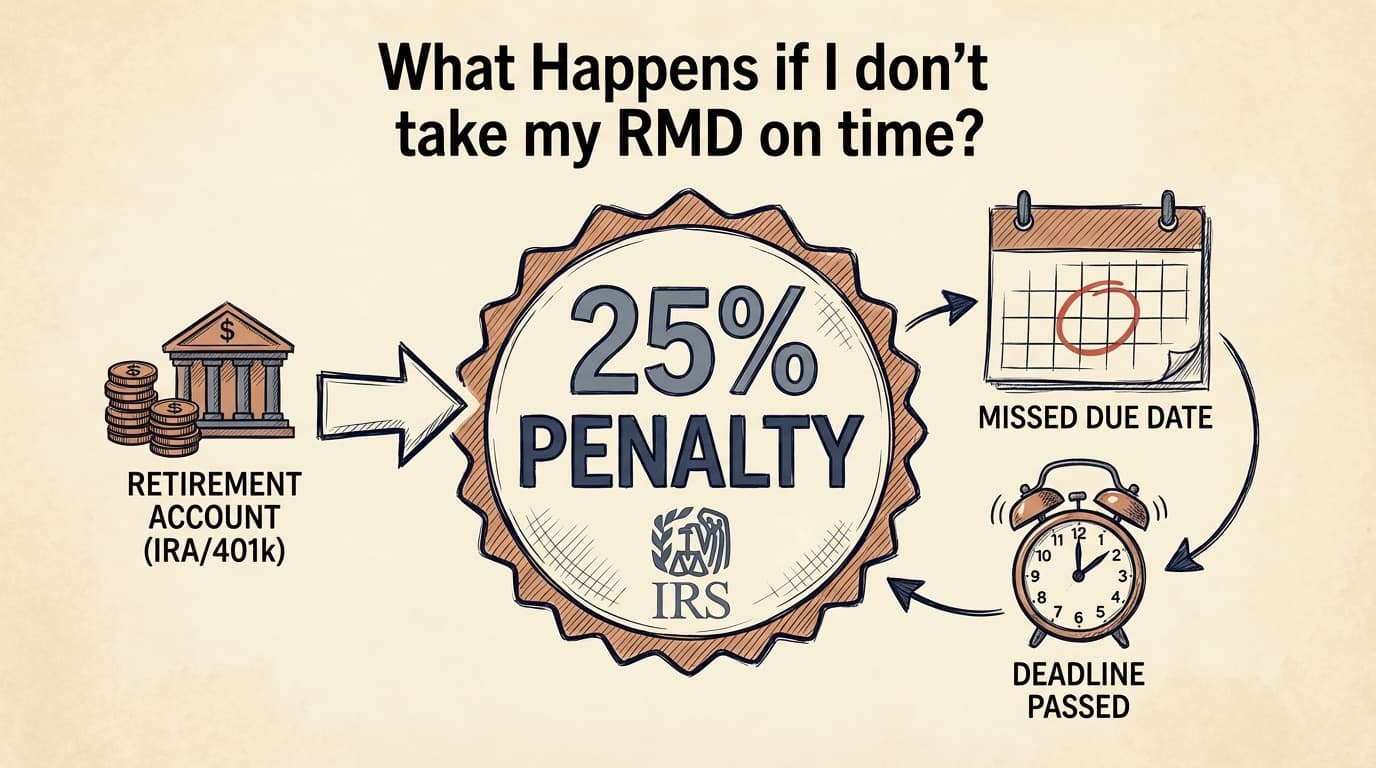
In short: The penalty for a missed or insufficient RMD is 25% of the shortfall — not 25% of your account balance. It drops to 10% if corrected within two years, and the IRS can waive it to $0 with a reasonable cause explanation on Form 5329. The most important first step: take the missed distribution as soon as possible.
On this page
- The Penalty: What You're Actually Facing
- How the Math Works: A Real Example
- Common Scenarios (and How to Correct Each One)
- Inherited IRA Penalties: What Changed in 2025
- How to Fix a Missed RMD
- What to Do Next
If you miss a Required Minimum Distribution — or don't withdraw enough — the IRS charges a 25% excise tax on the amount you should have taken but didn't. That sounds harsh, and it is. But the penalty is almost always reducible, and in many cases the IRS will waive it entirely if you correct the mistake promptly and explain what happened.
The worst thing you can do is nothing. The second-worst thing is to panic. Here's what you're actually facing — and how to fix it.
Penalty tier staircase showing 25% uncorrected, 10% corrected within 2 years, and $0 with reasonable cause waiver, plus the correction path
The Penalty: What You're Actually Facing
The excise tax applies only to the shortfall — the difference between what you were required to withdraw and what you actually took. If you withdrew some of your RMD but not all of it, you're penalized on the gap, not the full amount.
| Situation | Penalty |
|---|---|
| Missed or insufficient RMD (uncorrected) | 25% excise tax on the shortfall |
| Corrected within 2 years | Reduced to 10% — automatic, no waiver needed |
| Reasonable cause waiver approved | $0 — IRS waives the penalty entirely |
The 25% rate was reduced from 50% by the SECURE 2.0 Act, effective for tax years beginning in 2023. If you're reading older articles or forum posts that mention a 50% penalty, that rate no longer applies.
The two-year correction window works like this: if your RMD deadline was December 31, 2025, you have until December 31, 2027, to take the missed distribution and qualify for the automatic reduction to 10%. But most people don't want to pay 10% either — and the full waiver path is more straightforward than you'd expect. More on that below.
How the Math Works: A Real Example
Linda is 76. Her Traditional IRA had a balance of $420,000 on December 31 of last year. Using the Uniform Lifetime Table, her life expectancy factor is 22.0, which makes her RMD $19,091.
Linda forgot. She didn't take any distribution by December 31.
Here's what she's facing:
| Scenario | Penalty Amount |
|---|---|
| Does nothing | $4,773 (25% of $19,091) |
| Takes the $19,091 within two years | $1,909 (10% of $19,091) |
| Takes the $19,091 and files Form 5329 with reasonable cause | $0 (if the IRS approves the waiver) |
The penalty is real — but it's $4,773, not $105,000 (which is what 25% of her account balance would be). That distinction matters, and it's where most of the panic comes from. People hear "25% penalty" and assume it applies to everything.
Linda's best move: take the distribution immediately, then file Form 5329 with a short explanation of what happened. If her reason is legitimate and the correction is prompt, the IRS will very likely waive the penalty in full.
Not sure what your RMD amount is? Run the calculator — it's free and requires no account.
Common Scenarios (and How to Correct Each One)
Not every missed RMD looks the same. Here are the situations we see most often and what to do about each.
You forgot entirely
This is the most common scenario — and the most forgivable. Life gets busy, a December deadline slips past, and suddenly it's January. Take the full distribution as soon as you realize the error. This is exactly the kind of situation the IRS routinely waives.
You took too little
Maybe you used last year's balance instead of the correct one, or your custodian's estimate was off. The penalty applies only to the shortfall. Withdraw the difference, and file Form 5329 for the gap amount.
You missed multiple years
This is more serious, but still correctable. You'll need to take each missed distribution separately and file a separate Form 5329 for each year you missed. Reasonable cause letters for multi-year misses are stronger when the explanation is consistent across years — an ongoing health issue, a multi-year misunderstanding about inherited IRA rules, or reliance on incorrect professional advice. This is a situation where working with a CPA is worth it.
Your custodian didn't process it in time
You requested the distribution before the deadline, but your broker didn't execute it until January. This happens more than it should, especially in November and December when custodians are processing high volumes. Keep documentation — the date you submitted the request, confirmation numbers, any correspondence. Custodian delays are a well-established reasonable cause.
You didn't know RMDs were required
First-year retirees sometimes don't realize they have an RMD obligation, especially if their custodian doesn't send a reminder. "I didn't know" isn't a guaranteed waiver — but combined with a prompt correction, it's a common one. If this is your first year, see: First-year RMD rules
Inherited IRA Penalties: What Changed in 2025
If you inherited an IRA from someone who died after 2019, this section matters.
From 2021 through 2024, the IRS waived penalties for beneficiaries who were subject to the 10-year rule but didn't take annual distributions during those years. The rules were genuinely unclear — the IRS itself took until July 2024 to finalize the regulations — and the penalty relief reflected that.
That grace period is over. Starting with distributions due in 2025, the standard 25% excise tax applies to missed inherited IRA RMDs. The key question is whether the original account owner had already reached their required beginning date (RBD) — meaning they had started, or were required to start, taking their own RMDs — before they died. If they had, you are generally required to take annual distributions in years 1 through 9, with the account fully emptied by year 10. If the owner died before their RBD, annual distributions are not required, but the 10-year deadline is firm.
If you've been skipping annual distributions and the original owner died after their RBD, the missed amounts are now subject to the same 25%/10% penalty structure described above. For the waiver process, see: How to request an IRS waiver
If you're an inherited IRA beneficiary and haven't been taking annual distributions, now is the time to check whether you're required to. The inherited IRA RMD rules page walks through the full decision tree, including which beneficiaries are exempt. The 10-year rule explained covers the annual distribution requirement in detail.
Inherited IRA? Calculate your required distribution — free, no account required.
How to Fix a Missed RMD
The correction process is the same regardless of the scenario:
Step 1: Take the distribution. Contact your custodian and withdraw at least the shortfall amount. The sooner you correct it, the stronger your case for a waiver.
Step 2: File Form 5329. This is the form where you report the missed RMD and request penalty relief. You'll enter $0 on the penalty line and attach a short letter explaining what happened and what you've done to fix it. The IRS reviews the explanation and either accepts it silently (no penalty assessed) or sends a notice if they disagree.
If you've already filed your tax return for the year in question, you'll need to submit an amended return (Form 1040-X) with Form 5329 attached.
For the complete filing walkthrough — including what to put in your letter and when to involve a CPA — see: IRS waiver for a missed RMD
Source: IRS — Retirement Plan and IRA RMD FAQs
Remind me in November
We'll send one reminder in November. No newsletters.
You can unsubscribe anytime.
What to Do Next
- Run the calculator — free, no account required. Confirm what your RMD should have been (and what it is this year).
- How to request an IRS waiver — step-by-step Form 5329 walkthrough with letter template.
- RMD deadlines and penalties — full overview of deadlines, penalty tiers, and how to stay on track.
- Set up a November reminder — one email, once a year, so this doesn't happen again.
This article is for informational purposes only and does not constitute tax, legal, or financial advice. IRS rules and tax laws are subject to change. Consult a qualified tax professional or financial advisor for guidance specific to your situation. SimpleRMD is a calculation and tracking tool — not a financial advisory service.
Sources: IRS.gov (Publication 590-B, Form 5329 Instructions, Form 5329 PDF, RMD FAQs, Notice 2024-35). SECURE 2.0 Act of 2022 (Pub. L. 117-328). IRS Final Regulations T.D. 10001 (July 2024). Rules confirmed current as of February 2026.