

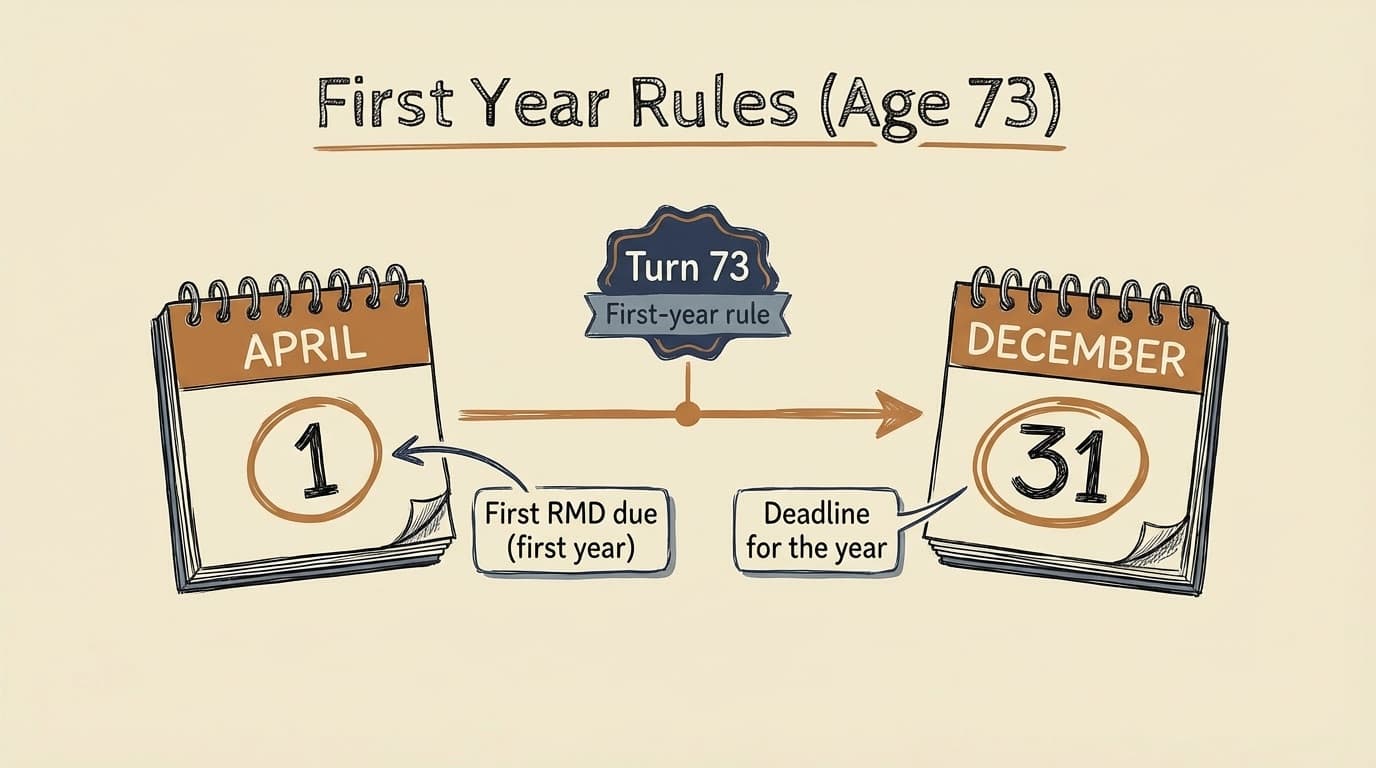
In short: You can delay your first RMD until April 1 of the year after you reach your starting age. But if you delay, you'll owe two RMDs in that second year — both taxable. For most people, taking the first RMD in the year they turn 73 avoids the problem entirely.
On this page
- The April 1 Rule: What It Actually Means
- The Double-Up: Two RMDs in One Year
- Worked Example: Take It Now vs. Delay
- When Delaying Might Make Sense
- Downstream Effects Beyond the Tax Bracket
- What to Do Next
Your first Required Minimum Distribution gets a special deadline: instead of the usual December 31, you can delay it until April 1 of the following year. The IRS calls this your "required beginning date." It sounds like a courtesy, but for most people it creates more problems than it solves — because your second RMD is still due by December 31 of that same year. That's two taxable distributions in one calendar year.
This is the most common first-year mistake we see, and it's almost always avoidable once you see the math.
Your First-Year Timeline — Option A: Take RMD by Dec 31 (one per year) vs. Option B: Delay to April 1 (two RMDs in one year).
The April 1 Rule: What It Actually Means
In most years, your RMD is due by December 31. No extensions, no exceptions. But for your very first RMD — and only your first — the IRS extends the deadline to April 1 of the following year.
This extended deadline is called the "required beginning date" (RBD). It applies once, in the year you reach your RMD starting age:
| Birth Year | Starting Age | First RMD For | Required Beginning Date |
|---|---|---|---|
| 1951–1959 | 73 | The year you turn 73 | April 1 of the year after |
| 1960 or later | 75 | The year you turn 75 | April 1 of the year after |
After your required beginning date passes, every future RMD is due by December 31. The April 1 extension never applies again.
For a full breakdown of starting ages: When do RMDs start?
The Double-Up: Two RMDs in One Year
Here's where the April 1 option gets costly. If you delay your first RMD into the following year, you don't eliminate the second year's RMD — you stack them.
Year 1 (the year you turn 73): No distribution taken. You've elected to delay.
Year 2: Two distributions are due — your delayed first RMD (by April 1) and your current-year RMD (by December 31). Both are included in your taxable income for Year 2.
The IRS doesn't spread this over two tax years. Both distributions land in the same calendar year, on the same tax return, pushing your total income higher than it would have been if you'd simply taken one RMD per year.
Worked Example: Take It Now vs. Delay
Patricia turns 73 in July 2026. She has a Traditional IRA with a balance of $380,000 on December 31, 2025. Her Uniform Lifetime Table factor at age 73 is 26.5.
2026 RMD: $380,000 ÷ 26.5 = $14,340
Assume her IRA balance on December 31, 2026 is $372,000 and her factor at age 74 is 25.5.
2027 RMD: $372,000 ÷ 25.5 = $14,588
| Option A: Take First RMD in 2026 | Option B: Delay to April 1, 2027 | |
|---|---|---|
| 2026 taxable RMD income | $14,340 | $0 |
| 2027 taxable RMD income | $14,588 | $28,928 (both RMDs) |
| Highest single-year RMD income | $14,588 | $28,928 |
| Total RMD income (2026–2027) | $28,928 | $28,928 |
The total amount withdrawn is identical. The difference is timing — Option B concentrates all of it into 2027, which can push Patricia into a higher marginal tax bracket that year.
Source: IRS Publication 590-B — Uniform Lifetime Table
When Delaying Might Make Sense
The delay isn't always wrong. There are a few situations where it could work in your favor:
- Unusually high income in the starting year. If you're receiving a large pension payout, selling a property, or realizing capital gains in the year you turn 73, adding an RMD on top could push you into an even higher bracket than the double-up would the following year.
- Retiring mid-year with a sharp income drop. If you turn 73 in 2026 but retire in early 2027 with significantly less income, stacking two RMDs into a lower-income year may cost less in taxes.
- Roth conversion planning. Some people deliberately delay the first RMD to create room for a Roth conversion in the starting year — but this is advanced tax planning that belongs in a conversation with your CPA, not a DIY decision.
The common thread: you're comparing projected taxable income in both years and choosing the year where the extra income costs less. This is a calculation your tax professional can run in minutes.
I've talked to people who delayed without thinking it through and people who delayed strategically with their CPA — the difference is always whether someone ran the numbers first.
Downstream Effects Beyond the Tax Bracket
The double-up doesn't just affect your marginal rate. Higher adjusted gross income in a single year can trigger:
- IRMAA surcharges. Medicare Part B and Part D premiums are income-based, using a two-year look-back. A single high-income year can mean higher premiums for two years afterward.
- Social Security taxation. Up to 85% of your Social Security benefits can become taxable if your combined income exceeds certain thresholds. A double RMD year can push you past those thresholds when a single RMD wouldn't.
- Net Investment Income Tax. If you have investment income and your modified AGI exceeds $200,000 (single) or $250,000 (married filing jointly), the 3.8% NIIT may apply. A double-up could put you over the line.
None of these are reasons to panic — they're reasons to model it before you decide. Your CPA can project both scenarios and show you the actual dollar difference.
What to Do Next
- Ready to check your number? Enter your birth year and account balance. The calculator shows your RMD amount and helps you compare timing options. Free, no account required.
- When do RMDs start? — starting ages, the still-working exception, and Roth account rules.
- How to calculate your RMD — the formula, the IRS tables, and a step-by-step walkthrough.
- RMD basics overview — the full picture in one page.
This article is for informational purposes only and does not constitute tax, legal, or financial advice. IRS rules and tax laws are subject to change. Consult a qualified tax professional or financial advisor for guidance specific to your situation. SimpleRMD is a calculation and tracking tool — not a financial advisory service.
Sources: IRS.gov (Retirement Topics: RMDs, Publication 590-B (PDF), Publication 590-B (HTML)). SECURE 2.0 Act of 2022, Section 107 (Pub. L. 117-328). Rules confirmed current as of February 2026 per IRS Pub 590-B (2025).