

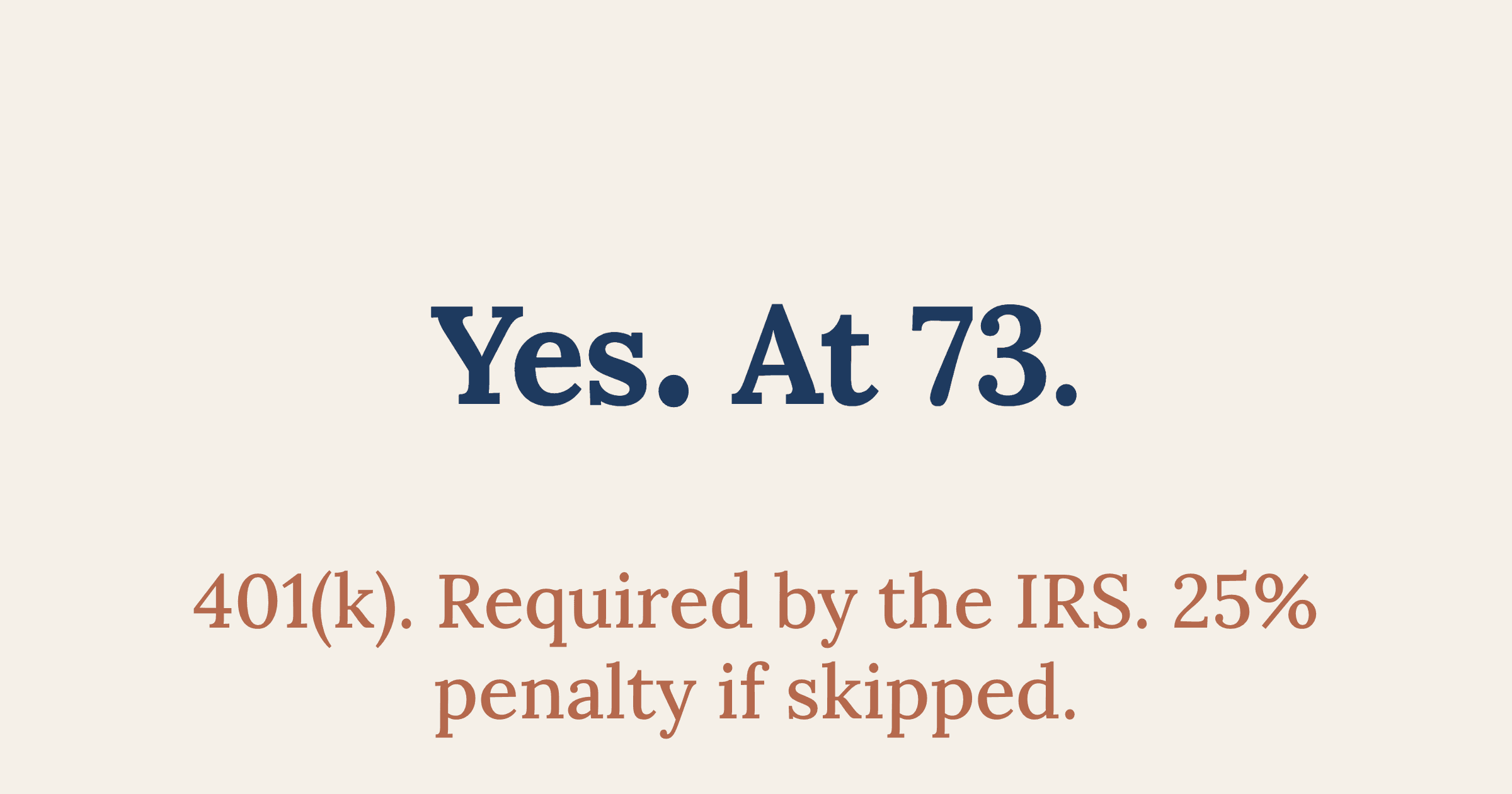
A 401(k) requires mandatory withdrawals starting at age 73 — the IRS calls these Required Minimum Distributions, or RMDs. The amount depends on your December 31 account balance and your IRS life expectancy factor. Missing one triggers a 25% excise tax on the shortfall, reducible to 10% if you correct it within two years.
Two important nuances change the timing for some people. If you were born in 1960 or later, your trigger age is 75 under SECURE 2.0. And if you are still employed by the company that sponsors the plan, you may be able to delay RMDs from that specific 401(k) until you actually retire.
Calculate Your RMDWhen mandatory 401(k) withdrawals start
Age 73 is the trigger for most people. Your first mandatory withdrawal is due by April 1 of the year after you turn 73. Every subsequent year, the deadline is December 31. If you were born in 1960 or later, the trigger age moves to 75 — SECURE 2.0 raised it for that birth cohort.
Older references to age 70½ or 72 are outdated for new RMD timelines. The original 70½ rule applied before 2020. The SECURE Act of 2019 raised the trigger to 72. SECURE 2.0 raised it to 73 in 2023 and to 75 for those born in 1960 or later. If you reached 70½ before 2020, the original rule still applied at the time and you should already be taking RMDs annually. The rule changes since then do not unwind your existing schedule.
One exception applies specifically to workplace plans like 401(k)s. If you are still employed by the company sponsoring the plan and you do not own 5% or more of the business, you may be able to defer RMDs from that specific 401(k) until the year you retire. The exception covers your current employer's plan only — not IRAs, not old 401(k)s from previous employers. For the full age trigger walkthrough across all account types, see When do RMDs start?
How much you have to withdraw
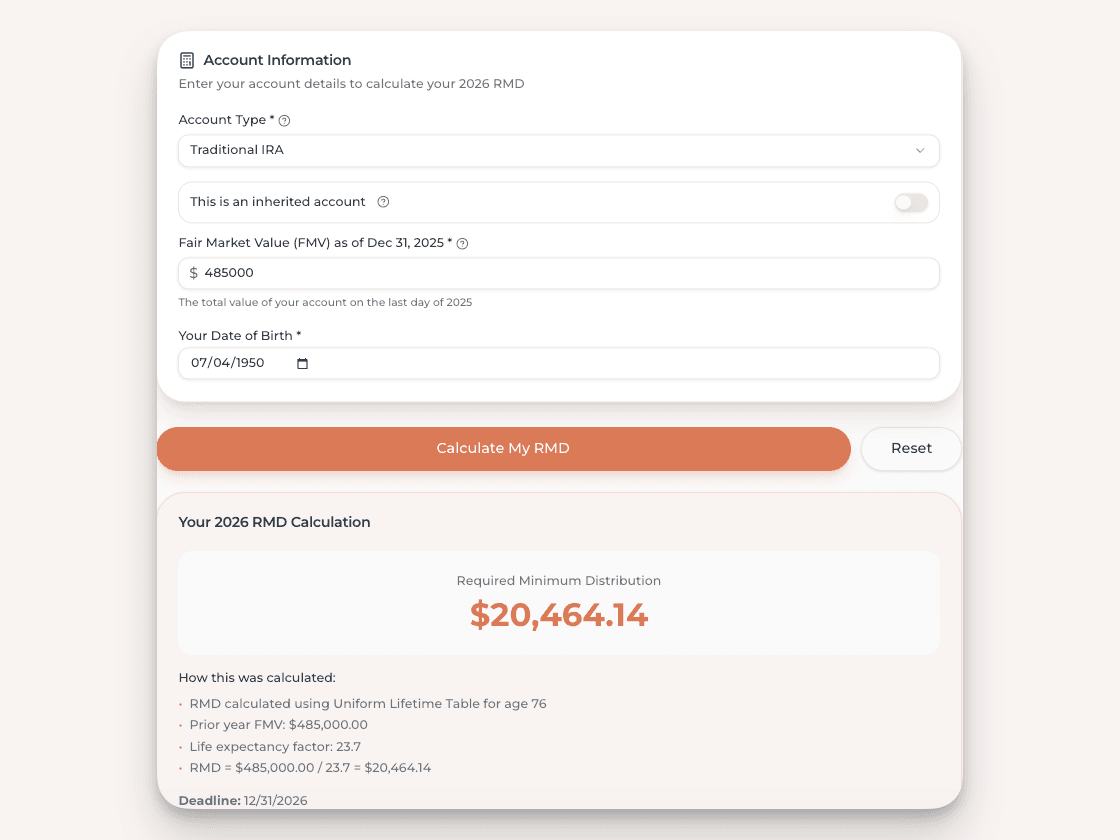
The formula is straightforward. Your mandatory 401(k) withdrawal equals your prior December 31 account balance divided by your IRS life expectancy factor. Most account holders use the Uniform Lifetime Table — a different table (Joint Life and Last Survivor Expectancy) applies if your spouse is your sole beneficiary and is more than 10 years younger than you. At age 73, the 2026 Uniform Lifetime factor is 26.5. On a $200,000 balance, that produces an RMD of approximately $7,547 for the year.
The factor decreases each year as you age, so the percentage of your account you must withdraw grows over time. The dollar amount also moves with your balance — if the account grew, the RMD grows; if it shrank, the RMD shrinks. Each 401(k) plan calculates its own RMD separately. You cannot satisfy a 401(k) RMD from an IRA or from another 401(k), even if both belong to you. For the formula walkthrough with worked examples, see How to calculate your RMD.
What happens if you skip a mandatory withdrawal
The IRS charges a 25% excise tax on the amount you should have withdrawn but did not. SECURE 2.0 reduced the rate from 50% to 25%, effective for tax years 2023 and later. If you take the missed amount within roughly two years and file Form 5329, the rate drops further to 10%. The IRS may waive the penalty entirely for reasonable cause — late discovery, custodian error, serious illness — also filed on Form 5329 with a letter explaining the circumstances.
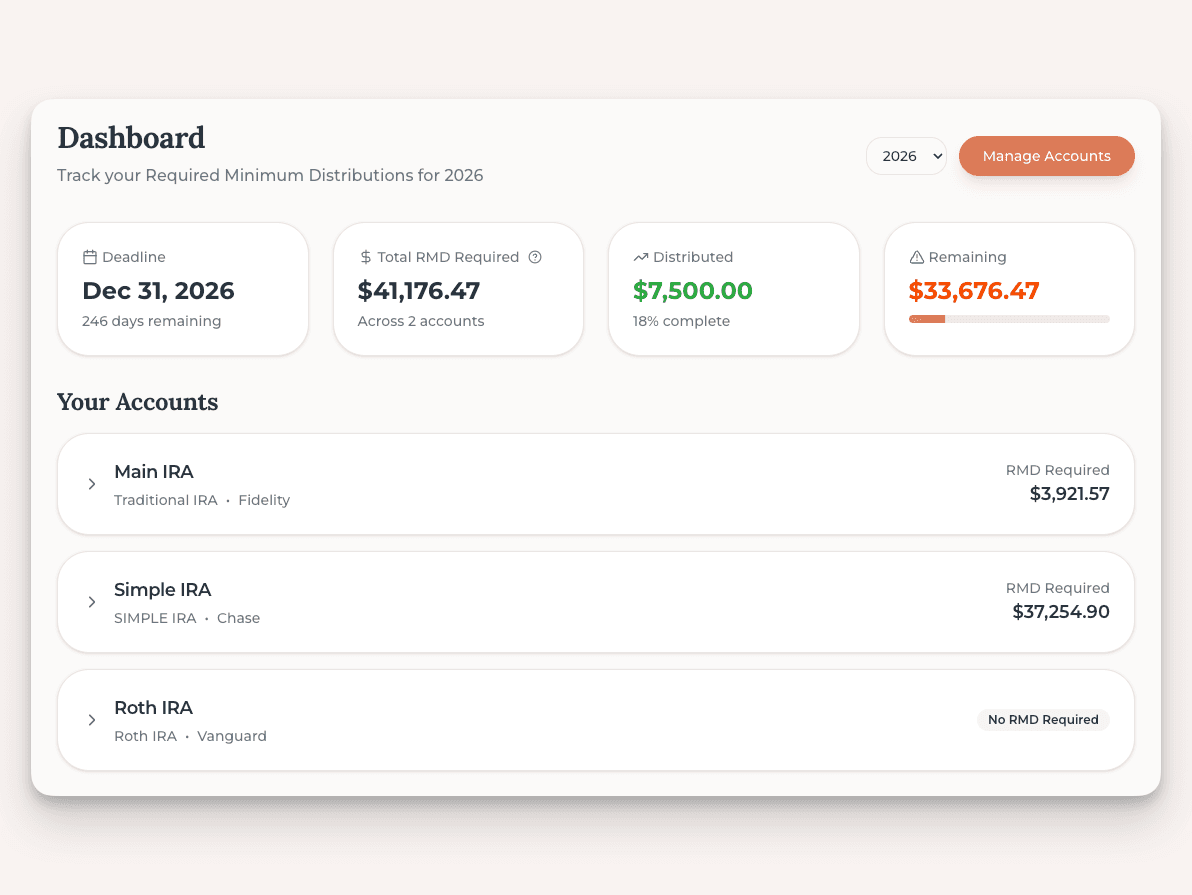
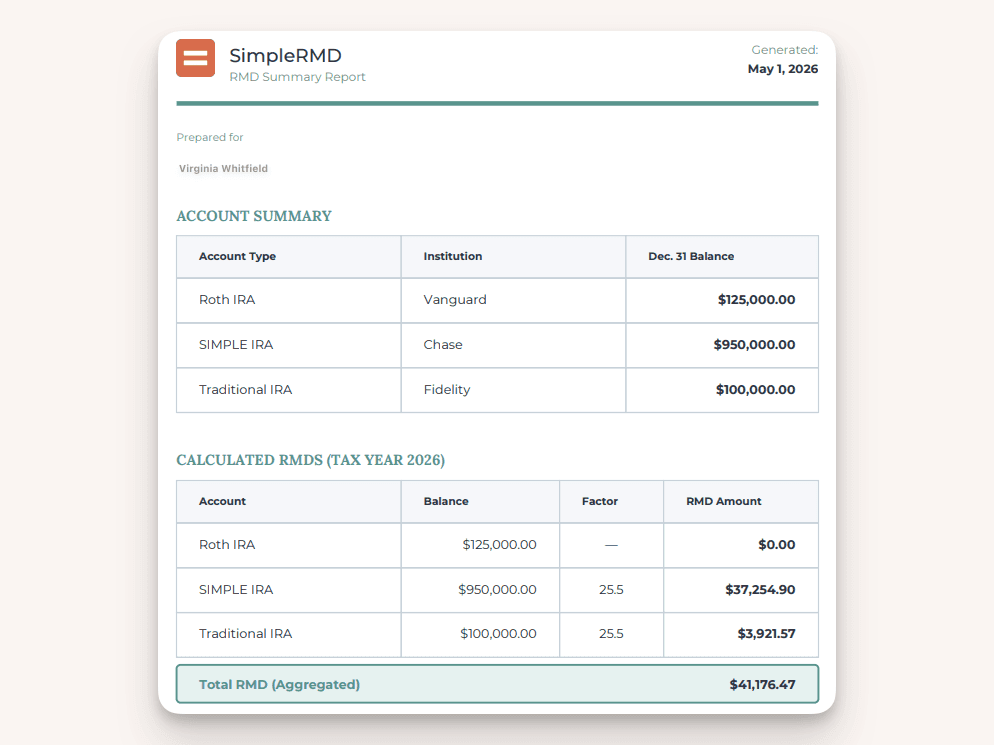
Do not panic if you have already missed one. Take the shortfall as soon as possible, file Form 5329, and document the situation. The IRS has historically been reasonable when errors are corrected promptly. For the broader 401(k) RMD rule set including aggregation and rollover rules, see 401(k) RMD rules: what is different from an IRA. For deeper coverage of the penalty and the waiver path, see RMD deadlines and penalties. How SimpleRMD works walks through what the calculator and dashboard do at each step.
This article is for informational purposes only and does not constitute tax, legal, or financial advice. IRS rules and tax laws are subject to change. Consult a qualified tax professional or financial advisor for guidance specific to your situation. SimpleRMD is a calculation and tracking tool — not a financial advisory service.
Sources: IRS.gov (Publication 590-B, Retirement Topics: RMDs, RMD FAQs). SECURE Act of 2019 (Pub. L. 116-94). SECURE 2.0 Act of 2022 (Pub. L. 117-328), Section 107 (age trigger), Section 302 (reduced excise tax). Rules confirmed current as of May 2026.