

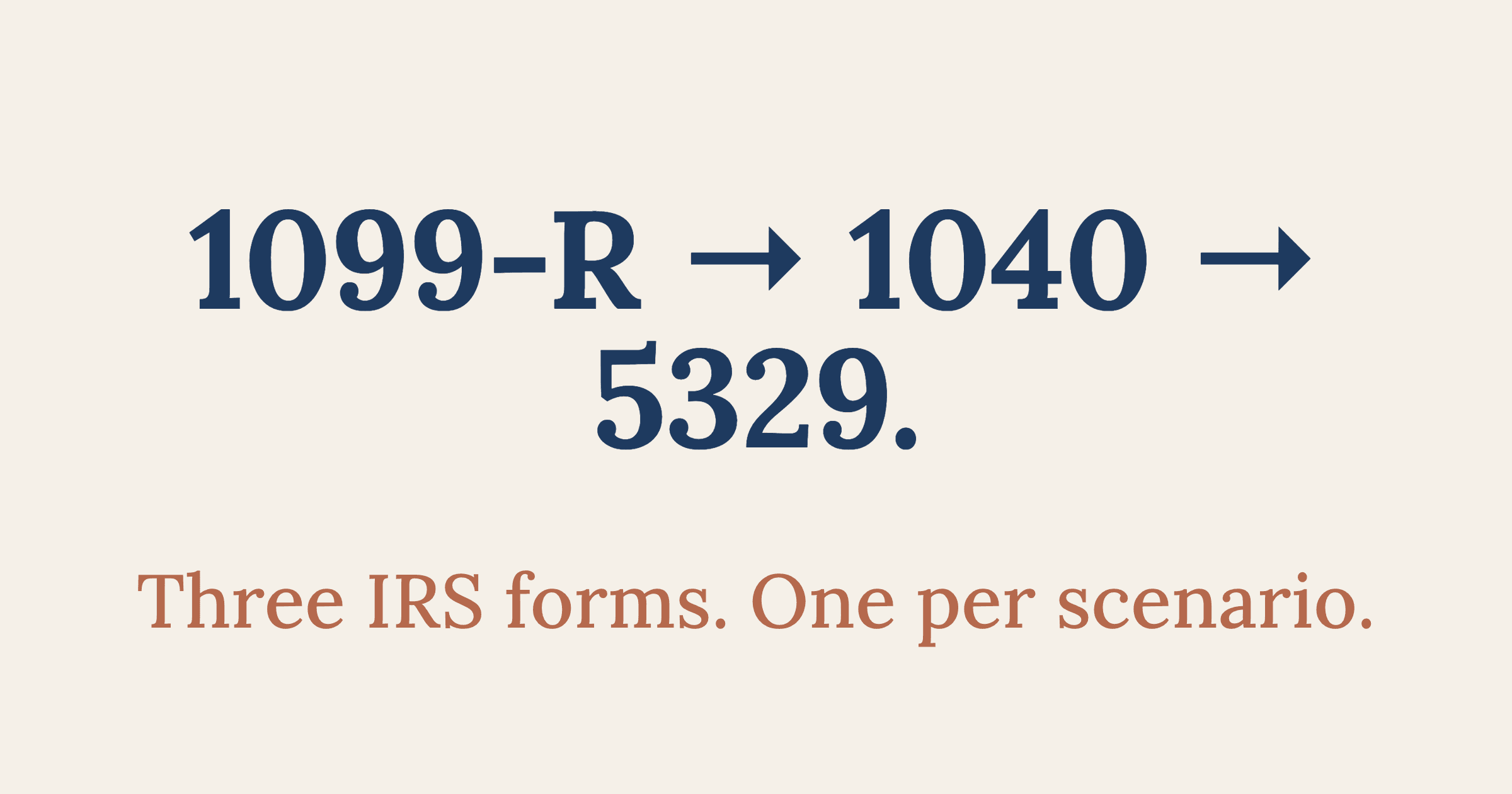
Three IRS forms cover the entire process. Form 1099-R arrives from your 401(k) custodian by January 31 of the year after the distribution. The taxable amount flows onto Form 1040 lines 5a and 5b. Form 5329 only enters the picture if a penalty applies — either an early-withdrawal additional tax or a missed RMD excise tax.
That sequence is the whole framework. The detail that catches people is in the rollover-handling and code-letter cases, which is where most reporting errors happen.
Calculate Your RMDForm 1099-R — what you receive from the custodian
Your 401(k) plan administrator sends Form 1099-R to you and a copy to the IRS by January 31 reporting any distribution from the plan during the prior year. The form has several boxes that matter for your return.
Box 1 reports the gross distribution — the total amount that left the account. Box 2a reports the taxable amount. For most 401(k) distributions, Box 1 and Box 2a match. For rollovers, Box 2a should show zero if the rollover was direct (a direct-to-IRA transfer) or if the indirect rollover was completed within 60 days.
Box 7 carries the distribution code that tells the IRS what kind of withdrawal this was. Code 7 means normal distribution (age 59½ or older). Code 1 means early distribution without known exception, triggering the 10% additional tax. Code 2 means early distribution with a known exception. Code G means direct rollover. Check Box 7 first — it determines whether Form 5329 is in play.
Form 1040 — lines 5a and 5b
Form 1040 has two lines dedicated to pension and IRA distributions. Line 5a takes the gross distribution from Box 1 of Form 1099-R. Line 5b takes the taxable portion from Box 2a. The taxable amount flows into your overall income calculation; the gross amount is informational.
For a normal distribution with no rollover, line 5a and line 5b carry the same number. For a complete direct rollover, line 5a shows the gross and line 5b shows zero, with the word "Rollover" written next to line 5b. For a partial rollover, line 5a shows the gross, line 5b shows whatever was not rolled over, and "Rollover" is written next to line 5b for the rolled-over portion.
If you took a Required Minimum Distribution from your 401(k), that amount flows the same way — Box 1 to 5a, Box 2a to 5b. The RMD itself does not require special tagging on Form 1040; the IRS tracks RMD compliance through the custodian's reporting and the broader audit framework. For deeper coverage of how RMD amounts are taxed, see How much tax do you pay on an RMD?
Form 5329 — only if a penalty applies
Most 401(k) distribution reporting ends with Form 1099-R and Form 1040. Form 5329 enters in two scenarios most commonly relevant to 401(k) distributions (the form covers a broader set of penalty calculations across retirement accounts overall).
Early-withdrawal penalty. If you took a distribution before age 59½ and the distribution code in Box 7 is 1, you owe a 10% additional tax on the early withdrawal. Part I of Form 5329 calculates the additional tax. If you qualify for an exception (substantially equal periodic payments, disability, separation from service after age 55, qualified medical expenses, and others), Part I also allows you to claim it.
Missed RMD excise tax. If you were required to take an RMD from the 401(k) and missed all or part of it, you owe a 25% excise tax on the shortfall (reduced to 10% if you correct it within roughly two years). Part IX of Form 5329 calculates and reports this. You can request a waiver of the penalty for reasonable cause on the same form — see IRS waiver for a missed RMD for the full waiver request walkthrough.
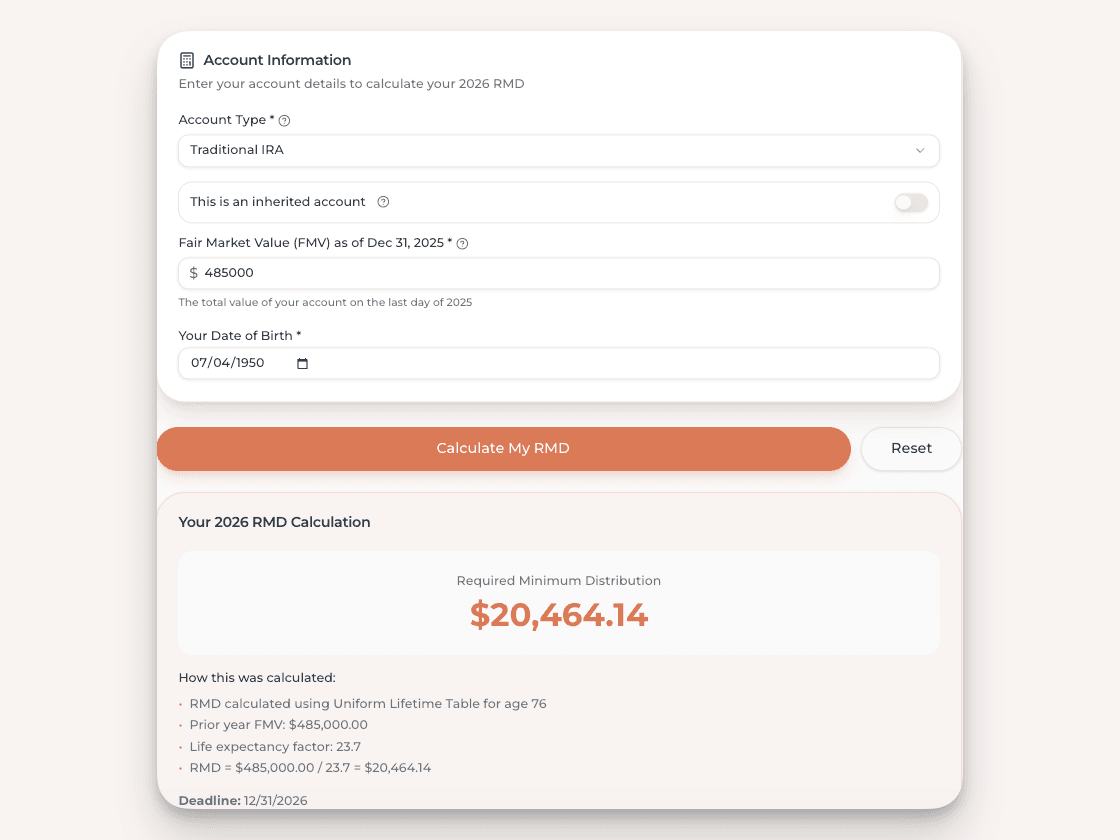
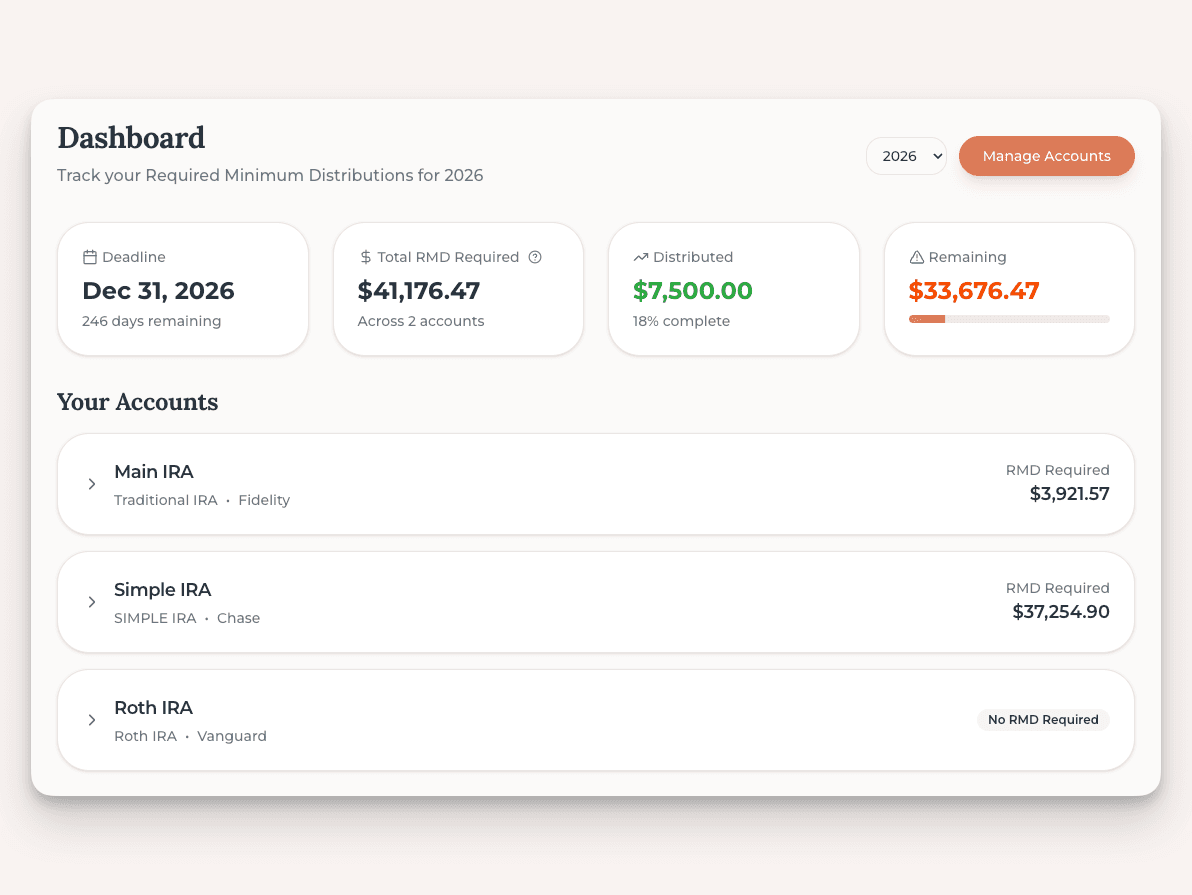
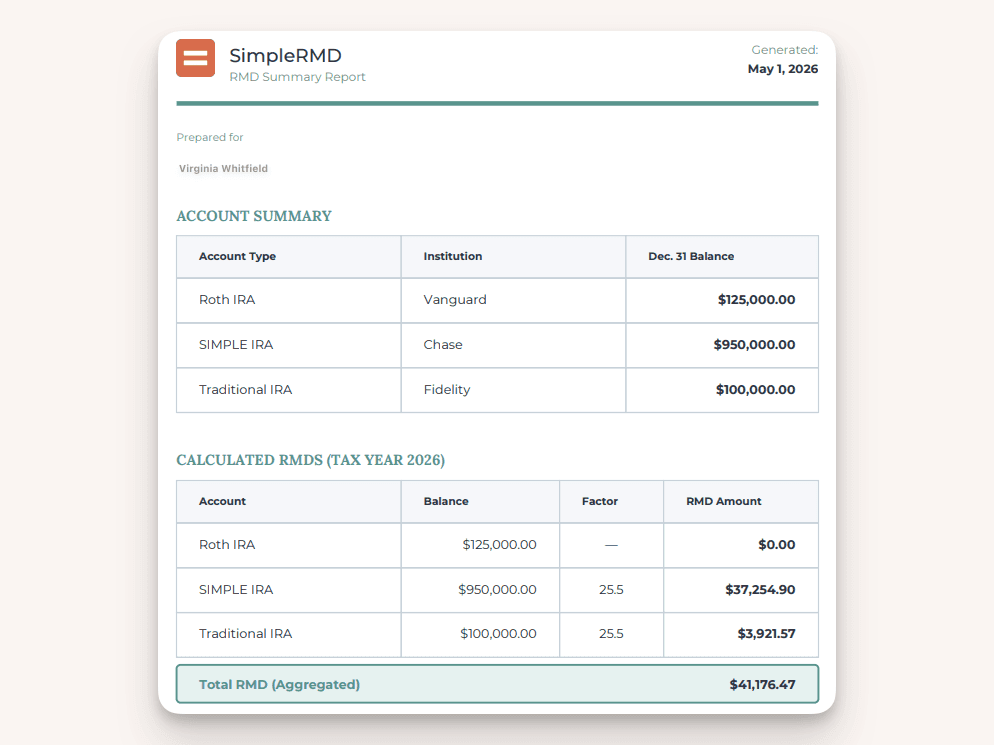
For the broader 401(k) RMD rule set including aggregation and rollover sequencing, see 401(k) RMD rules. How SimpleRMD works walks through what the calculator and dashboard do at each step.
This article is for informational purposes only and does not constitute tax, legal, or financial advice. IRS rules and tax laws are subject to change. Consult a qualified tax professional or financial advisor for guidance specific to your situation. SimpleRMD is a calculation and tracking tool — not a financial advisory service.
Sources: IRS.gov (Publication 590-B, Form 1099-R Instructions, Form 1040 Instructions, Form 5329 Instructions, Topic 424: 401(k) plans). SECURE 2.0 Act of 2022 (Pub. L. 117-328), Section 302 (reduced excise tax). Rules confirmed current as of May 2026.