

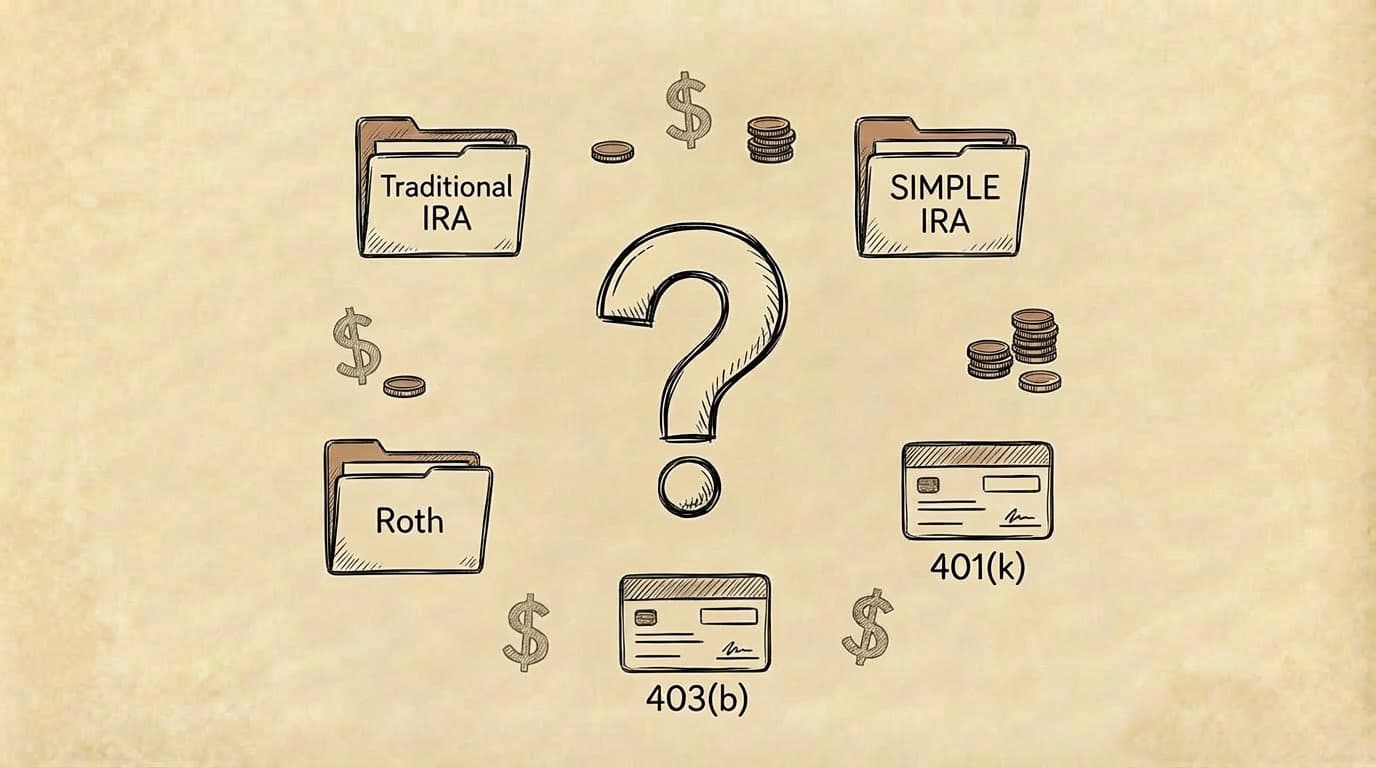
Yes. If you own multiple Traditional IRAs, the IRS allows you to add up your Required Minimum Distributions from all of them and withdraw the total from just one account. This is called the aggregation rule.
SimpleRMD calculates your combined RMD across all accounts automatically.
Calculate Your RMD Free — no signup requiredSimpleRMD multi-account dashboard showing combined RMD total across three IRAs
How the Aggregation Rule Works
The IRS calculates a separate RMD for each Traditional IRA you own. But it doesn't require a separate withdrawal from each one. You total the amounts and take the full distribution from whichever account you choose.
For example: Maria is 76 and owns three Traditional IRAs worth a combined $800,000 at year-end. Her total RMD is $36,496. She can pull the entire $36,496 from one account and satisfy the requirement for all three.
This gives you flexibility. You can withdraw from the account with the lowest-performing investments, the one with the easiest distribution process, or whichever makes sense for your situation.
When You Cannot Aggregate
The aggregation rule only applies to Traditional IRAs. You cannot mix account types.
A 401(k) RMD must come from that 401(k). An inherited IRA RMD must come from that inherited IRA. A SEP IRA can aggregate with Traditional IRAs, but a SIMPLE IRA in its first two years cannot.
The most common mistake is pulling an inherited IRA RMD from a personal IRA. The IRS treats that as a missed distribution — and the penalty is 25% of the shortfall.
Infographic showing which account types can and cannot aggregate RMDs
FAQ
Can I aggregate 401(k) and IRA RMDs together?
No. 401(k) RMDs must come from the 401(k) plan itself. The aggregation rule applies only to Traditional IRAs (and SEP IRAs, which the IRS treats as Traditional IRAs for this purpose).
What if I have both inherited and personal IRAs?
You must calculate and satisfy them separately. Inherited IRA RMDs cannot be combined with your personal IRA RMDs. Each inherited IRA from a different decedent must also be tracked independently.
Do I still need to calculate the RMD for each IRA separately?
Yes. The IRS requires you to calculate the RMD for each Traditional IRA individually using that account's year-end balance. Aggregation only applies to how you withdraw — not how you calculate.
Calculate Your RMD Free — no signup requiredWhat to do next
This article is for informational purposes only and does not constitute tax, legal, or financial advice. Consult a qualified tax professional for guidance specific to your situation.
Sources: IRS.gov (Publication 590-B, Retirement Topics: RMDs). Rules confirmed current as of February 2026 per IRS Pub 590-B (2025).