

No. The IRS does not allow a Required Minimum Distribution to be converted or rolled into a Roth IRA. RMDs are explicitly excluded from the rollover rules — they have to come out of the account as a taxable distribution, not redirected into another retirement account. The rule applies to RMDs from a Traditional IRA, a 401(k), or an inherited IRA — no RMD is eligible for conversion or rollover.
You can still do a Roth conversion in the same year you take your RMD. You just have to take the RMD first, separately, and then convert other Traditional IRA funds. Both transactions are taxable, and the sequencing matters for a reason most people learn the hard way.
Calculate Your RMDWhy the answer is no
Two IRS rules combine to close this door. First, RMDs are not eligible rollover distributions — the tax code excludes them from the rollover provisions that allow other distributions to be redirected into a Roth IRA as a conversion. Second, the first-dollars-out rule: the first money to leave your IRA in any year an RMD is owed is treated as the RMD until the full RMD amount has been satisfied. That money cannot be redirected.
Put together, the IRS treats an attempt to roll your RMD into a Roth IRA as a failed rollover. The RMD itself remains a taxable distribution, and the amount that landed in the Roth IRA is an excess contribution — see the third section below for what that triggers.
What you can do — and how to sequence it
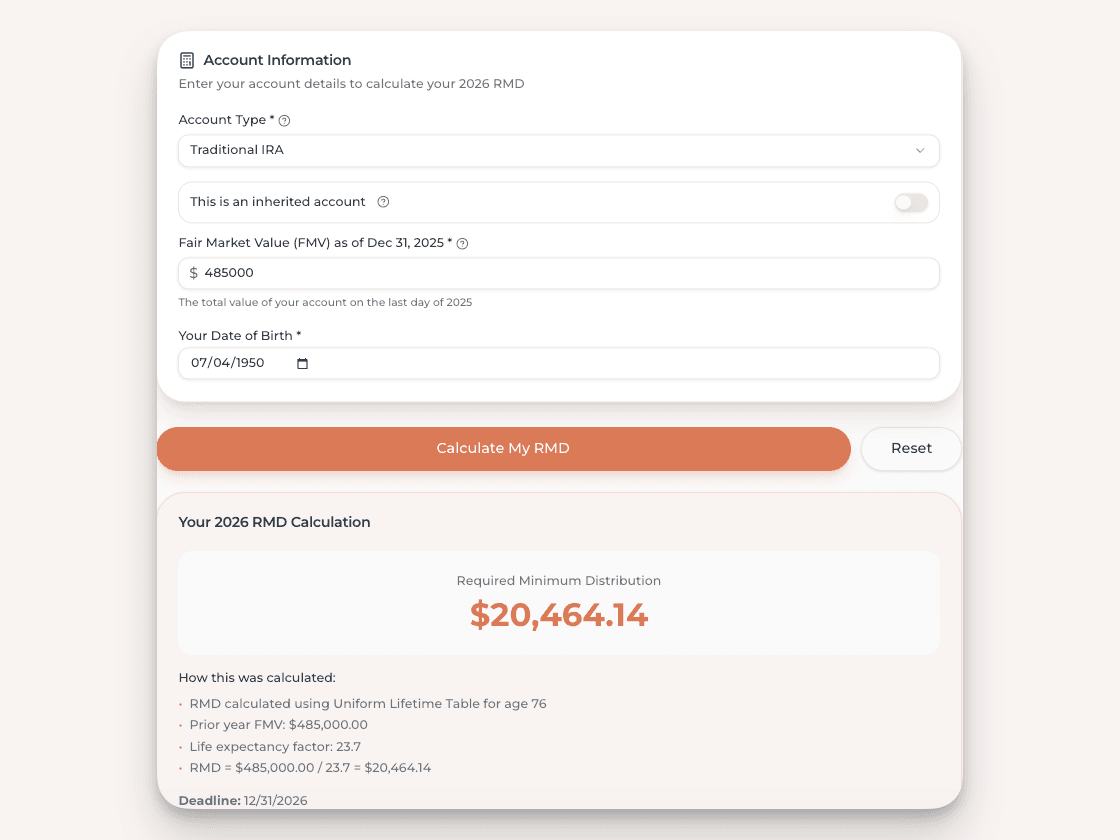
You can take your RMD and complete a Roth conversion in the same calendar year. The sequencing is the part the IRS cares about: RMD out first as a taxable distribution, then convert any portion of your remaining Traditional IRA balance to a Roth IRA. The conversion is also taxable as ordinary income, so you pay tax on both transactions.
A worked example. You owe a $12,000 RMD for the year and want to convert $50,000 from your Traditional IRA to a Roth IRA. Take the $12,000 RMD as cash to a taxable account. Then convert $50,000 to the Roth. Your taxable income for the year includes $62,000 from these two transactions. Order matters — the IRS will treat the first $12,000 of any distribution as the RMD regardless of what you intended.
Same year is fine. Same transaction is not. Spreading the RMD and the conversion across multiple years may also help control which tax brackets the income hits — worth a conversation with your tax professional. Roth IRA RMD rules covers the broader Roth picture, including what happens to converted balances later.
What happens if you do it wrong
If you accidentally roll an RMD into a Roth IRA — or into any IRA — the IRS treats the amount as an excess contribution to that account. Excess contributions are subject to a 6% annual penalty for every year the excess remains in the account. The penalty compounds until corrected.
The fix has to happen by October 15 of the year after the rollover. Withdraw the excess amount plus any earnings attributable to it from the Roth IRA. Withdrawn correctly, no 6% penalty applies. Beyond that deadline, the penalty continues annually until the excess is removed. If you discover this years later, talk to a tax professional. There are paths to correction, but they require careful documentation.
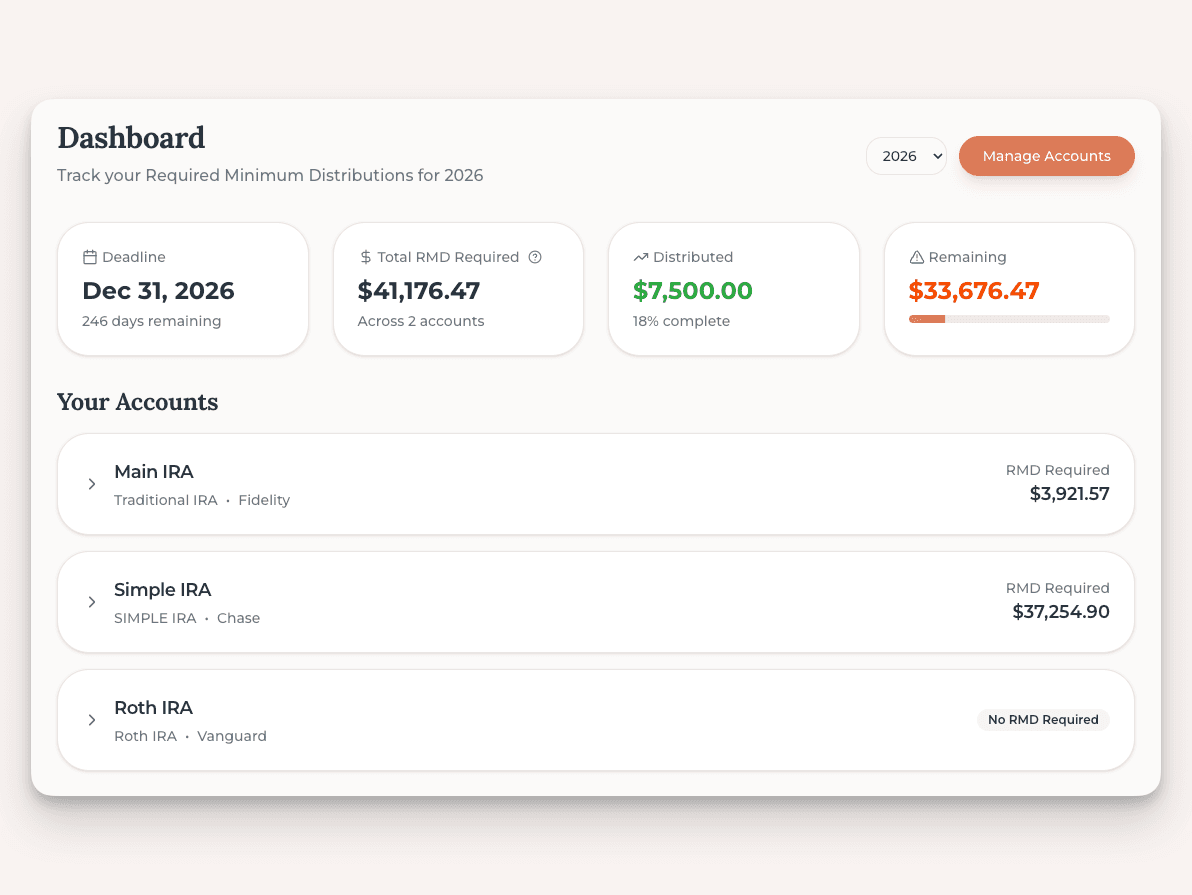
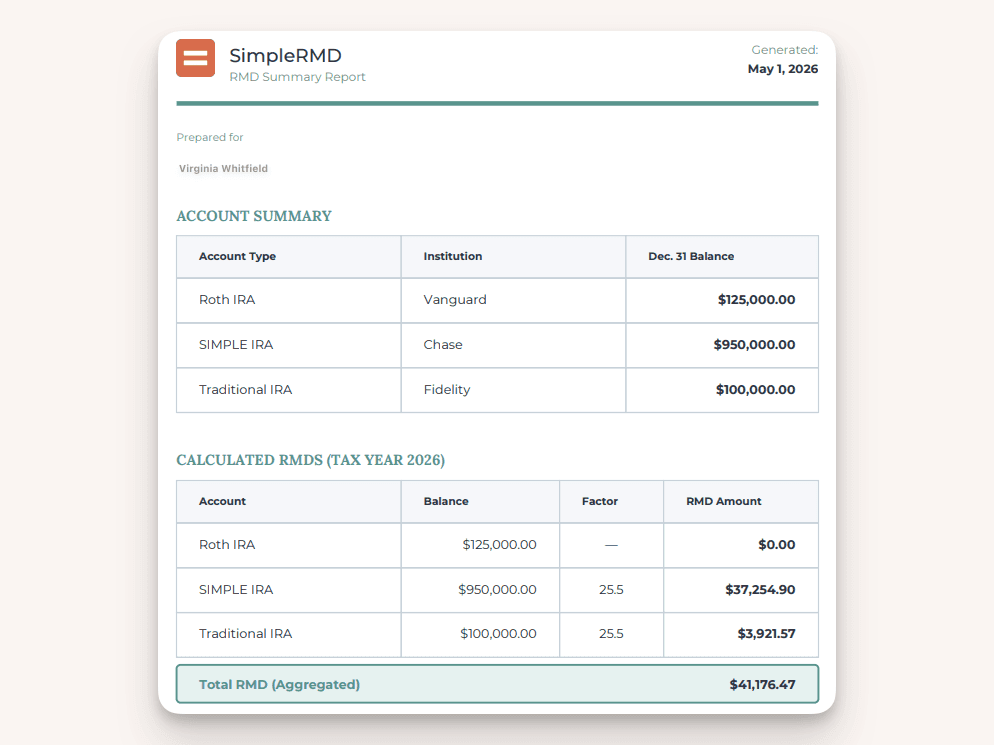
For the broader RMD-and-rollover rule set including the 401(k) version of this same trap, see 401(k) RMD rules and RMD deadlines and penalties. How SimpleRMD works covers what the calculator and dashboard do at each step.
This article is for informational purposes only and does not constitute tax, legal, or financial advice. IRS rules and tax laws are subject to change. Consult a qualified tax professional or financial advisor for guidance specific to your situation. SimpleRMD is a calculation and tracking tool — not a financial advisory service.
Sources: IRS.gov (Publication 590-A, Publication 590-B, Retirement Topics: RMDs). IRC §408(d)(3)(E) (RMDs not eligible for rollover). IRC §4973 (excess contributions). Rules confirmed current as of May 2026.