

If an IRA owner dies after their required beginning date without taking that year's full RMD, the beneficiary must take the rest of it — and the deadline is later than most older articles say. Under the 2024 final regulations, the year-of-death RMD is timely if taken by the later of the beneficiary's tax filing deadline for the year of death (extensions included) or December 31 of the following year. Meet that date and the missed-RMD penalty is waived automatically. No Form 5329, no waiver letter, no explanation.
The old rule — December 31 of the year of death, then beg for relief — is still what much of the internet says. It has not been true since the final regulations took effect.
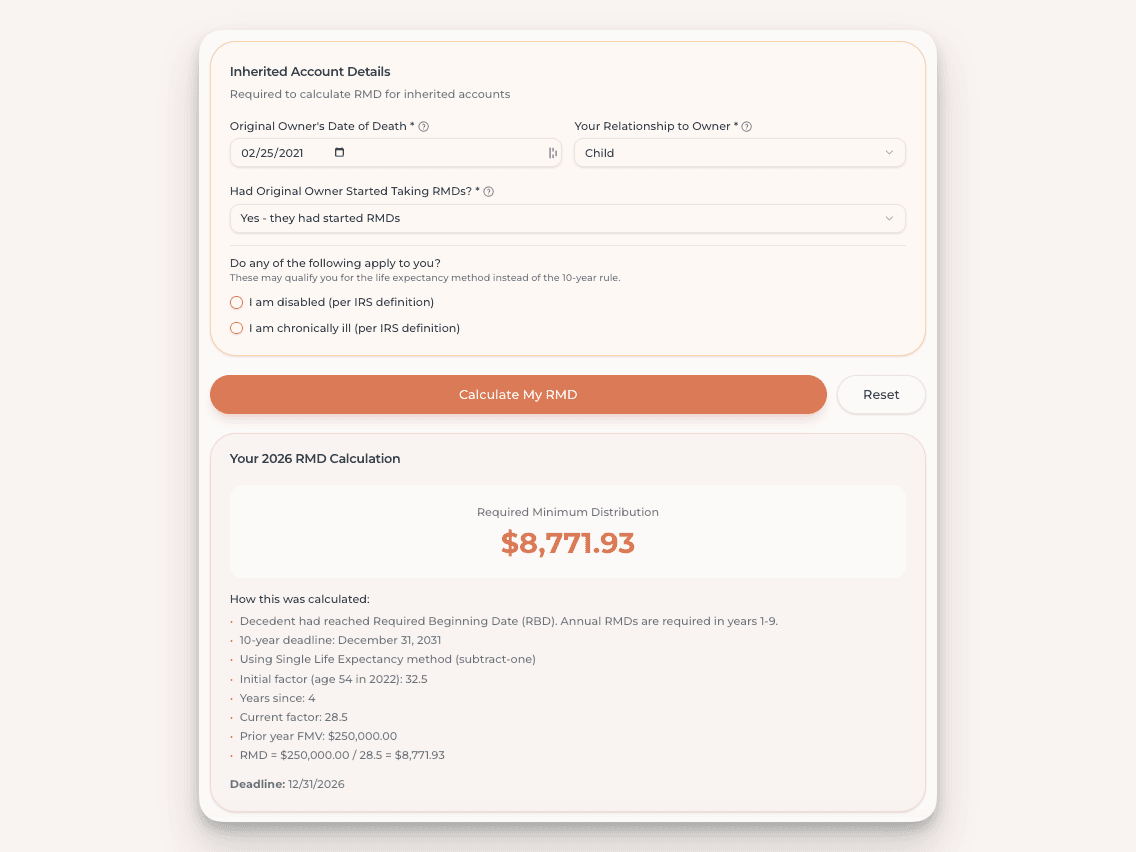
Calculate Your Inherited IRA RMDWho takes it, and how much
The year-of-death RMD belongs to whoever inherits the account: the named beneficiaries, or the estate only when no beneficiary was designated. The amount is whatever remains of the RMD the owner was required to take that year, calculated exactly as the owner would have: their age, their table, the prior December 31 balance. If the owner already took part of it, the beneficiaries only owe the difference. If the owner had not yet reached their required beginning date, no year-of-death RMD exists at all.
With multiple beneficiaries, the regulations settled an old ambiguity: any one of them can take the full remaining amount. It does not have to be split proportionally, and the IRS does not care which beneficiary's account it comes from. The income lands on whoever takes it.
The deadline and the automatic waiver
A December death used to create an impossible scramble: retitle the account, calculate the shortfall, and distribute it inside a few weeks. The final regulations fixed this. The deadline is now the later of two dates — the beneficiary's own tax filing deadline for the death year, including any extension, or the end of the calendar year after the year of death. In practice that means at least twelve months of room, and often more.
The penalty relief is built in. Take the distribution by that date and the excise tax is automatically waived: nothing to file, nothing to request. Only a beneficiary who misses even the extended date needs the manual route: Form 5329 Part IX and a reasonable cause statement, with ready-made language in the waiver letter samples.
What the year-of-death RMD does not change
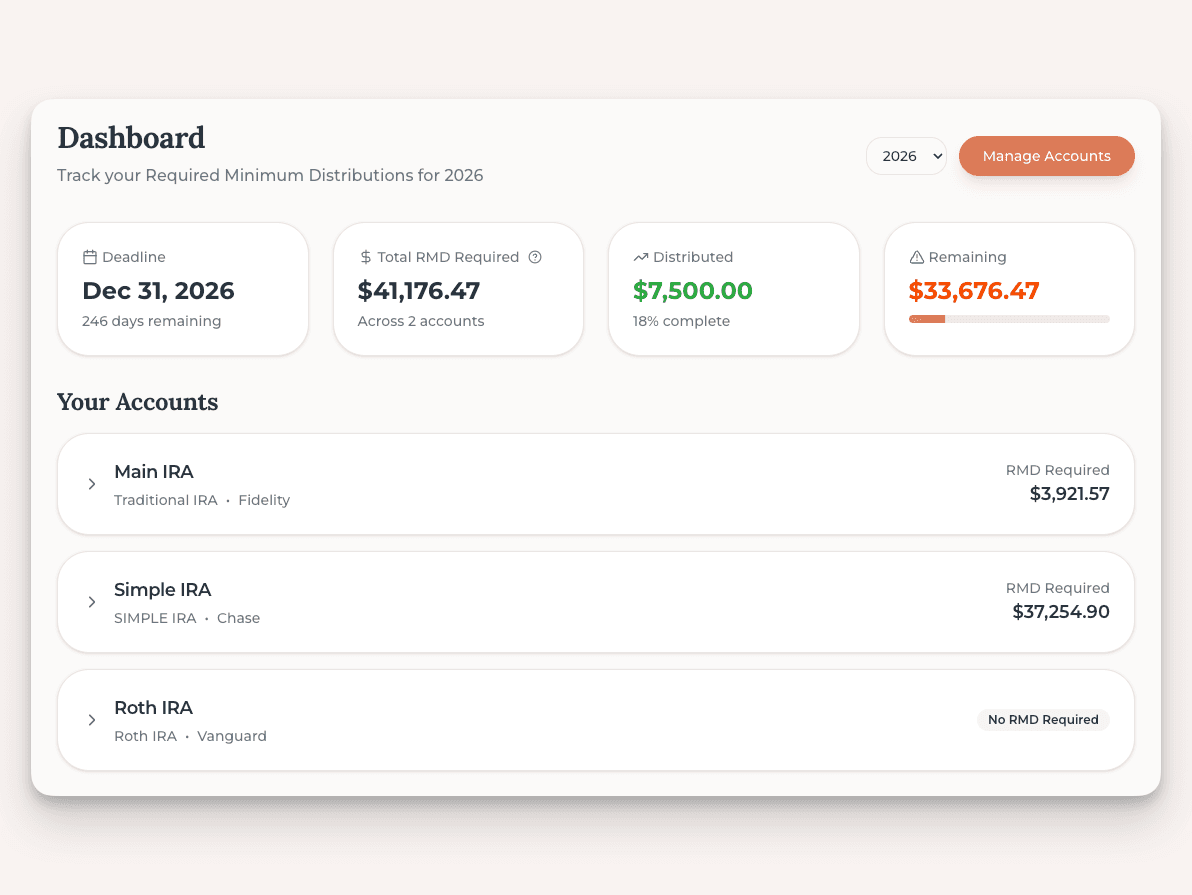
Taking the owner's final RMD does not start or satisfy your own obligations as beneficiary. Your 10-year window (or life-expectancy schedule) is measured from the year of death, and your own first-year RMD, if one is due, lands on December 31 of the following year. The same rules are covered in RMDs after death and the inherited IRA hub.
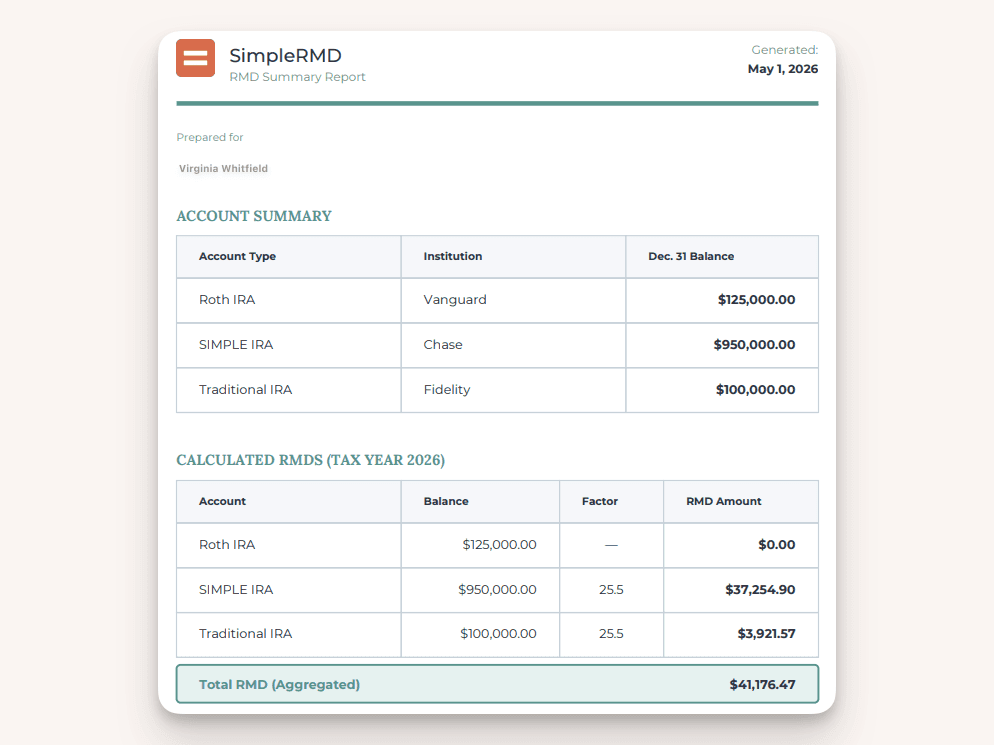
One more distinction: the year-of-death RMD is taxable to the beneficiary who takes it, in the year it is taken. It never goes on the deceased's final return unless the owner took it before dying. Get the schedule for both obligations in one place — the RMD overview covers the fundamentals, and how SimpleRMD works shows how the tracking handles a mid-year inheritance.
This article is for informational purposes only and does not constitute tax, legal, or financial advice. IRS rules and tax laws are subject to change. Consult a qualified tax professional or financial advisor for guidance specific to your situation. SimpleRMD is a calculation and tracking tool — not a financial advisory service.
Sources: IRS.gov (Publication 590-B, Required minimum distributions for IRA beneficiaries, Form 5329 Instructions (2025)); 2024 final RMD regulations (T.D. 10001). Rules confirmed current as of July 2026.