

When you request a waiver of the 25% missed-RMD additional tax on Form 5329, the IRS expects two things in the same envelope: the form itself with "RC" (reasonable cause) noted on the relevant line 54, and a written statement explaining what happened. The statement is the letter. It does not have a required format, but it does have a required substance: what was missed, when you discovered it, why it happened, what you did to fix it, and the date you took the corrective distribution.
The three templates below cover the three most common reasonable-cause scenarios. Each is meant to be copied, edited with your specifics, and printed for mailing with Form 5329. Keep the actual letter to one page. The IRS reviewer skims; concision helps your case.
Calculate Your RMDTemplate 1 — Custodian processing error
Use when you requested the distribution on time but the broker, bank, or plan administrator failed to process it before the December 31 deadline.
[Date]

Internal Revenue Service
[Service center mailing address for your state]

Re:  Request for Waiver of Additional Tax Under IRC §4974(d)
     [Your Name] — SSN: XXX-XX-XXXX
     Tax Year [YYYY] — Form 5329, Part IX

To Whom It May Concern:

I am writing to request a waiver of the additional tax on the
required minimum distribution shortfall reported on the enclosed
Form 5329, Part IX.

In [Month YYYY] I submitted a written distribution request to
[custodian name] for the full $[amount] RMD due from my IRA
[account number ending in XXXX] for tax year [YYYY]. I confirmed
the request was received by [evidence — confirmation number,
email, dated form]. The custodian did not process the distribution
before the December 31 deadline. I discovered the missed
distribution on [date] when reviewing my year-end statements.

Upon discovery I immediately contacted the custodian. The
corrective distribution of $[amount] was processed and received
on [date]. Documentation of the original request and the late
processing is attached.

I respectfully request that the additional tax be waived under
Treasury Regulation §54.4974-2 because the shortfall was due to
reasonable error and reasonable steps were taken to remedy it.

Sincerely,

[Your signature]
[Typed name]
[Phone number]
Template 2 — Late discovery (advisor lapse or illness)
Use when the RMD was missed because you relied on a financial professional, were ill, or only discovered the miss months or years after the deadline.
[Date]

Internal Revenue Service
[Service center mailing address for your state]

Re:  Request for Waiver of Additional Tax Under IRC §4974(d)
     [Your Name] — SSN: XXX-XX-XXXX
     Tax Year [YYYY] — Form 5329, Part IX

To Whom It May Concern:

I am writing to request a waiver of the additional tax on the
required minimum distribution shortfall reported on the enclosed
Form 5329, Part IX.

My required minimum distribution from [account custodian, account
number ending in XXXX] for tax year [YYYY] was $[amount]. The
distribution was not taken before the December 31, [YYYY]
deadline because [brief factual cause — e.g., "I was hospitalized
for [condition] from [date] through [date] and unable to manage
my financial affairs," or "my financial advisor at [firm] had been
managing the calculation and missed the year due to a
reassignment of accounts within the firm"].

I discovered the missed distribution on [date] while [reviewing
year-end statements / completing my tax return / receiving a
notice from the custodian]. The corrective distribution of
$[amount] was processed and received on [date], within the
SECURE 2.0 two-year correction window.

This is the first time I have missed an RMD. I have since
established [the specific change — e.g., "automatic year-end
withholding through SimpleRMD account tracking and deadline
reminders"] to prevent a repeat.

I respectfully request that the additional tax be waived under
Treasury Regulation §54.4974-2 because the shortfall was due to
reasonable error and reasonable steps were taken to remedy it.

Sincerely,

[Your signature]
[Typed name]
[Phone number]
Template 3 — Inherited IRA, year-of-death RMD
Use when the missed RMD was the original owner's final RMD in the year of their death, and you (the beneficiary) only became aware of the shortfall during estate administration.
[Date]

Internal Revenue Service
[Service center mailing address for your state]

Re:  Request for Waiver of Additional Tax Under IRC §4974(d)
     [Your Name], as beneficiary of [Decedent Name, SSN]
     Tax Year [YYYY] — Form 5329, Part IX

To Whom It May Concern:

I am writing as the beneficiary of [decedent name] to request a
waiver of the additional tax on the year-of-death required
minimum distribution shortfall reported on the enclosed
Form 5329, Part IX.

[Decedent name] passed away on [date]. At the time of death,
[their/his/her] [YYYY] required minimum distribution of $[amount]
from the [account custodian] IRA, account ending in XXXX, had not
been taken. As beneficiary, I became aware of the outstanding
year-of-death RMD obligation on [date] during [the inherited-IRA
retitling process / estate administration / consultation with
the executor]. I took the corrective distribution from the
inherited account in the amount of $[amount] on [date].

Treasury Regulation §1.401(a)(9)-5, Q&A-4(a) treats any year-of-
death RMD the original owner did not complete as the beneficiary's
responsibility when the original owner died on or after their
required beginning date. This was the first beneficiary year, and
the timing reflected the discovery during estate administration
rather than neglect.

I respectfully request that the additional tax be waived under
Treasury Regulation §54.4974-2 because the shortfall was due to
reasonable error and reasonable steps were taken to remedy it.

Sincerely,

[Your signature]
[Typed name]
[Phone number]
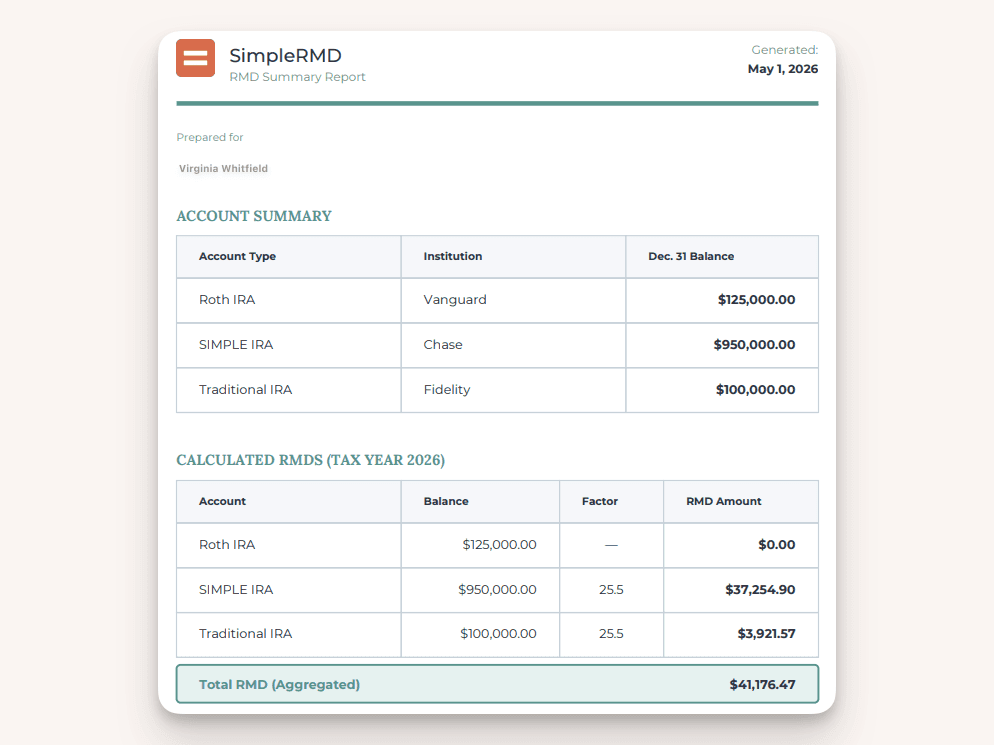
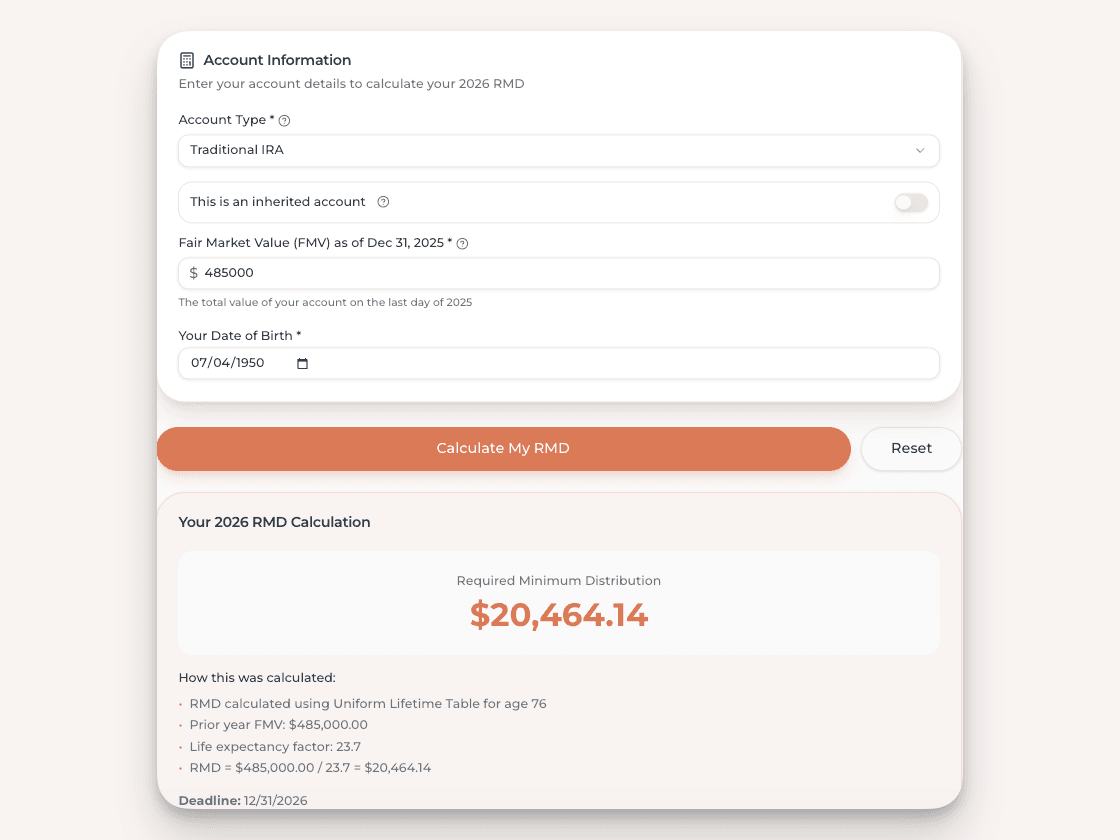
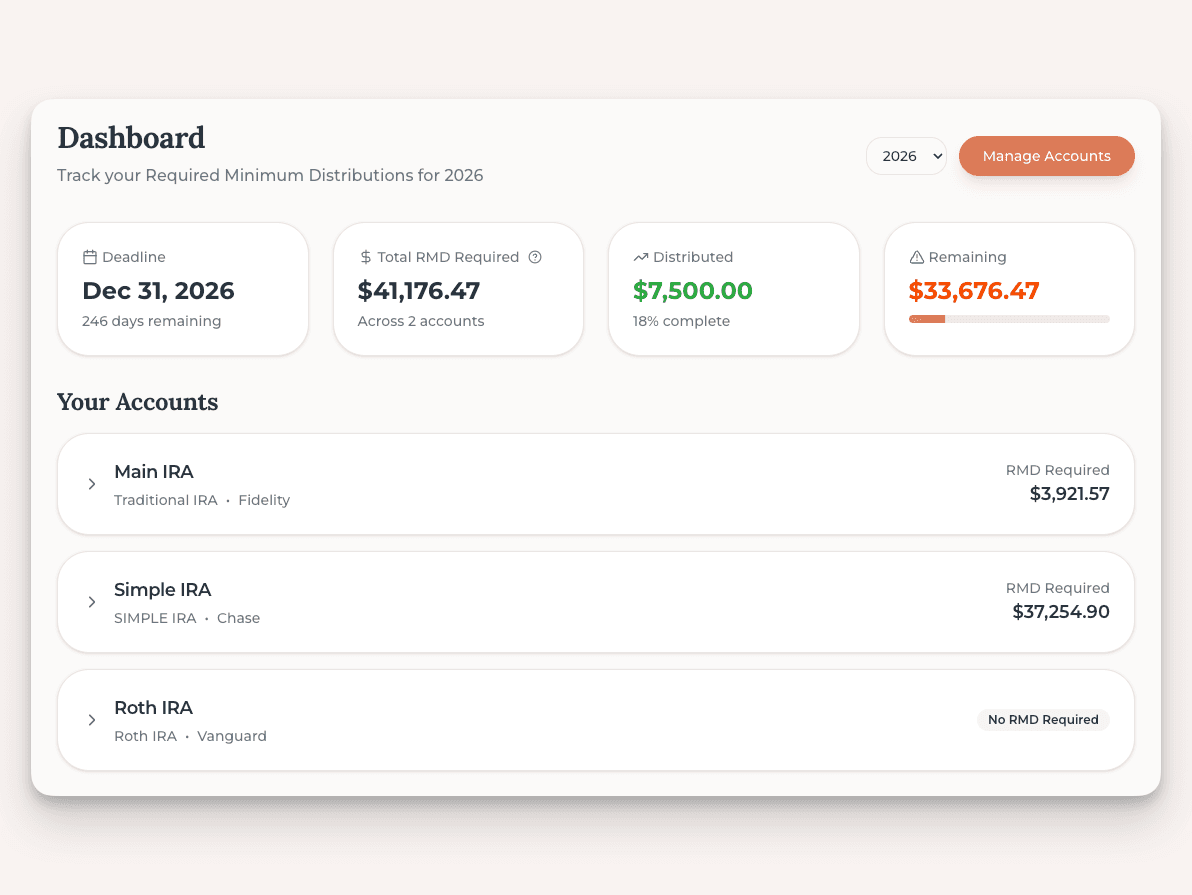
For the line-by-line Form 5329 walkthrough that pairs with these letters, see Missed RMD: How to Fill Out Form 5329 Part IX. For the broader penalty-and-waiver framework (reasonable-cause standards, IRS approval timeline, what counts as adequate documentation), see IRS waiver for a missed RMD. For the deadline tracking and account-level RMD monitoring that prevents the next miss, see how SimpleRMD works or the main RMD overview.
This article is for informational purposes only and does not constitute tax, legal, or financial advice. IRS rules and tax laws are subject to change. Consult a qualified tax professional or financial advisor for guidance specific to your situation. SimpleRMD is a calculation and tracking tool — not a financial advisory service.
Sources: IRS.gov (Form 5329 Instructions (2025), Publication 590-B, Correcting RMD failures). Treasury Regulation §54.4974-2 (reasonable-cause waiver standard). Treasury Regulation §1.401(a)(9)-5, Q&A-4(a) (beneficiary year-of-death RMD responsibility). SECURE 2.0 Act of 2022 (Pub. L. 117-328), Section 302. Rules confirmed current as of May 2026.