


The short answer depends on the type of account. Distributions from an inherited Traditional IRA are taxed as ordinary income in the year you take them. Distributions from an inherited Roth IRA are generally tax-free, with one timing rule that occasionally catches beneficiaries.
The inheritance itself is not a taxable event. You owe federal income tax on the money only when it comes out of the account.
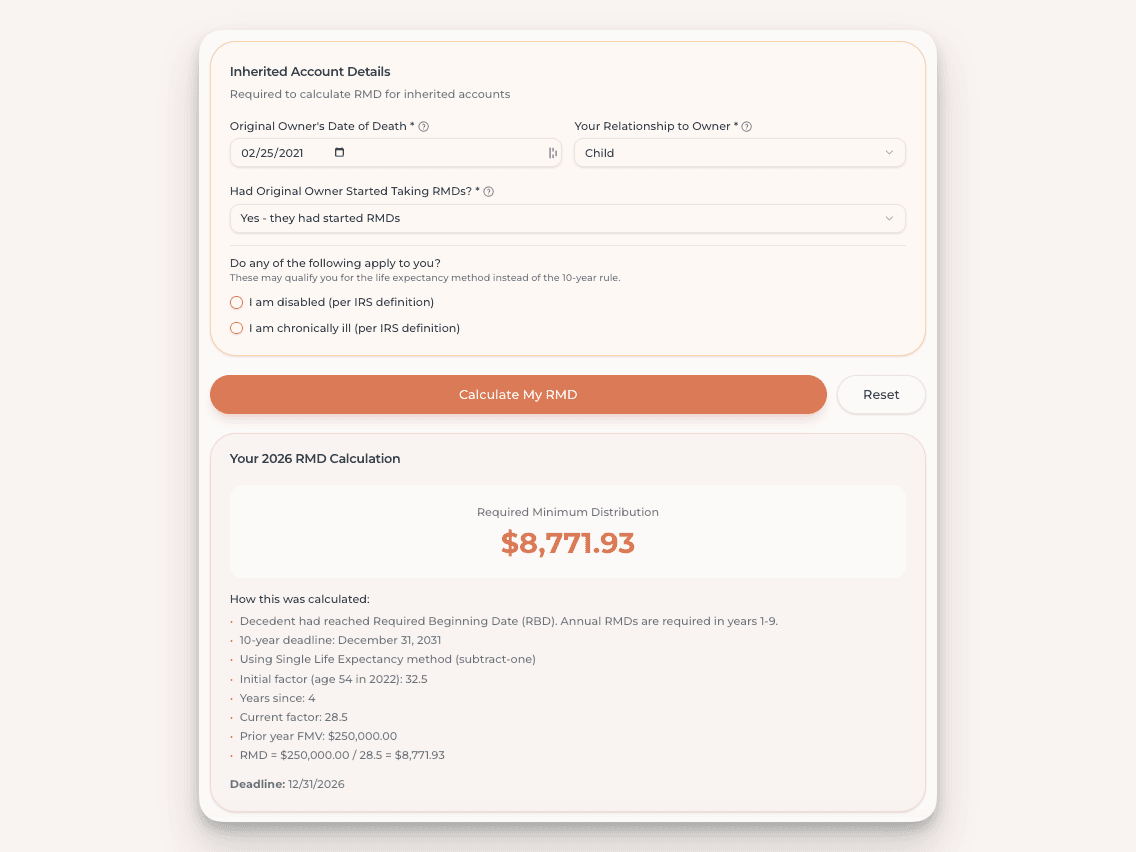
Try the Free Inherited IRA RMD CalculatorTraditional inherited IRAs: ordinary income on each withdrawal
Every dollar you withdraw from an inherited Traditional IRA is taxable as ordinary income, taxed at your own marginal rate in the year of the withdrawal. The custodian issues a Form 1099-R reporting the gross distribution, and the amount flows onto your federal return. State income tax usually applies as well, depending on where you live.
Two narrow exceptions reduce the taxable portion. First, if the original owner made nondeductible contributions, those amounts carry forward as basis and come out tax-free. The basis follows the inherited account on Form 8606. Second, the step-up in basis that applies to many other inherited assets does not apply to a Traditional IRA — the deferred income tax travels with the account.
There is no separate federal inheritance tax on the IRA itself. Estate tax can apply to very large estates, but that is filed by the estate, not by you.
Inherited Roth IRAs: usually tax-free, with a 5-year clock
Roth contributions and conversions were already taxed during the original owner's lifetime, so withdrawals from an inherited Roth IRA are generally income-tax-free. The exception is the original owner's 5-year clock on earnings. If the account was funded fewer than five tax years before the owner's death, earnings withdrawn from it are subject to ordinary income tax until the clock matures. Original contributions remain tax-free at any time.
The 5-year clock is anchored to the original owner. It does not restart when you inherit. A Roth funded in 2022 reaches the 5-year mark in 2027 regardless of who is holding the account by then.
Roth inherited IRAs still carry a deadline. Most non-spouse beneficiaries have to empty the account by the end of year 10, but no annual RMD is required during the runway because Roth owners are never on RBD.

The 10% early-withdrawal penalty does not apply
Inherited IRA distributions are exempt from the 10% early-withdrawal penalty that applies to your own retirement accounts before age 59½. This is true regardless of the beneficiary's age or the type of inherited account. The exemption is tied to the inherited-IRA titling, not your age.
One spousal trap to know: if a surviving spouse elects to treat the IRA as their own — a path only available to spouse beneficiaries — and then withdraws before reaching 59½, the 10% penalty does apply. Treating the account as your own moves it under your own withdrawal rules, including the age threshold.
The default IRA withholding rate is 10% federal, which the custodian applies unless you elect a different rate at the time of withdrawal. That withholding is a prepayment, not the final tax — your actual liability is calculated on your return.
For the broader inherited-IRA framework see the inherited-IRA pillar hub. The main RMD hub covers RMD rules across all account types, and How It Works walks through what SimpleRMD does at each step.
This article is for informational purposes only and does not constitute tax, legal, or financial advice. IRS rules and tax laws are subject to change. Consult a qualified tax professional or financial advisor for guidance specific to your situation. SimpleRMD is a calculation and tracking tool — not a financial advisory service.
Sources: IRS Final Regulations T.D. 10001 (July 2024). IRS.gov (Publication 590-B, "Beneficiaries"). IRS Notices 2022-53, 2023-54, 2024-35. SECURE Act of 2019 (Pub. L. 116-94). SECURE 2.0 Act of 2022 (Pub. L. 117-328). Rules confirmed current as of May 2026.