

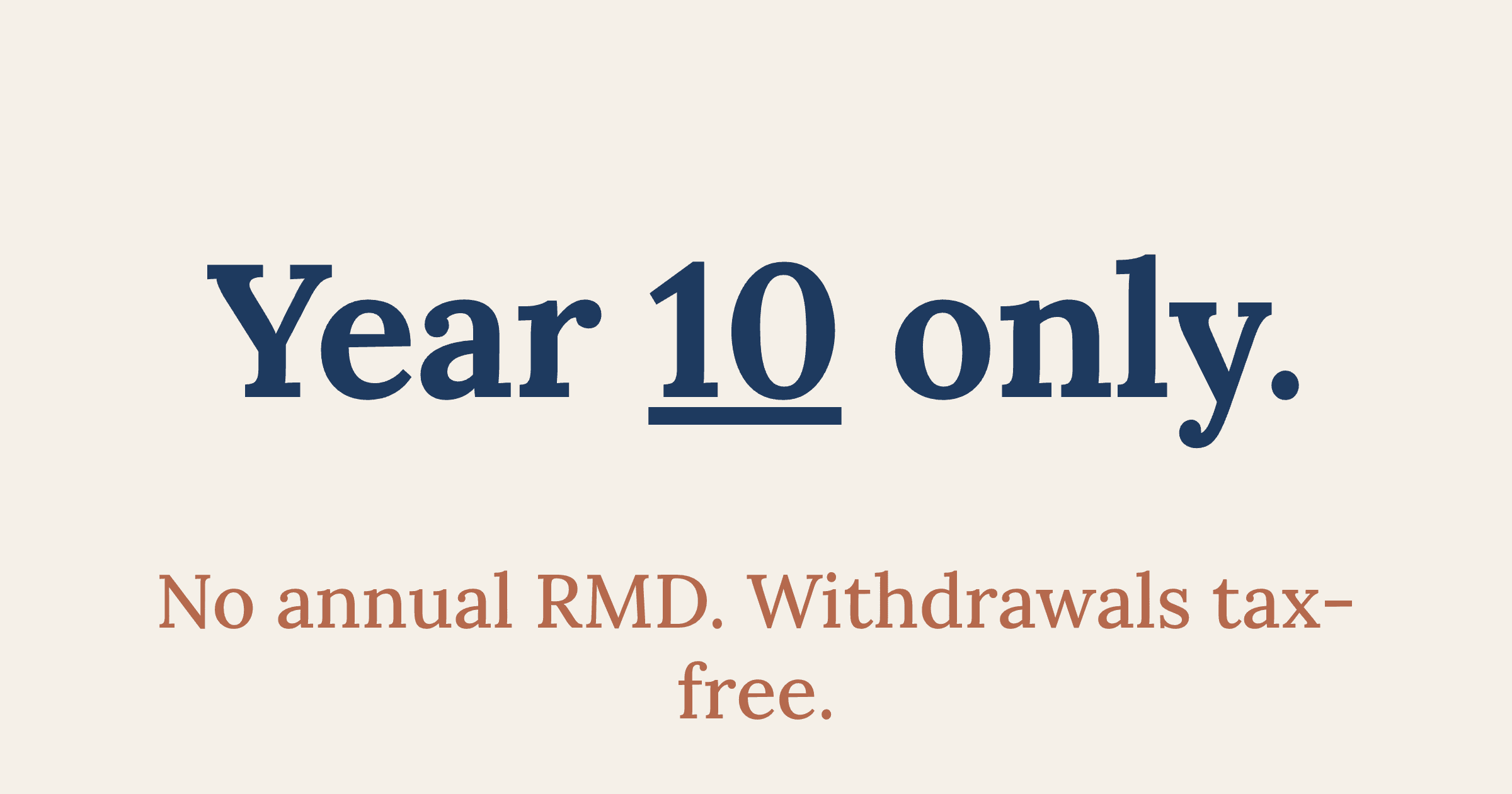
For most beneficiaries, no annual Required Minimum Distribution (RMD) applies to an inherited Roth IRA. But the account does not stay open forever. Under the SECURE Act, a non-spouse beneficiary must empty the inherited Roth by December 31 of the 10th year after the original owner's death.
The withdrawals along the way are tax-free. The deadline at the end is hard.
Try the Free Inherited IRA RMD CalculatorNo annual RMD during the 10-year window
IRS Final Regulations T.D. 10001 (July 2024) confirmed that the original Roth IRA owner is treated as having died before their required beginning date — no matter what age they were. That treatment shuts off the annual RMD requirement that applies to most inherited Traditional IRAs.
For a non-spouse beneficiary on the standard 10-year rule, this means there is no required minimum to take in years one through nine. A beneficiary can let the entire balance grow tax-free for the full ten-year window if they choose, then withdraw it all in year ten.
This is a meaningful planning advantage that does not exist for inherited Traditional IRAs, where annual RMDs are usually required throughout the 10-year window when the original owner died on or after their required beginning date.
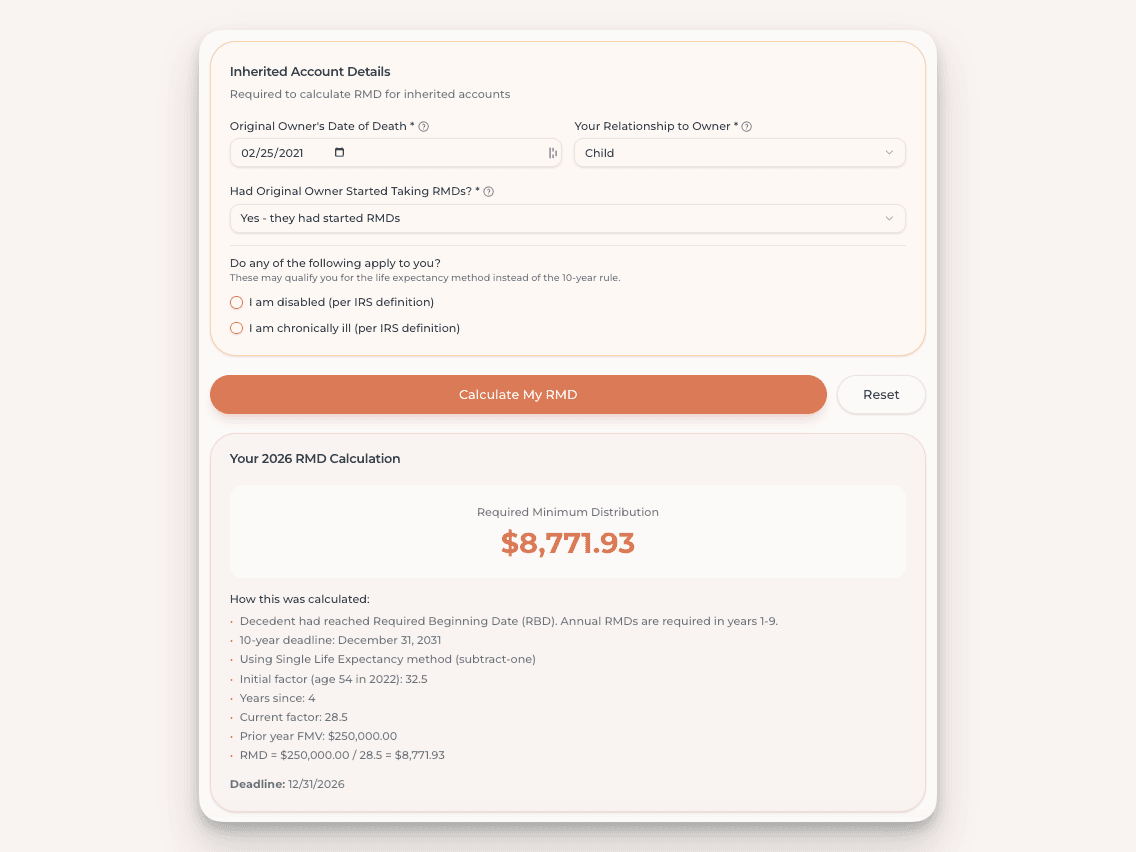
The 10-year deadline still applies
The full inherited Roth balance must be distributed by December 31 of the 10th year after the original owner's death. Missing the deadline triggers the IRS 25% excise tax on whatever should have been distributed.
Withdrawals from an inherited Roth are tax-free as long as the original owner had held any Roth IRA for at least five years before death. The clock is the original owner's first Roth, not the beneficiary's — a beneficiary cannot start a new clock that satisfies the rule. If the original owner's five-year clock had not been met, earnings withdrawn before the clock runs are subject to ordinary income tax. Contributions and converted amounts are tax-free regardless.
Strategy choices range from "withdraw nothing until year ten" to "spread it evenly across the runway." Tax-free growth argues for waiting; estate-planning, divorce, or beneficiary-of-beneficiary risk can argue for earlier withdrawal.

Spousal beneficiaries and EDBs: different paths
A surviving spouse who inherits a Roth IRA has additional options, including treating the Roth as their own. Once that election is made, the spouse never has to take an RMD from the account during their lifetime — Roth IRAs have no lifetime RMD for the original or surviving-spouse owner.
An eligible designated beneficiary other than a spouse — a minor child of the original owner, a chronically ill or disabled person, or someone less than 10 years younger than the deceased — generally takes life-expectancy distributions from an inherited Roth, no 10-year deadline. There is still no income tax on those withdrawals if the five-year holding rule is met.
See the inherited-IRA pillar hub for the full beneficiary framework, How It Works for what SimpleRMD does, and the main RMD hub for the lifetime RMD rules that do not apply to original Roth owners but do apply to most other accounts.
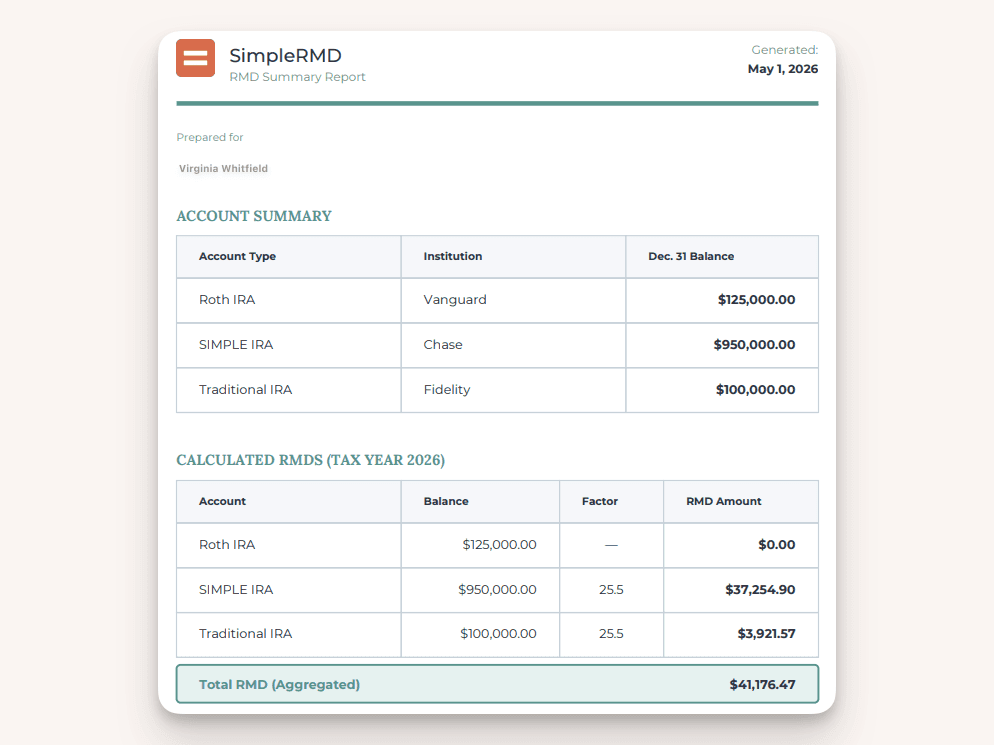
This article is for informational purposes only and does not constitute tax, legal, or financial advice. IRS rules and tax laws are subject to change. Consult a qualified tax professional or financial advisor for guidance specific to your situation. SimpleRMD is a calculation and tracking tool — not a financial advisory service.
Sources: IRS Final Regulations T.D. 10001 (July 2024). IRS.gov (Publication 590-B, "Distributions from Roth IRAs"). IRS Notices 2022-53, 2023-54, 2024-35. SECURE Act of 2019 (Pub. L. 116-94). SECURE 2.0 Act of 2022 (Pub. L. 117-328). Rules confirmed current as of May 2026.