


No. Inherited IRAs do not receive a step-up in basis at the original owner's death. This is one of the most consequential and most misunderstood differences between inherited retirement accounts and inherited taxable assets like stocks or real estate.
The beneficiary inherits the account, the rules that came with it, and — for a Traditional IRA — the same future tax bill the original owner was deferring.
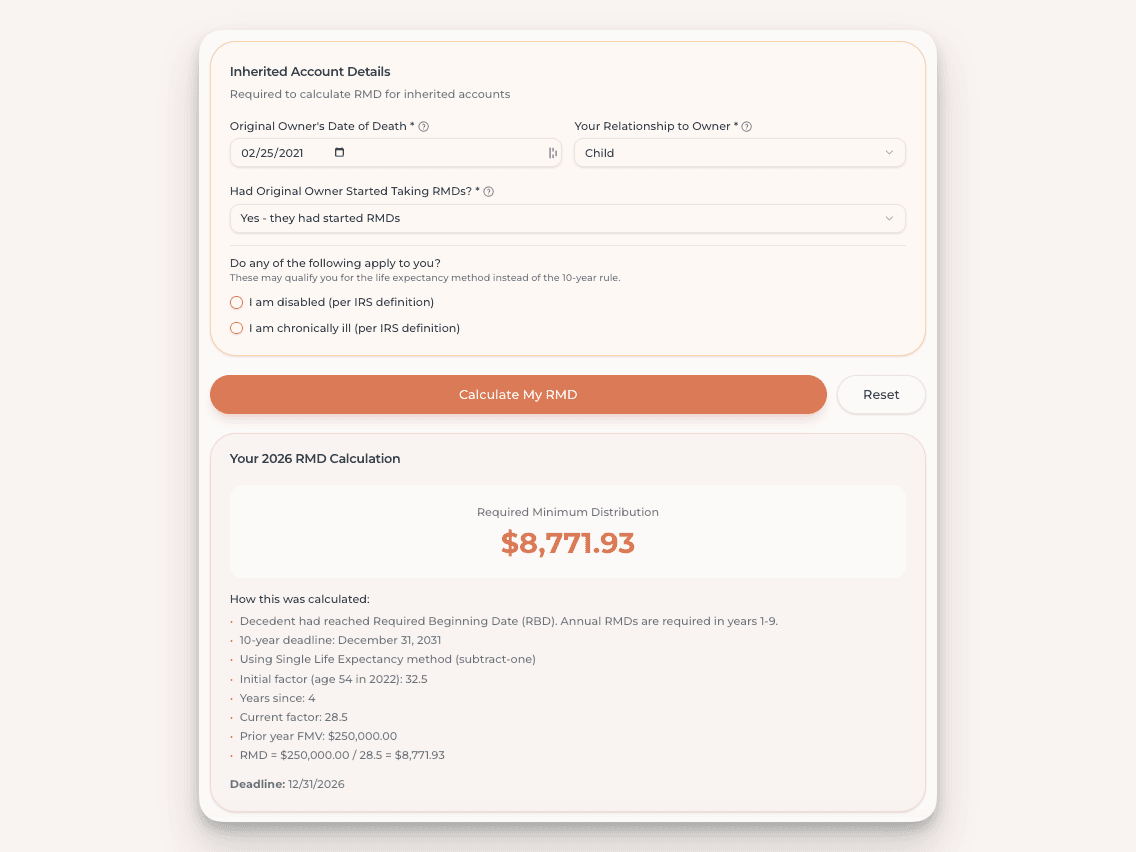
Try the Free Inherited IRA RMD CalculatorWhy a taxable account gets a step-up but an IRA does not
Step-up in basis applies to assets held outside retirement accounts. When someone dies, the cost basis of those assets resets to fair market value on the date of death. The beneficiary can sell immediately and owe nothing on the appreciation that built up during the original owner's lifetime.
IRAs work differently because the assets inside an IRA were never taxed in the same way. Traditional IRA contributions and growth are tax-deferred — the IRS has not collected income tax on any of it. The beneficiary inheriting that account inherits the deferred tax along with the balance.
Tax rules call this "income in respect of a decedent" (IRD). The income was earned by the original owner but not yet taxed; it gets taxed to whoever receives it.
What this means for Traditional vs. Roth
For an inherited Traditional IRA, every dollar withdrawn is ordinary income to the beneficiary. There is no basis reset, no capital-gains treatment, no step-up.
For an inherited Roth IRA, the basis question is different but the answer is still no step-up. The Roth's tax-free treatment is what matters: qualified withdrawals come out without tax regardless of basis, provided the original owner had held a Roth for at least five years before death.
If the original owner had after-tax basis in a Traditional IRA — for example, from non-deductible contributions reported on Form 8606 — that basis transfers to the beneficiary. Each distribution is partly tax-free and partly taxable, in the same proportion the basis bore to the total balance.

The estate-planning implication
The lack of step-up reshapes how families think about which assets to spend and which to leave behind. Heirs who inherit appreciated stocks or real estate get a step-up to date-of-death value and can sell with little or no tax. Heirs who inherit a Traditional IRA pay ordinary income tax on every withdrawal, often within the SECURE Act's 10-year deadline.
This is one reason RMDs and inherited-IRA distributions deserve careful timing planning. Pulling the entire 10-year balance in year ten can create a tax spike; spreading withdrawals can keep the beneficiary in lower brackets.
See the inherited-IRA pillar hub for the broader beneficiary framework, How It Works for what SimpleRMD does, and the main RMD hub for RMD rules across all account types. For the question of whether you can withdraw more than the RMD in a given year, see can I withdraw more than the RMD from an inherited IRA.
This article is for informational purposes only and does not constitute tax, legal, or financial advice. IRS rules and tax laws are subject to change. Consult a qualified tax professional or financial advisor for guidance specific to your situation. SimpleRMD is a calculation and tracking tool — not a financial advisory service.
Sources: IRS Final Regulations T.D. 10001 (July 2024). IRS.gov (Publication 590-B, "Income in Respect of a Decedent"). IRS Form 8606 instructions. IRS Notices 2022-53, 2023-54, 2024-35. SECURE Act of 2019 (Pub. L. 116-94). SECURE 2.0 Act of 2022 (Pub. L. 117-328). Rules confirmed current as of May 2026.