


Yes. A beneficiary of an inherited IRA can name a successor beneficiary on the account, and in most cases the custodian requires it as part of the inherited-IRA setup. Whoever is named becomes the successor beneficiary and inherits whatever runway is left if the primary beneficiary dies before the account is empty.
The detail that catches people off guard is that the deadline does not reset. The successor steps into the primary beneficiary's schedule — both the year-of-emptying deadline and any annual Required Minimum Distribution already in motion.
Try the Free Inherited IRA RMD CalculatorHow to name a successor beneficiary
Most custodians ask for a successor beneficiary designation when the inherited-IRA account is opened. The form looks similar to the original IRA beneficiary form: name, date of birth, relationship, share percentage. Primary and contingent slots are usually both available.
If no successor is named, the inherited IRA passes to the primary beneficiary's estate at their death. That triggers a non-designated-beneficiary outcome for the successor side of the chain — the estate route generally accelerates the timeline and removes any individual-beneficiary flexibility. Naming a person on the form prevents that.
Multiple successors can be named with percentage splits. Trusts can be named as successor beneficiaries under the same rules as trusts named as primary beneficiaries — see can a trust be the beneficiary of an IRA for the see-through requirements. A minor can be named as a successor, though a custodian on the minor's behalf will need to be designated.
The deadline does not reset
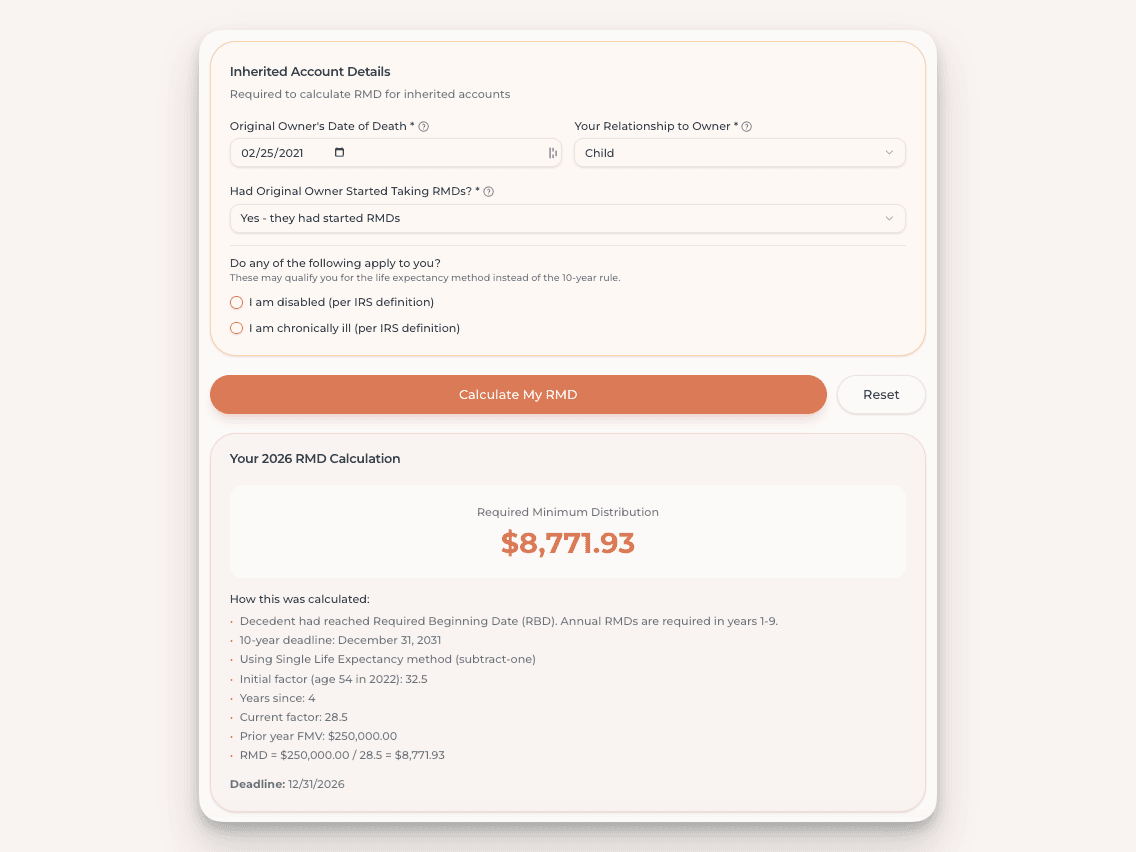
When a successor beneficiary inherits, the existing schedule continues. If the primary beneficiary was on a 10-year clock that ends in 2032, the successor's deadline is also December 31, 2032 — not ten more years from the successor's inheritance date.
Any annual RMD already running on the primary beneficiary's life expectancy continues on the same schedule. The successor uses the primary's age-based factor from the IRS Single Life Table reduced by one each subsequent year, not a fresh single-life table lookup based on the successor's own age. The schedule already in motion stays in motion.
One narrow exception: if the primary beneficiary was an eligible designated beneficiary taking lifetime stretch distributions, the successor generally gets a fresh 10-year window starting from the primary beneficiary's death, with annual RMDs continuing during that period using the primary's schedule. The 10-year clock is the runway; the annual amount is the floor.

What changes for the successor's options
A successor beneficiary does not get the same set of options the original primary beneficiary had. A surviving spouse who is a successor beneficiary cannot treat the account as their own — that option is reserved for direct beneficiaries of the original owner. The successor is treated like any other successor: continue the existing schedule, no rollover-to-own.
The 10% early-withdrawal penalty does not apply to inherited-IRA distributions, including for a successor. That exemption stays with the account titling regardless of who currently holds it.
Account titling needs to follow IRS formatting: "[Original owner's name], deceased, IRA F/B/O [successor's name], beneficiary." A new account at the same custodian or a trustee-to-trustee transfer to another custodian preserves the titling. A 60-day rollover does not work for non-spouse successors and triggers full taxation.
For the related question of what happens when you are the successor stepping into the role, see successor beneficiary of an inherited IRA. The inherited-IRA pillar hub covers the broader beneficiary framework, the main RMD hub covers RMD rules across all account types, and How It Works walks through what SimpleRMD does at each step.
This article is for informational purposes only and does not constitute tax, legal, or financial advice. IRS rules and tax laws are subject to change. Consult a qualified tax professional or financial advisor for guidance specific to your situation. SimpleRMD is a calculation and tracking tool — not a financial advisory service.
Sources: IRS Final Regulations T.D. 10001 (July 2024). IRS.gov (Publication 590-B, "Beneficiaries"). IRS Notices 2022-53, 2023-54, 2024-35. SECURE Act of 2019 (Pub. L. 116-94). SECURE 2.0 Act of 2022 (Pub. L. 117-328). Rules confirmed current as of May 2026.