


Yes. A trust can be named the beneficiary of an IRA, and on the day the IRA owner dies, the trust inherits the account. Whether that is a good idea depends on what the trust says, who the underlying beneficiaries are, and whether the trust is structured to qualify as a "see-through" trust under IRS rules.
The wrong trust structure costs years of tax-deferred growth.
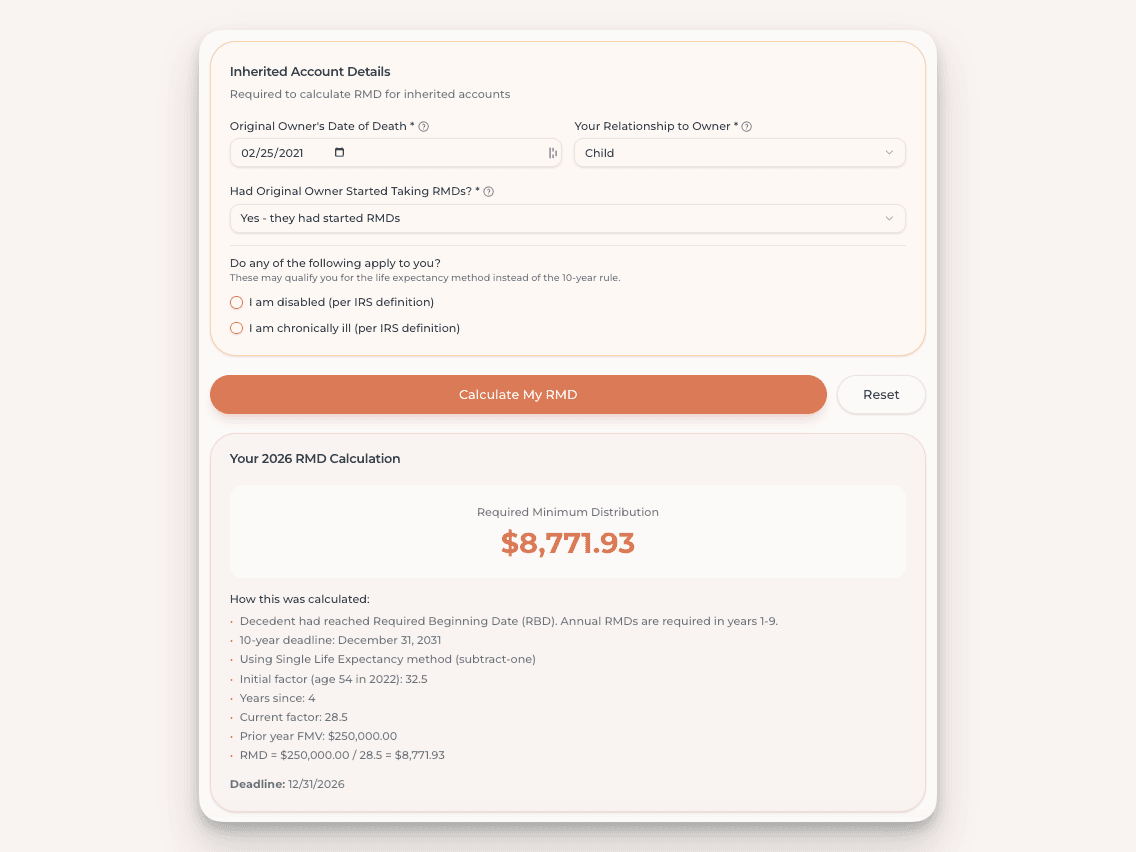
Try the Free Inherited IRA RMD CalculatorSee-through trusts: the standard rules apply
A trust that meets the IRS "see-through" requirements lets the IRS look past the trust to the individual beneficiaries underneath. Those individuals are then treated as the beneficiaries for distribution purposes — and the standard inherited-IRA rules apply based on who they are.
Under T.D. 10001, a see-through trust must be valid under state law, irrevocable on the IRA owner's death, identify the beneficiaries from the trust document, and have all beneficiaries who are individuals. The required documentation must be provided to the IRA custodian by October 31 of the year after death.
When those tests are met, the trust beneficiaries fall under the same buckets as a direct beneficiary: spouse, eligible designated beneficiary, designated beneficiary, or non-designated beneficiary. The 10-year rule, the annual RMD requirement, and the eligible-designated-beneficiary exceptions all flow through.
Non-qualifying trusts: the 5-year rule
A trust that fails the see-through tests — or any non-individual beneficiary like an estate or charity — is treated as a non-designated beneficiary. The 5-year rule applies if the IRA owner died before their required beginning date, meaning the entire account must be distributed by December 31 of the fifth year after death.
If the IRA owner died on or after the required beginning date, the trust takes distributions over the deceased owner's remaining single life expectancy — a payout schedule that is often shorter than ten years for older owners.
Either way, the tax-deferred runway shrinks dramatically compared to a properly drafted see-through trust. This is the most common drafting failure: a trust intended to control distributions that quietly disqualifies itself for see-through treatment.

When naming a trust makes sense
Trusts are commonly named beneficiary in three situations: minor children who cannot legally own an IRA outright, beneficiaries who receive needs-based government benefits a trust is structured to preserve, and blended-family situations where the IRA owner wants distributions controlled across two generations.
In each case, drafting matters more than the decision itself. A see-through-qualified accumulation trust gives full control over distributions; a conduit trust passes RMDs through to the beneficiary as received. The choice has direct tax and timing consequences for the beneficiary.
This is the kind of decision that pays for an estate attorney with retirement-account experience. SimpleRMD calculates the RMD once the trust is in place; the inherited-IRA pillar hub covers the broader rules, How It Works walks through what SimpleRMD does, and the main RMD hub covers RMD rules across all account types.
This article is for informational purposes only and does not constitute tax, legal, or financial advice. IRS rules and tax laws are subject to change. Consult a qualified tax professional or financial advisor for guidance specific to your situation. SimpleRMD is a calculation and tracking tool — not a financial advisory service.
Sources: IRS Final Regulations T.D. 10001 (July 2024). IRS.gov (Publication 590-B, "See-Through Trust" rules). IRS Notices 2022-53, 2023-54, 2024-35. SECURE Act of 2019 (Pub. L. 116-94). SECURE 2.0 Act of 2022 (Pub. L. 117-328). Rules confirmed current as of May 2026.