

A successor beneficiary is the person who inherits an IRA that someone else already inherited. The original IRA owner died first; a primary beneficiary inherited the account; that primary beneficiary then died before fully draining it. Whoever is named on the inherited account at that point is the successor.
Two facts catch most successor beneficiaries off guard: the 10-year clock does not reset, and any annual Required Minimum Distribution (RMD) that applied to the prior beneficiary keeps running.
Try the Free Inherited IRA RMD CalculatorThe 10-year clock keeps running
Under IRS Final Regulations T.D. 10001 (July 2024), a successor beneficiary inherits the deadline that already applied to the prior beneficiary — the clock does not start over.
If the original (post-2019) beneficiary was on the standard 10-year rule, the successor must empty the account by December 31 of the same 10th year — whatever time is left, that is the runway.
Example: An IRA owner dies in 2022, a daughter inherits, and the daughter dies in 2025. The daughter was on track for a 2032 deadline. Her successor inherits in 2025 with seven years left — not ten. The successor's December 31, 2032 deadline matches the daughter's.
One exception: if the prior beneficiary was an eligible designated beneficiary taking life-expectancy distributions, the successor generally gets a fresh 10-year window starting from the prior beneficiary's death, with annual RMDs based on the EDB's schedule continuing during that period.
Annual RMDs may still be required
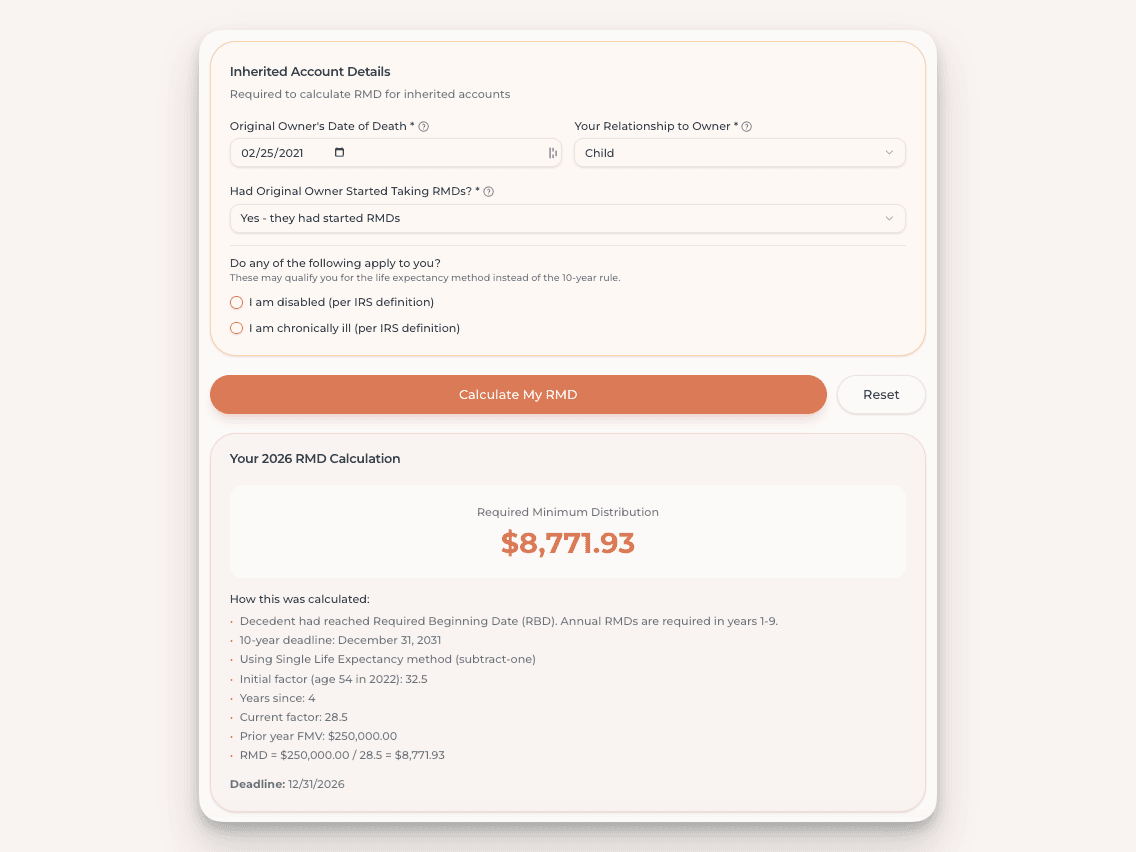
If the prior beneficiary was required to take annual RMDs — which generally happens when the original IRA owner died on or after their required beginning date — the successor continues those annual RMDs in addition to the year-10 cleanup.
The annual amount is calculated using the prior beneficiary's life expectancy schedule, with the factor reduced by one each year. The successor does not get a fresh life expectancy table; the schedule already in motion stays in motion.
Skipping a required annual amount triggers the IRS 25% excise tax on the missed RMD. The 10-year deadline at the end of the runway is separate, and missing that triggers the same penalty on the remaining balance.

Spousal exceptions do not pass through
A surviving spouse who inherits directly from the original IRA owner has special options, including treating the IRA as their own. A spouse who is a successor beneficiary does not.
The spousal-treatment-as-own option is reserved for direct beneficiaries of the original owner. A spouse stepping into a successor seat is treated as any other successor: the runway and any annual RMD that applied to the prior beneficiary continue, no rollover-to-own option.
If the inherited account is sitting at one custodian and you want it at another, request a trustee-to-trustee transfer, not a 60-day rollover. SimpleRMD's inherited-IRA pillar hub covers the broader beneficiary framework, and How It Works walks through what SimpleRMD does at each step. For the underlying RMD rules across all account types, see the main RMD hub.
This article is for informational purposes only and does not constitute tax, legal, or financial advice. IRS rules and tax laws are subject to change. Consult a qualified tax professional or financial advisor for guidance specific to your situation. SimpleRMD is a calculation and tracking tool — not a financial advisory service.
Sources: IRS Final Regulations T.D. 10001 (July 2024). IRS.gov (Publication 590-B, RMD FAQs). IRS Notices 2022-53, 2023-54, 2024-35. SECURE Act of 2019 (Pub. L. 116-94). SECURE 2.0 Act of 2022 (Pub. L. 117-328). Rules confirmed current as of May 2026.