

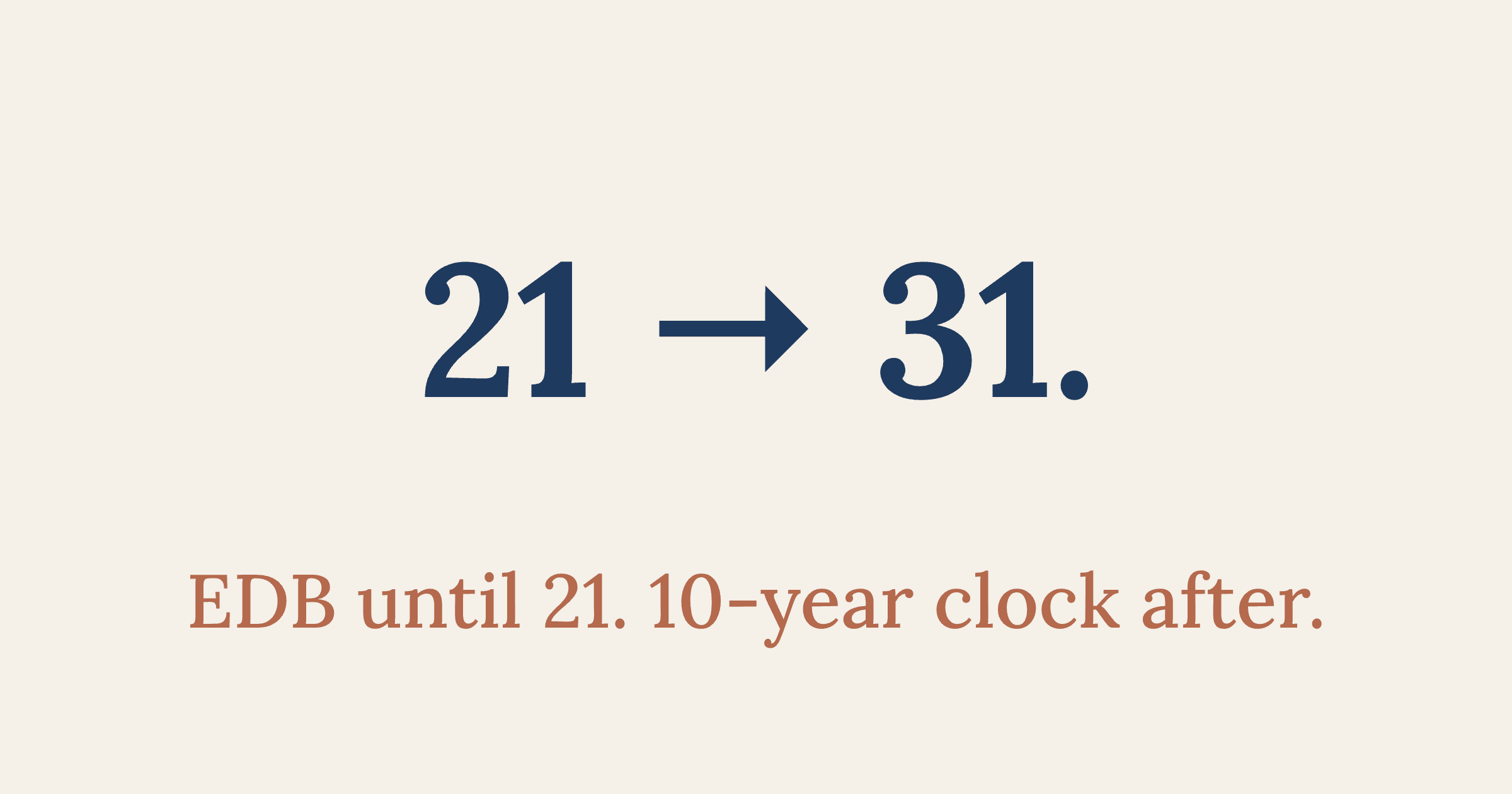
Only a minor child of the original IRA owner — not a grandchild, niece, nephew, or unrelated minor — qualifies as an eligible designated beneficiary by reason of age. Until age 21, that minor takes annual RMDs on a life-expectancy schedule. At age 21, the rules shift: a 10-year clock starts, and the inherited IRA must be empty by age 31.
This two-stage structure is unique to a minor child of the deceased owner. Other minor beneficiaries fall straight into the 10-year rule.
Try the Free Inherited IRA RMD CalculatorThe minor-child rule, precisely
Under the SECURE Act and T.D. 10001, a minor child of the original IRA owner is treated as an eligible designated beneficiary until they reach age 21. From the year after the original owner's death until that birthday, the child takes annual RMDs based on the IRS Single Life Table and the child's age each year, reducing the factor by one annually.
The age of majority for this rule is 21 federally, regardless of state law. State age of majority does not change the IRS treatment.
Only a minor child of the deceased owner qualifies. A grandchild, stepchild, godchild, or unrelated minor does not — those minors fall under the standard 10-year rule from day one, the same as any non-EDB non-spouse beneficiary.
What happens at age 21
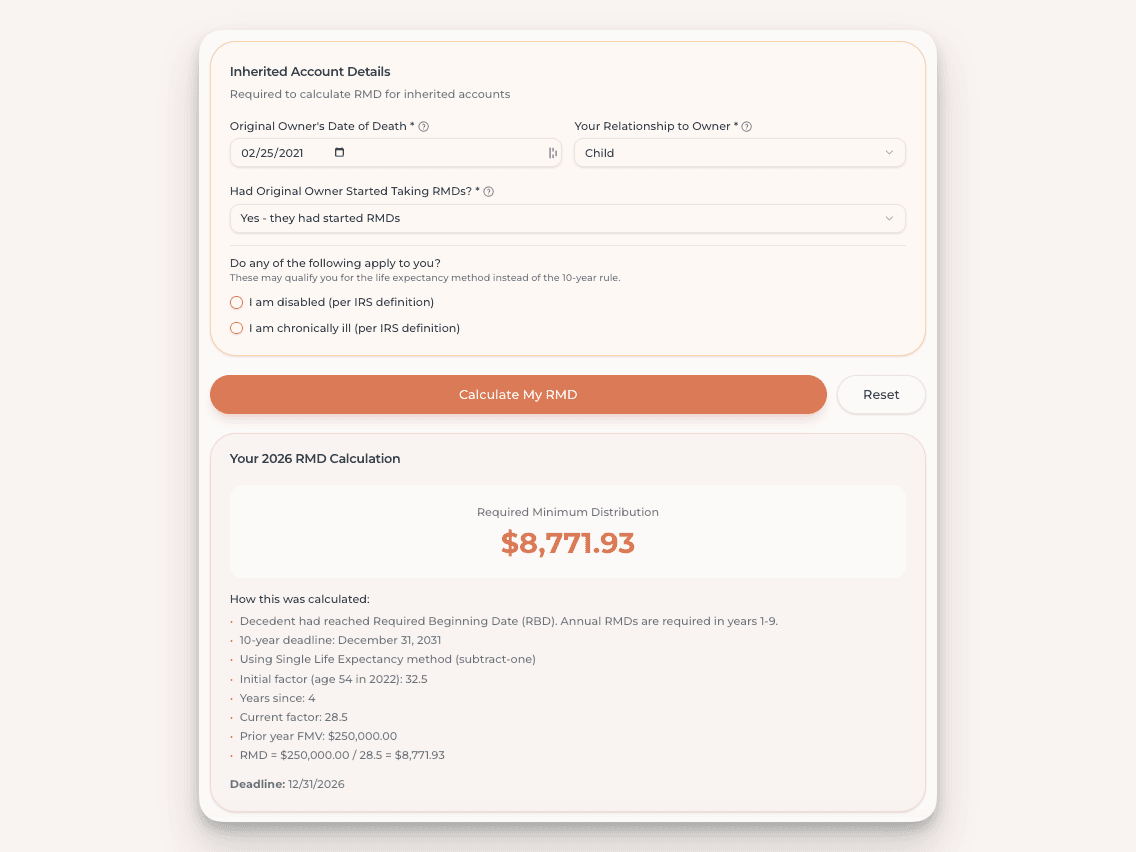
When the minor child reaches age 21, the eligible-designated-beneficiary status ends and the 10-year clock starts. The full inherited IRA balance must be distributed by December 31 of the 10th year following the year the child turns 21 — typically by age 31. The rule operates at calendar-year granularity; the specific birthday date does not change the deadline.
Annual RMDs continue during that 10-year window using the same life-expectancy schedule that was already in motion. The transition does not reset the schedule; it adds a hard end date.
Missing either the annual RMD or the year-10 cleanup deadline triggers the IRS 25% excise tax on the missed amount. The penalty applies to the beneficiary, not the custodian or the account.

Custodial accounts and tax mechanics
A minor cannot legally hold an IRA in their own name. The inherited IRA is opened as a custodial account under a state Uniform Transfers to Minors Act (UTMA) structure, with a parent or court-appointed guardian as custodian. The custodian signs paperwork and authorizes distributions. The minor is the legal owner.
Distributions are taxable income to the minor. For a Traditional IRA, every dollar withdrawn is ordinary income on the child's tax return. The kiddie tax may apply: unearned income above the IRS threshold is taxed at the parents' marginal rate until the child meets the kiddie-tax exit conditions.
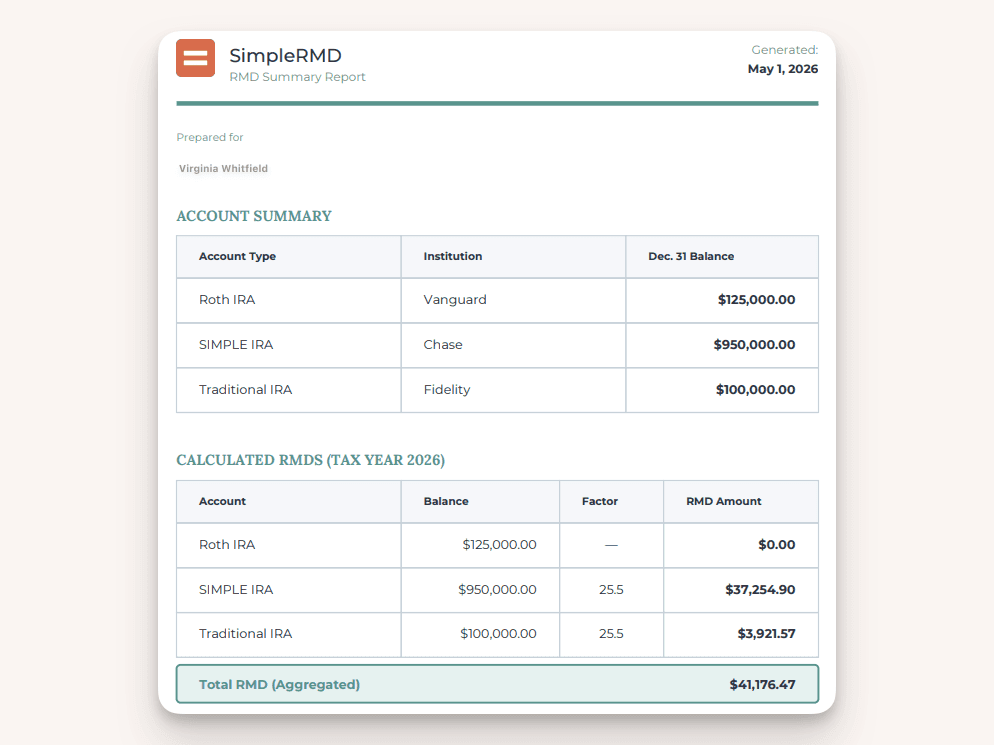
See the inherited-IRA pillar hub for the broader beneficiary framework, How It Works for what SimpleRMD does, and the main RMD hub for RMD rules across all account types. For the question of whether a trust should be the beneficiary instead of a minor child outright, see can a trust be the beneficiary of an IRA.
This article is for informational purposes only and does not constitute tax, legal, or financial advice. IRS rules and tax laws are subject to change. Consult a qualified tax professional or financial advisor for guidance specific to your situation. SimpleRMD is a calculation and tracking tool — not a financial advisory service.
Sources: IRS Final Regulations T.D. 10001 (July 2024). IRS.gov (Publication 590-B, "Eligible Designated Beneficiaries"). IRS Notices 2022-53, 2023-54, 2024-35. SECURE Act of 2019 (Pub. L. 116-94). SECURE 2.0 Act of 2022 (Pub. L. 117-328). Rules confirmed current as of May 2026.