

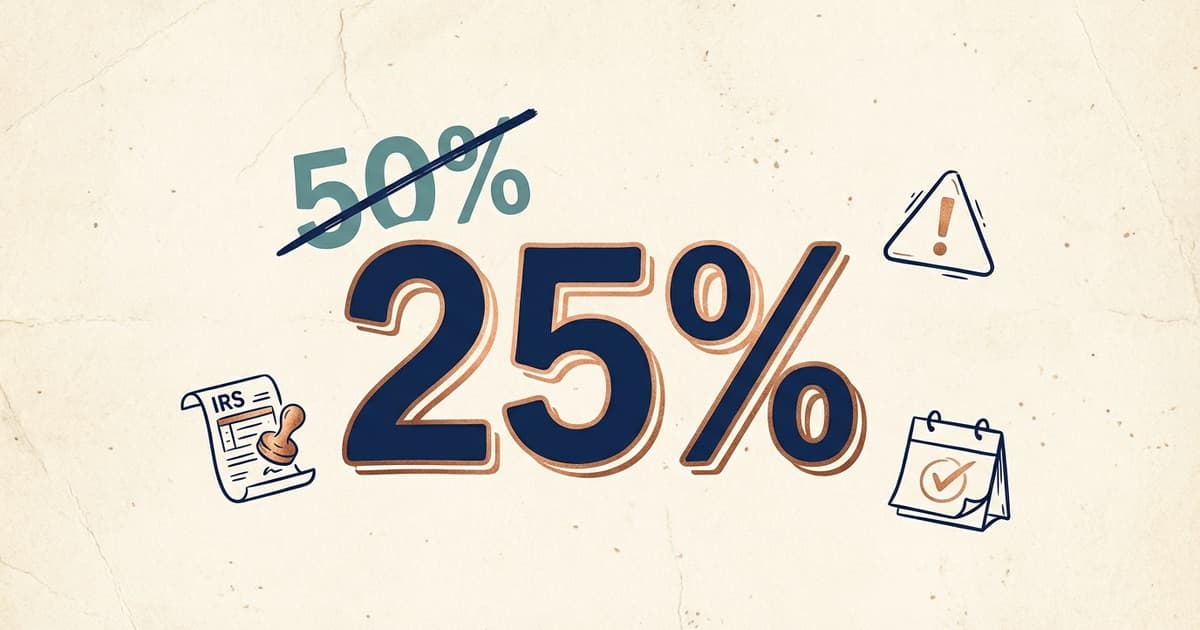
If you've read anything about missing an RMD and seen the number 50%, that figure is out of date. The SECURE 2.0 Act of 2022 cut the penalty in half — the excise tax for a missed or insufficient Required Minimum Distribution is now 25% of the shortfall, not 50%.
That change is significant, but there's more good news buried in it: the penalty can be reduced further to 10% automatically if you correct the mistake within two years. And with a reasonable explanation filed on Form 5329, the IRS may waive it to $0 entirely.
Here's exactly how the penalty structure works, who it applies to, and what your options are if you've missed one. (Not sure whether you've actually missed a deadline? Start with the RMD deadlines and penalties overview.)
In short: The RMD penalty is 25% of the amount you should have withdrawn but didn't — not 25% of your account balance. It drops automatically to 10% if you correct the error within two years. The IRS can waive it entirely with a reasonable explanation on Form 5329. SECURE 2.0 reduced the penalty from 50% to 25% for tax years after December 29, 2022.
Why You're Seeing "50%" Everywhere
The 50% penalty was in effect for decades and is still widely quoted — on brokerage websites, in news articles, in financial planning guides. It was one of the steepest penalties in the tax code, and it got a lot of attention.
The SECURE 2.0 Act, signed into law on December 29, 2022, reduced that rate to 25% for any RMD shortfall in tax years beginning after that date. So for 2023 and all subsequent years, the 25% rate applies. If you missed an RMD in 2022 or earlier, the old 50% rate still governs that year's shortfall — but for anything from 2023 forward, you're in 25% territory.
The IRS hasn't been aggressive about updating older guidance across the web. When you search for RMD penalties and see 50%, it's usually a page that hasn't been updated since 2022.
What the Penalty Actually Applies To
This is where most of the panic comes from. People hear "25% penalty" and assume the IRS is taking a quarter of their retirement savings. That's not how it works.
The penalty applies to the shortfall — the amount you should have withdrawn but didn't.
If your RMD was $14,000 and you withdrew $0, the penalty is 25% of $14,000, which is $3,500. If you withdrew $10,000 and fell short by $4,000, the penalty is 25% of $4,000 — $1,000.
Worked example:
Margaret is 77. Her Traditional IRA had a December 31, 2025 balance of $380,000. Her life expectancy factor at age 77, using the Uniform Lifetime Table, is 22.9. Her 2025 RMD is:
$380,000 ÷ 22.9 = $16,594
Margaret didn't take any distribution before December 31, 2025.
Her maximum penalty is 25% of $16,594 = $4,149.
Not $380,000 × 25% = $95,000. The penalty is on the missed amount, not the account.
Margaret still owes income tax on the $16,594 distribution when she takes it. But the penalty itself — the part that's punitive — is calculated on the gap.
The Three Penalty Tiers
There's a sliding scale depending on how quickly you correct the mistake:
| Situation | Penalty Rate | What's Required |
|---|---|---|
| Missed RMD, not yet corrected | 25% | Take the distribution, file Form 5329 |
| Corrected within 2-year correction window | 10% (automatic) | Take the distribution, file Form 5329 — no letter needed |
| Reasonable cause waiver approved | $0 | Take the distribution, file Form 5329 with explanation letter |
The 10% automatic reduction
The two-year correction window runs from the original RMD deadline. If your RMD was due December 31, 2025, you have until December 31, 2027 to take the missed distribution and file Form 5329 to qualify for the 10% rate. You don't need to write an explanation or make a case — the reduced rate is automatic if you correct within the window.
First-year note: If you missed your very first RMD — the one with the April 1 deadline — the correction window still runs from the original April 1 due date, not December 31. First-year timing is one of the most common sources of genuine confusion, and the IRS treats it as reasonable cause more often than most people expect. See: First-year RMD rules
The window closes earlier if the IRS mails a notice of deficiency or assesses the tax before the two years are up.
The $0 waiver path
If you believe the missed distribution was due to a reasonable error, you can request a full waiver from the IRS. This requires filing Form 5329 with your tax return and attaching a short letter explaining what happened and what you did to fix it.
The IRS evaluates each case individually, but the bar is lower than most people expect. Common reasons that have supported successful waivers: an illness or hospitalization that disrupted your normal financial routine, a custodian processing error, genuine confusion about first-year RMD rules, or a misunderstanding about inherited IRA requirements that were, frankly, confusing even to the IRS for several years.
The key is to take the distribution before you file and to be honest and specific in the letter. The IRS is looking for good faith and a prompt correction — not a perfect record.
For a full walkthrough of Form 5329 and what to write in your letter, see: IRS waiver for a missed RMD
What About Inherited IRAs?
The same penalty structure applies to inherited IRA required distributions.
From 2021 through 2024, the IRS waived penalties for beneficiaries who missed annual distributions under the 10-year rule while the final regulations were being drafted. That relief ended on December 31, 2024. Starting with distributions due in 2025, the standard 25%/10% penalty structure applies to missed inherited IRA RMDs — no exceptions.
If you inherited an IRA in 2020–2023 and haven't been taking annual distributions, the 10-year clock has been running the whole time. The waiver years did not pause the clock. Work with a tax professional to assess where you stand and how to get current.
For the full picture on inherited IRA distribution rules: Inherited IRA RMD rules · The 10-year rule explained
The Statute of Limitations
SECURE 2.0 also introduced a 3-year statute of limitations for missed RMDs. The clock starts from the tax filing deadline (not including extensions) for the year in which the RMD was missed.
In practical terms: once three years pass from the original filing deadline, the IRS can no longer assess the excise tax for that specific missed distribution. But this is not a strategy — a missed RMD still creates a tax filing obligation, and the penalty clock still runs until corrected. The statute simply sets an outer limit on IRS assessment.
First Step: Take the Distribution Now
Before anything else — before filing any forms, before calling your CPA — take the distribution.
This matters because:
- The correction window starts from the original deadline. Every day you wait without taking the distribution is time on the clock.
- Demonstrating prompt correction is the single strongest argument for a full waiver, if you pursue one.
- The IRS evaluates your waiver request more favorably when you've already fixed the mistake.
Once the distribution is taken, you or your tax professional can handle the Form 5329 filing at tax time. The distribution goes into the tax year you take it, not the year it was due.
One thing to be aware of: the corrective distribution is taxable income in the year it's received. If you missed your 2025 RMD and take the distribution in 2026, that income shows up on your 2026 return — not 2025. Depending on the size of the distribution, this could affect your tax bracket, your Medicare Part B and D premiums (via IRMAA), or how much of your Social Security is taxable. It's worth running the numbers with your CPA before choosing when to take a large corrective withdrawal.
Not sure how much to withdraw? The SimpleRMD calculator will calculate your exact RMD from the missed year — use your December 31 balance from the year the distribution was due, not today's balance.
Remind me in November
We'll send one reminder in November. No newsletters.
You can unsubscribe anytime.
Frequently Asked Questions
Does this apply to 401(k)s and other employer plans, not just IRAs?
Yes — the same 25%/10% penalty structure applies to required distributions from 401(k)s, 403(b)s, and other qualified employer plans. The correction process for individual participants is the same (Form 5329). Note that if the failure is at the plan level rather than the participant level, plan sponsors have a separate correction pathway through the IRS Employee Plans Compliance Resolution System (EPCRS). If you participate in an employer plan and have questions about a missed distribution, check with your plan administrator in addition to your tax professional.
Is the penalty 25% of my account balance or 25% of my RMD?
Neither, exactly — it's 25% of the shortfall. If your RMD was $12,000 and you withdrew $8,000, the penalty applies to the $4,000 difference. If you withdrew nothing, the penalty applies to the full $12,000 RMD amount.
Does the 25% rate apply to 2022 missed RMDs?
No. For any RMD shortfall in tax years beginning on or before December 29, 2022, the old 50% rate applies. The 25% rate took effect for tax years beginning after that date. If you're dealing with a 2022 miss, confirm the applicable rate with your tax professional.
Do I have to pay the penalty before requesting a waiver?
No. If you're requesting a waiver, you enter $0 on the penalty line of Form 5329. The IRS will either accept your waiver or contact you with a different assessment. You don't pay the penalty and then ask for a refund.
Can I get the waiver if I correct the mistake in the same tax year?
Yes — correcting promptly within the same year you missed actually strengthens your waiver case. The IRS looks for evidence that you corrected the error as soon as you realized it. Same-year corrections tend to produce favorable outcomes.
What if I've missed RMDs across multiple years?
You'll need to file a separate Form 5329 for each year you missed, using that year's version of the form. Each year's shortfall is calculated independently — based on that year's December 31 account balance and the applicable life expectancy factor for that year — so the penalty amounts can vary. Corrective distributions can be allocated to specific years, which matters when some years are still within the two-year correction window and others aren't. Multi-year situations are more complex, and working with a tax professional is usually worthwhile. The correction and waiver process still works — it just involves more paperwork.
For the step-by-step correction process, see: Late RMD distribution — what to do
What to do next
- Run the calculator — calculate the exact amount you owe for the year you missed, free, no account required
- Step-by-step correction guide — what to do after you've missed a deadline
- How to request an IRS waiver — Form 5329 walkthrough with letter guidance
- RMD deadlines and penalties — full overview
- What happens if you don't take an RMD
This article is for informational purposes only and does not constitute tax, legal, or financial advice. IRS rules and tax laws are subject to change. Consult a qualified tax professional or financial advisor for guidance specific to your situation. SimpleRMD is a calculation and tracking tool — not a financial advisory service.
Sources: IRS Publication 590-B (2025); IRS Form 5329 Instructions (2025), Part IX — Additional Tax on Excess Accumulations; SECURE 2.0 Act of 2022 (Pub. L. 117-328); IRS Notice 2024-35 (inherited IRA transition relief); IRS.gov — Retirement Topics: Required Minimum Distributions; Retirement Plan and IRA RMD FAQs. Rules confirmed current as of 2026. IRS rules are subject to change — verify with the latest IRS publications or a qualified tax professional.