

Yes. The Required Minimum Distribution (RMD) is a floor, not a ceiling. A beneficiary can withdraw any amount above the required minimum in any year, and there is no IRS 10% early-withdrawal penalty on inherited-IRA distributions regardless of the beneficiary's age.
The right amount to withdraw is rarely the bare minimum. Here is when taking more makes sense — and what to watch for.
Try the Free Inherited IRA RMD CalculatorThe rule is straightforward
An inherited IRA has no early-withdrawal penalty. Beneficiaries of any age can take distributions without owing the 10% penalty that applies to early withdrawals from a beneficiary's own IRA before age 59½.
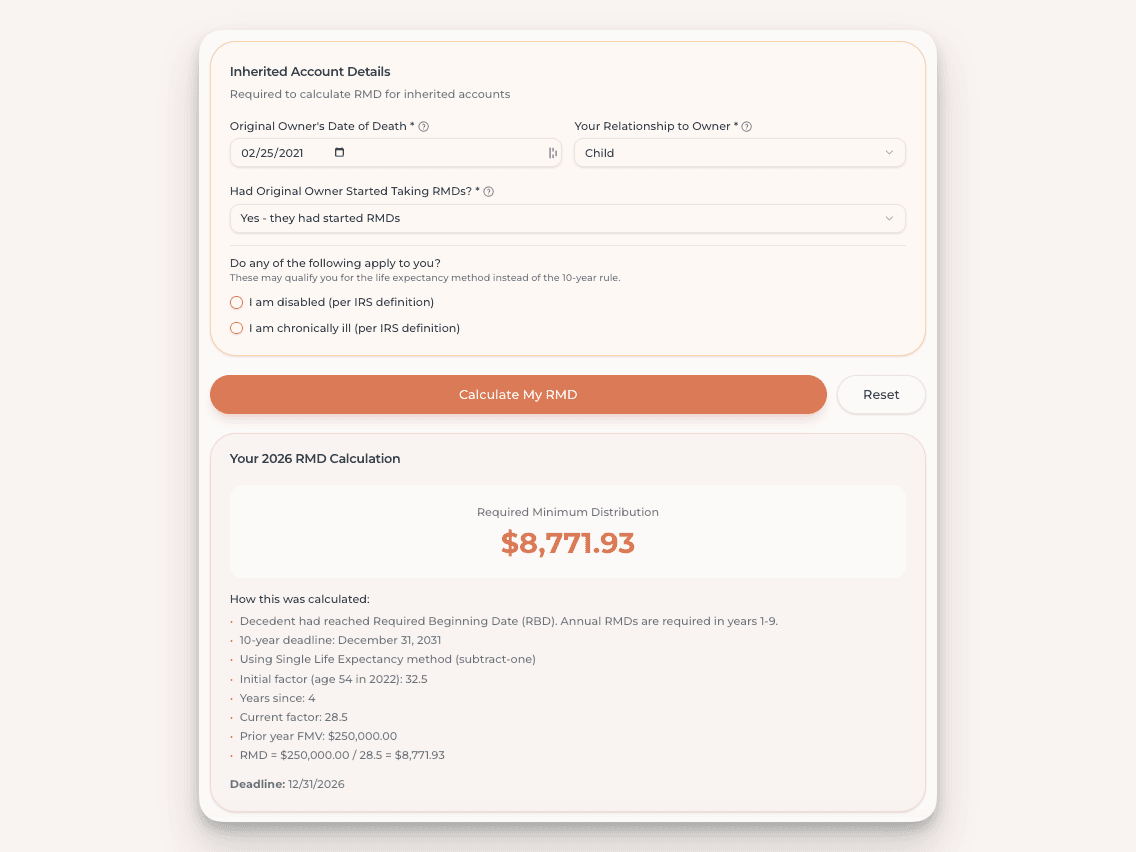
Whatever annual RMD applies to the account is the minimum required for that year. Anything above the minimum is allowed. The account can be drained in a single year if that is what the beneficiary wants.
For an inherited Traditional IRA, every withdrawal is ordinary income to the beneficiary in the year received. For an inherited Roth IRA, qualified withdrawals are tax-free as long as the original owner held any Roth for at least five years before death.
When taking more than the RMD makes sense
Three situations regularly call for above-minimum withdrawals on an inherited Traditional IRA.
First, the 10-year rule. A non-spouse beneficiary on the standard 10-year deadline owes income tax on the full balance by December 31 of year ten. Letting the balance ride to year ten and taking it as a single lump can push the beneficiary into the top federal bracket. Spreading the withdrawal across the runway often produces a lower lifetime tax bill.
Second, low-income years. A beneficiary with an unusually low-income year — between jobs, on partial sabbatical, in early retirement before Social Security starts — can use the lower bracket to pull more out at a lower tax cost.
Third, expected tax-rate increases. Filing changes (single to MFJ or vice versa), a planned move to a higher-tax state, or a known income jump can argue for accelerating withdrawals into a lower-tax year.
What the extra withdrawal does not do
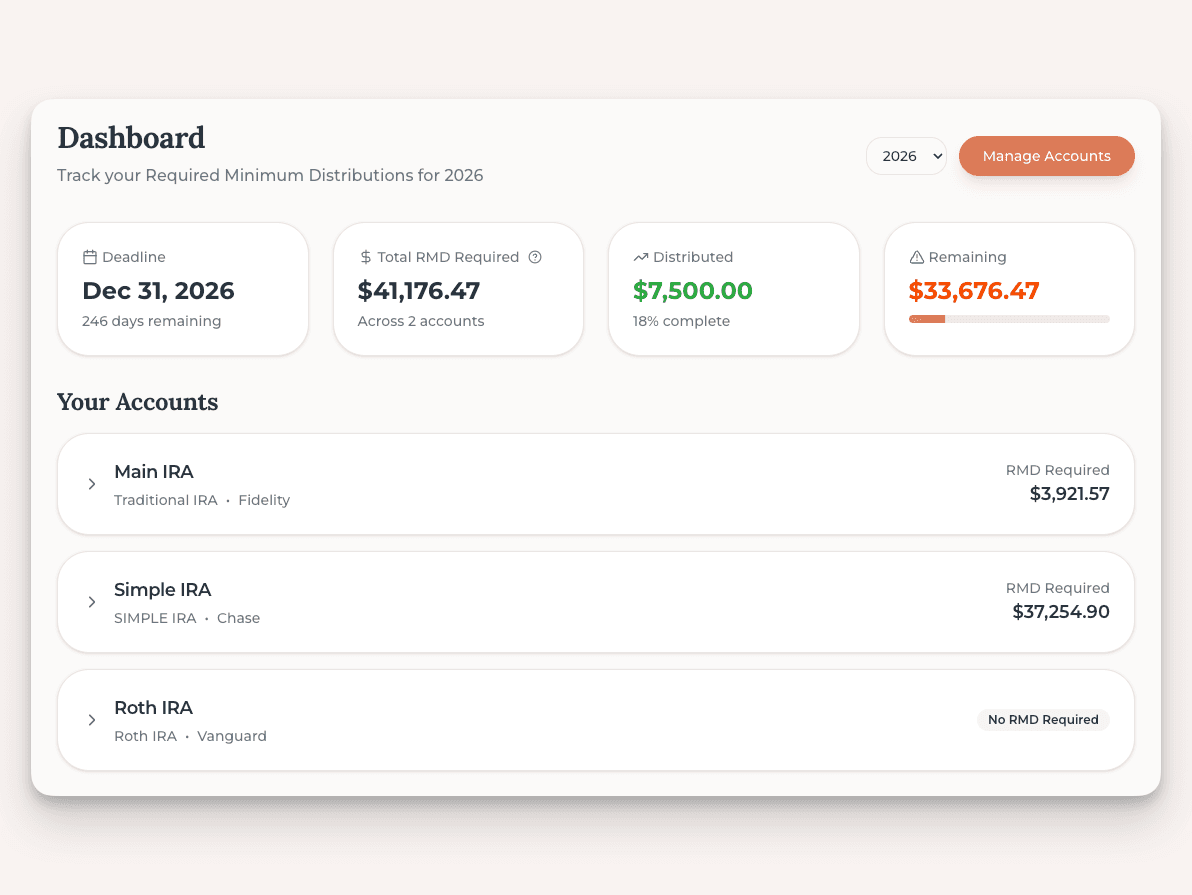
Withdrawing more than the RMD does not satisfy future-year RMDs. Each year's RMD is calculated against that year's prior-year-end balance and the applicable life expectancy factor. A large withdrawal in year three reduces the balance going into year four, which slightly reduces year four's RMD — but it does not skip year four.
Roth conversion is also off the table. A beneficiary cannot convert an inherited Traditional IRA to a Roth IRA. A surviving spouse who has elected to treat the inherited IRA as their own can convert at that point, but only because the IRA is no longer treated as inherited.
See the inherited-IRA pillar hub for the broader rules, How It Works for what SimpleRMD does, and the main RMD hub for RMD rules across all account types. For the related question of whether annual RMDs apply at all on an inherited Roth, see do I need to take an RMD from an inherited Roth IRA.
This article is for informational purposes only and does not constitute tax, legal, or financial advice. IRS rules and tax laws are subject to change. Consult a qualified tax professional or financial advisor for guidance specific to your situation. SimpleRMD is a calculation and tracking tool — not a financial advisory service.
Sources: IRS Final Regulations T.D. 10001 (July 2024). IRS.gov (Publication 590-B, RMD FAQs). IRS Notices 2022-53, 2023-54, 2024-35. SECURE Act of 2019 (Pub. L. 116-94). SECURE 2.0 Act of 2022 (Pub. L. 117-328). Rules confirmed current as of May 2026.