

The answer depends on the type of account. A Required Minimum Distribution (RMD) from a Traditional IRA, Roth IRA, or inherited IRA never requires spousal consent. An RMD from an ERISA-covered 401(k), 403(b), or similar qualified plan may require spousal consent, depending on the plan's default distribution form and the participant's marital status.
The confusion is common because the two rule sets live near each other in retirement law. IRA rules and ERISA rules are different, and the spousal-consent layer comes from ERISA.
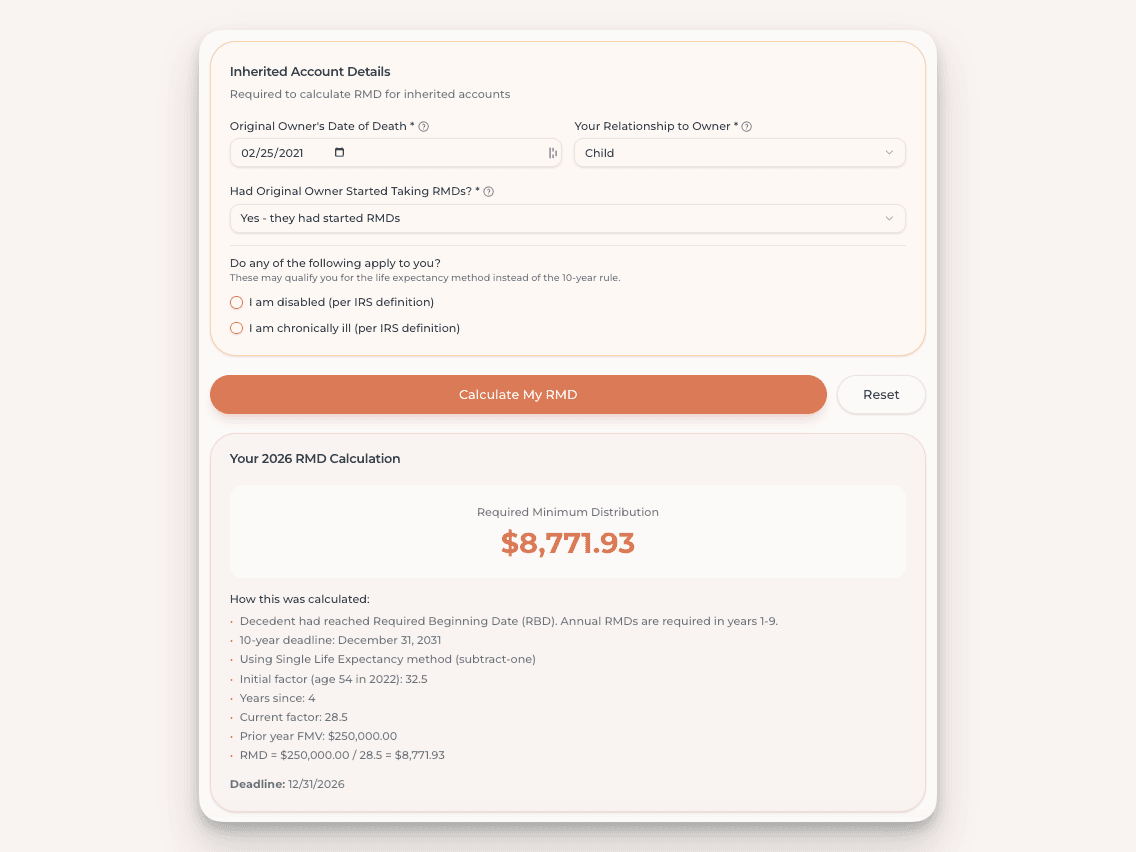
Try the Free Inherited IRA RMD CalculatorIRAs: no federal spousal-consent requirement
Traditional IRAs, Roth IRAs, SEP-IRAs, and SIMPLE IRAs are not ERISA-governed in the same way as employer plans. The account owner can take any RMD or any other distribution without their spouse's consent or signature. The custodian does not request it because federal law does not require it.
The same holds for inherited IRAs. A beneficiary distributing from an inherited IRA does not need consent from the beneficiary's spouse to take an RMD, take more than the RMD, or empty the account before the deadline. The inherited-IRA titling is a beneficiary account, and beneficiary distributions are governed by IRC §408(a)(6) and the inherited-IRA rules, not by ERISA's joint-and-survivor protections.
Beneficiary designation on an IRA is a separate question from distribution consent. Some community-property states have rules requiring spousal consent to name a non-spouse as a primary beneficiary on an IRA, but the distribution itself is the account owner's decision.
ERISA plans: consent depends on the default form
401(k), 403(b), and other defined-contribution plans covered by ERISA often default to a Qualified Joint and Survivor Annuity (QJSA) as the distribution form for married participants. The QJSA pays out as an annuity over the joint lives of the participant and spouse. To take any other distribution form — including a lump sum, installment withdrawals, or an RMD-amount distribution that does not match the QJSA stream — the participant typically needs the spouse's signed consent on the plan's distribution-election form.
Not every ERISA plan uses the QJSA default. Many modern 401(k) plans use a non-QJSA default for the participant's own account, in which case spousal consent applies only when the participant names someone other than the spouse as primary beneficiary, not for RMDs. The plan document is the source of truth — the plan administrator can confirm what is required for a specific distribution.
Money purchase pension plans and defined benefit plans almost always carry QJSA protections. Spousal consent is required for any non-annuity distribution from those plans, including the participant's own RMDs.
Two more places spousal consent shows up
Federal Thrift Savings Plan (TSP) accounts require spousal consent for most distributions, including RMDs, when the participant is married. A narrow set of waivers applies — for example, when the spouse cannot be located — but the default rule is consent.
Beneficiary designation on an ERISA plan is the second place spousal-consent rules show up. Federal law requires the spouse to be the sole primary beneficiary of an ERISA-covered plan account unless the spouse signs a notarized waiver. This is different from the IRA rule, where federal law lets the account owner name anyone as beneficiary, subject to any community-property-state limits.
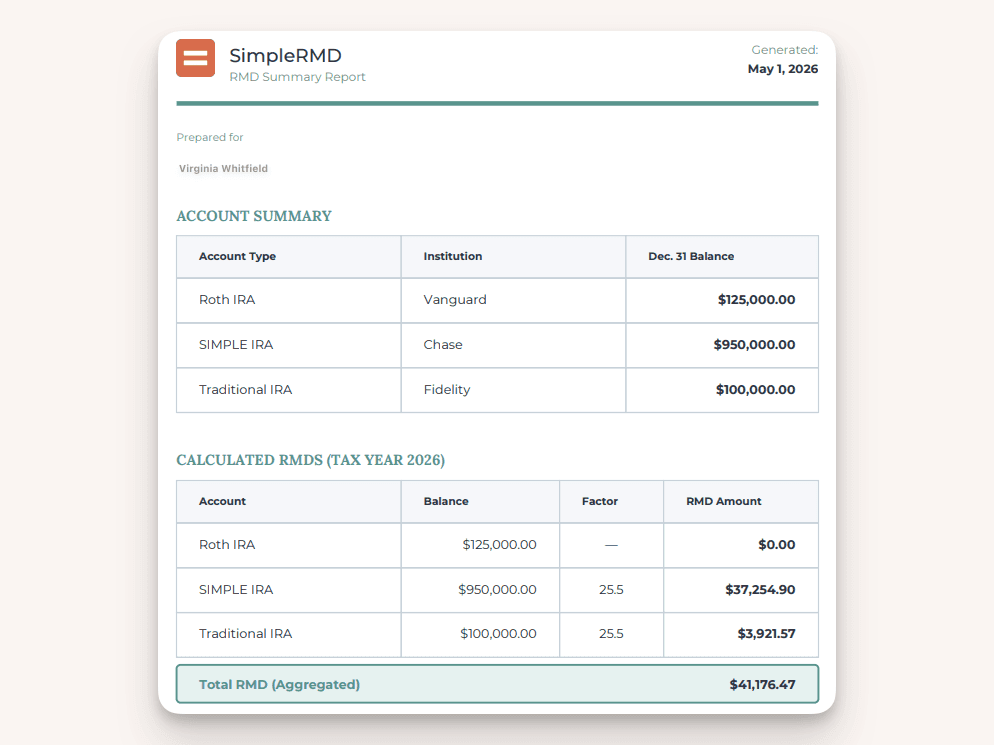
For the related question of how a surviving spouse takes RMDs from an inherited IRA, see does a spouse have to take RMDs from an inherited IRA. The inherited-IRA pillar hub covers the broader beneficiary framework. The main RMD hub covers RMD rules across all account types. How It Works walks through what SimpleRMD does at each step.
This article is for informational purposes only and does not constitute tax, legal, or financial advice. IRS rules and tax laws are subject to change. Consult a qualified tax professional or financial advisor for guidance specific to your situation. SimpleRMD is a calculation and tracking tool — not a financial advisory service.
Sources: IRS Final Regulations T.D. 10001 (July 2024). IRS.gov (Publication 590-B, "Beneficiaries"). Employee Retirement Income Security Act of 1974 (ERISA) §205. Internal Revenue Code §401(a)(11). SECURE Act of 2019 (Pub. L. 116-94). SECURE 2.0 Act of 2022 (Pub. L. 117-328). Rules confirmed current as of May 2026.