

Yes — but the timing and amount depend on which option the spouse picks. A surviving spouse beneficiary has three paths that no other beneficiary has access to, and the Required Minimum Distribution (RMD) schedule looks different under each.
A Roth IRA inherited from a spouse has its own twist worth knowing up front: no annual RMD applies to the spouse during life if the spouse treats the account as their own, and no annual RMD applies under the inherited-account route either, because Roth owners never reach a required beginning date.
Try the Free Inherited IRA RMD CalculatorPath 1: treat the IRA as your own
A surviving spouse can roll the inherited IRA into their own IRA or retitle the deceased's account in the spouse's name. Once that happens, the account is no longer an inherited IRA — it is the spouse's own retirement account, governed by the same rules as any other IRA the spouse already owns.
RMDs begin at age 73 (age 75 for spouses born in 1960 or later, per SECURE 2.0). Before that age, no annual withdrawal is required. The 10% early-withdrawal penalty now applies to distributions before age 59½, because the account is the spouse's own.
This path is only available to a surviving spouse who inherits directly from the original owner. A spouse who is a successor beneficiary — inheriting from someone else who had already inherited — does not have the treat-as-own option.
Path 2: keep it as an inherited IRA
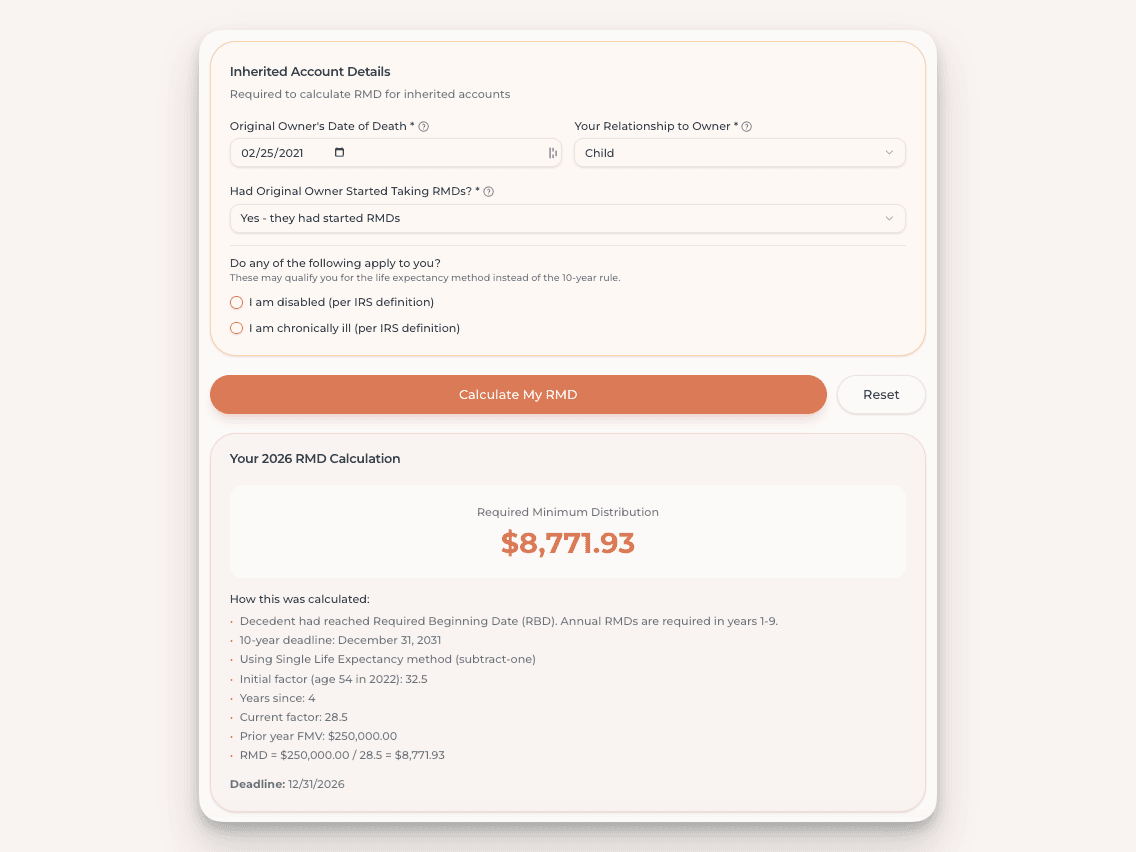
Holding the account as a beneficiary-titled inherited IRA preserves the spouse's status as an eligible designated beneficiary. That status allows lifetime stretch distributions based on the spouse's own single life expectancy, recalculated each year from the IRS Single Life Table.
Timing of the first RMD splits two ways. If the deceased spouse died before reaching their required beginning date, the surviving spouse can wait until the deceased would have reached RMD age before starting distributions. If the deceased had already started RMDs, the surviving spouse continues annual RMDs by December 31 of the year following the year of death.
The 10% early-withdrawal penalty does not apply to inherited-IRA distributions at any age. The spouse can also switch from this path to Path 1 at any later date, which is useful when the spouse's own RMD age is still years away.
Path 3: treat as the deceased participant (SECURE 2.0 election)
SECURE 2.0 created a third option for surviving spouses, effective for deaths in 2024 and later. The spouse can elect to be treated as the deceased participant for RMD purposes. That means the RMD schedule follows the deceased's age, not the spouse's, using the Uniform Lifetime Table.
This election makes sense when the deceased spouse was younger than the survivor, because RMDs start later than they would under Path 1 and use a more favorable factor than the Single Life Table under Path 2. The election is made on the beneficiary's tax return for the year of the first required distribution.
All three paths apply to a surviving spouse who inherits directly. For the related question of when a spouse can use a 60-day rollover to move the inherited IRA, see 60-day rollover from an inherited IRA. The inherited-IRA pillar hub covers the broader beneficiary framework, the main RMD hub covers RMD rules across all account types, and How It Works walks through what SimpleRMD does at each step.
This article is for informational purposes only and does not constitute tax, legal, or financial advice. IRS rules and tax laws are subject to change. Consult a qualified tax professional or financial advisor for guidance specific to your situation. SimpleRMD is a calculation and tracking tool — not a financial advisory service.
Sources: IRS Final Regulations T.D. 10001 (July 2024). IRS.gov (Publication 590-B, "Beneficiaries"). IRS Notices 2022-53, 2023-54, 2024-35. SECURE Act of 2019 (Pub. L. 116-94). SECURE 2.0 Act of 2022 (Pub. L. 117-328), Section 327. Rules confirmed current as of May 2026.