

For most non-spouse beneficiaries inheriting from someone who died in 2020 or later, the answer is no. The SECURE Act of 2019 replaced the lifetime "stretch IRA" with a 10-year deadline. A specific group of beneficiaries — surviving spouses and the four categories of eligible designated beneficiary — can still take life-expectancy distributions.
Whether you fit one of those categories determines how much tax-deferred runway you actually have.
Try the Free Inherited IRA RMD CalculatorWhat the stretch IRA was, and what changed
Before 2020, a non-spouse beneficiary could take RMDs from an inherited IRA over their own remaining life expectancy. A 45-year-old daughter inheriting from a parent could spread distributions across 40-plus years, paying tax slowly and letting the balance grow tax-deferred for decades. That schedule was the stretch IRA.
The SECURE Act ended the lifetime stretch for most non-spouse beneficiaries inheriting after December 31, 2019. The replacement is the 10-year rule: the entire account must be distributed by December 31 of the 10th year after the original owner's death.
IRAs inherited from someone who died before 2020 keep the old rules. The stretch is not retroactive, and it is not gone for everyone.
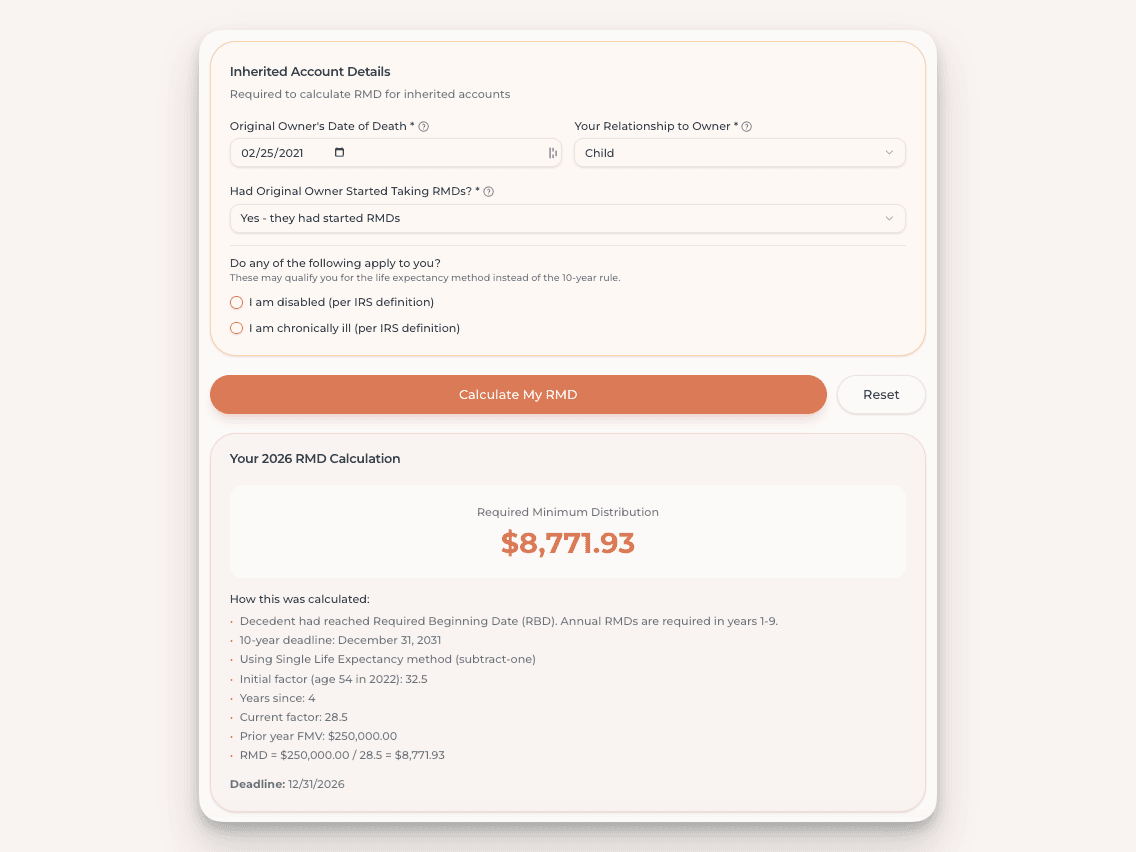
Eligible designated beneficiaries: stretch survives
Five groups of beneficiary qualify as eligible designated beneficiaries (EDBs) and can still take life-expectancy distributions:
- A surviving spouse
- A minor child of the original owner (until age 21, then a 10-year clock starts)
- A disabled person, by IRS standards
- A chronically ill person, by IRS standards
- A beneficiary not more than 10 years younger than the deceased — typically a sibling, partner, or close-in-age friend
An EDB calculates an annual RMD using the IRS Single Life Table and reduces the factor by one each subsequent year. The runway is whatever the EDB's life expectancy is — often longer than ten years, sometimes much longer.
Anyone who is not in one of those five categories falls under the standard 10-year rule.

The annual-RMD trap inside the 10-year rule
Even non-EDBs on the standard 10-year rule may owe annual RMDs along the way. Under T.D. 10001, when the original IRA owner died on or after their required beginning date, the beneficiary must take a yearly RMD in years one through nine in addition to draining the account by year ten.
When the original owner died before their required beginning date, no annual RMDs apply during the 10-year window — the beneficiary can let the balance ride and clean it out at the end.
This distinction is the most common modern-inherited-IRA mistake. Many beneficiaries assume the 10-year rule means "no annual withdrawals until year ten." That is only true if the original owner had not yet hit their required beginning date.
See the inherited-IRA pillar hub for the broader rules, How It Works for what SimpleRMD does, and the main RMD hub for RMD rules across all account types. For the related question of how RMDs work on inherited Roths, see do I need to take an RMD from an inherited Roth IRA.
This article is for informational purposes only and does not constitute tax, legal, or financial advice. IRS rules and tax laws are subject to change. Consult a qualified tax professional or financial advisor for guidance specific to your situation. SimpleRMD is a calculation and tracking tool — not a financial advisory service.
Sources: IRS Final Regulations T.D. 10001 (July 2024). IRS.gov (Publication 590-B, "Beneficiaries"). IRS Notices 2022-53, 2023-54, 2024-35. SECURE Act of 2019 (Pub. L. 116-94). SECURE 2.0 Act of 2022 (Pub. L. 117-328). Rules confirmed current as of May 2026.