

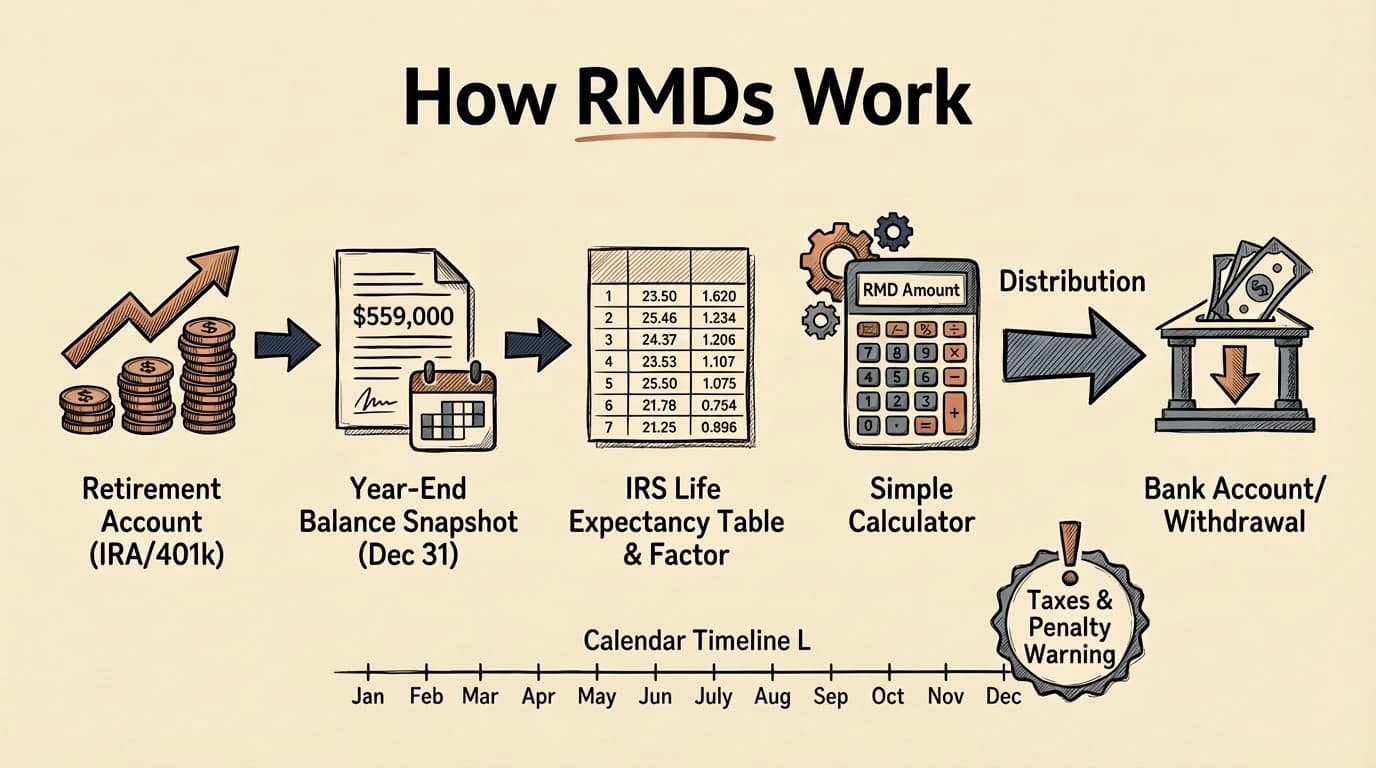
In short: Your RMD equals your prior December 31 account balance divided by a life expectancy factor from the IRS Uniform Lifetime Table — and because that factor shrinks each year as you age, the required withdrawal gradually increases even if your balance stays flat.
On this page
- The Formula
- Step 1: Your Account Balance
- Step 2: Your Life Expectancy Factor
- Step 3: Do the Math
- What If You Have More Than One Account?
- Key Deadlines
- A Quick Reference: RMD Factors by Age
A Required Minimum Distribution comes down to one formula: divide your prior year-end account balance by an IRS life expectancy factor. The result is the minimum amount you must withdraw for the year. Every RMD — regardless of account type, age, or balance — starts with that same calculation. What makes it feel complicated is knowing which numbers to use and where to find them.
This page walks through the full process so you can see exactly how the pieces fit together.
The Formula
Every RMD uses the same structure:
RMD = Prior year-end balance (Dec. 31) ÷ IRS life expectancy factor
The balance comes from your account statement. The factor comes from an IRS table. The reason RMDs increase over time is built into the math: as you age, your life expectancy factor shrinks. Dividing by a smaller number produces a larger result. At age 73, the factor is 26.5. By age 85, it's dropped to 16.0. Same balance, bigger withdrawal.
Four-step RMD calculation process: determine your starting age, find your prior year-end balance, look up your IRS life expectancy factor, and divide to get your RMD
Step 1: Your Account Balance
The balance the IRS uses is your account's fair market value on December 31 of the prior year — not today's value, not the date you take the withdrawal. For your 2026 RMD, you use the balance from December 31, 2025.
Your custodian (the brokerage or institution that holds your account) is required to report this value to the IRS on Form 5498, which typically arrives in May. You don't need to wait for it — your December 31 year-end statement (usually available in January) shows the same figure and is the right number to use for a timely calculation.
One detail that trips people up: if you made contributions or rollovers during the prior year, certain adjustments may apply. For most people this isn't a factor, but if you completed a rollover late in the year, confirm with your custodian that the year-end balance reflects it correctly.
Step 2: Your Life Expectancy Factor
The IRS publishes three life expectancy tables in Publication 590-B. Which one you use depends on your situation:
| Table | Who Uses It | When It Applies |
|---|---|---|
| Uniform Lifetime Table (Table III) | Most account owners | The default for anyone taking RMDs from their own IRA or retirement plan |
| Joint Life Table (Table II) | Account owners with a much-younger spouse | Only when your sole beneficiary is your spouse and they are more than 10 years younger than you |
| Single Life Table (Table I) | Beneficiaries of inherited IRAs | Used for inherited IRA RMD calculations only |
Inherited IRAs use the Single Life Table and follow a different set of rules entirely. See: Inherited IRA RMD rules
The vast majority of people use the Uniform Lifetime Table. You look up your age as of December 31 of the distribution year — not your age when you run the calculation — and find the corresponding factor. If you turn 78 in November 2026, you use the factor for age 78 for your 2026 RMD, even if you're doing the math in January.
This is one of the most common errors we see. Using the wrong age changes the factor by a full point, which shifts the result by hundreds of dollars — enough to create a shortfall that triggers a penalty.
For a detailed walkthrough of all three tables: RMD tables explained
Step 3: Do the Math
With both numbers in hand, the calculation takes about five seconds.
| Janet's Numbers | |
|---|---|
| Balance ÷ Factor = RMD | $420,000 ÷ 22.0 = $19,091 |
Worked Example: Janet
Janet is 78 years old (as of December 31, 2026) and has a Traditional IRA.
| IRA balance on Dec. 31, 2025: | $420,000 |
| Janet's age on Dec. 31, 2026: | 78 |
| Uniform Lifetime Table factor at age 78: | 22.0 |
| 2026 RMD: $420,000 ÷ 22.0 = | $19,091 |
Janet must withdraw at least $19,091 from her IRA by December 31, 2026. She can take more — there's no maximum — but withdrawing less than this amount triggers a 25% excise tax on the shortfall.
Next year, the calculation resets: Janet will use her December 31, 2026 balance, look up the factor for age 79 (21.1), and divide again. The process repeats every year.
One option worth knowing about: if Janet is 70½ or older and makes charitable donations, she could direct some or all of her RMD to a qualified charity through a Qualified Charitable Distribution (QCD) — up to $111,000 for 2026. The amount counts toward her RMD but isn't included in her taxable income. The transfer must go directly from the custodian to the charity. See: QCDs explained
Want to see your own number? Try the SimpleRMD calculator — free, no account required.
What If You Have More Than One Account?
If you have multiple retirement accounts, you must calculate the RMD for each one separately — using each account's own December 31 balance. But whether you can combine those withdrawals into a single distribution depends on the account type.
| Account Type | Calculate Separately? | Can You Aggregate Withdrawals? |
|---|---|---|
| Multiple Traditional IRAs | Yes | Yes — calculate each, then take the total from any one (or combination) of your IRAs |
| Multiple 401(k)s | Yes | No — you must take each 401(k)'s RMD from that specific plan |
| Multiple 403(b)s | Yes | Yes — can aggregate across 403(b)s, but not with IRAs or 401(k)s |
How Aggregation Works in Practice
Say Janet also has a second Traditional IRA at a different brokerage. Her RMDs might look like this:
| Account | Dec. 31, 2025 Balance | Factor (age 78) | RMD |
|---|---|---|---|
| IRA #1 (Fidelity) | $420,000 | 22.0 | $19,091 |
| IRA #2 (Schwab) | $130,000 | 22.0 | $5,909 |
| Total IRA RMD | $25,000 |
Janet's combined RMD is $25,000. She can take the full $25,000 from IRA #1, or split it however she likes between the two accounts. The IRS doesn't care where the money comes from, as long as the total is correct.
If Janet also had a 401(k), that plan's RMD would need to come from the 401(k) itself — she couldn't pull it from an IRA to cover it. Getting this wrong is one of the most common RMD mistakes, and it's the kind of thing that's easy to overlook when you're managing accounts at multiple institutions.
One more distinction: inherited IRAs are completely separate from your own accounts. They use a different IRS table, follow different rules, and cannot be aggregated with your personal IRAs. If you have both your own IRA and an inherited IRA, treat them as two independent calculations. See: Inherited IRA RMD rules
Multiple accounts? The SimpleRMD calculator handles aggregation — enter each account and see the combined result.
Related: RMD rules by account type · 401(k) RMD rules
Key Deadlines
Once you've calculated your RMD, you need to make sure the withdrawal is completed on time.
Your first RMD: You can delay until April 1 of the year after you turn 73 — but this means two RMDs in one calendar year, which can push you into a higher tax bracket. Most people are better off taking the first RMD in the year they turn 73. See: First-year RMD rules
Every RMD after that: Due by December 31 of each year. No extensions, no exceptions.
Processing time matters. Requesting a distribution on December 28 doesn't guarantee it settles by December 31. Custodians can take several business days — sometimes longer during the year-end rush. Build in a cushion. See: RMD deadline: what must happen by December 31
A Quick Reference: RMD Factors by Age
Here's a snapshot from the Uniform Lifetime Table to give you a sense of how factors change over time:
| Age | Factor | Approx % of Balance | RMD on $400,000 |
|---|---|---|---|
| 73 | 26.5 | 3.8% | $15,094 |
| 75 | 24.6 | 4.1% | $16,260 |
| 78 | 22.0 | 4.5% | $18,182 |
| 80 | 20.2 | 5.0% | $19,802 |
| 85 | 16.0 | 6.3% | $25,000 |
| 90 | 12.2 | 8.2% | $32,787 |
The pattern is clear: same balance, rising withdrawals. In practice, your balance will also change from year to year based on market performance and prior withdrawals — which is why recalculating each year matters.
For the complete table and how to read it: RMD tables explained · How to calculate your RMD
Ready to check your numbers?
- Run the calculator — free, no account required
- See how SimpleRMD works
- Back to RMD basics
This article is for informational purposes only and does not constitute tax, legal, or financial advice. IRS rules and tax laws are subject to change. Consult a qualified tax professional or financial advisor for guidance specific to your situation. SimpleRMD is a calculation and tracking tool — not a financial advisory service.
Sources: IRS Publication 590-B (PDF, Uniform Lifetime Table, 2025 edition). IRS — Retirement Topics: Required Minimum Distributions. SECURE 2.0 Act of 2022 (Pub. L. 117-328). Rules confirmed current as of February 2026.