

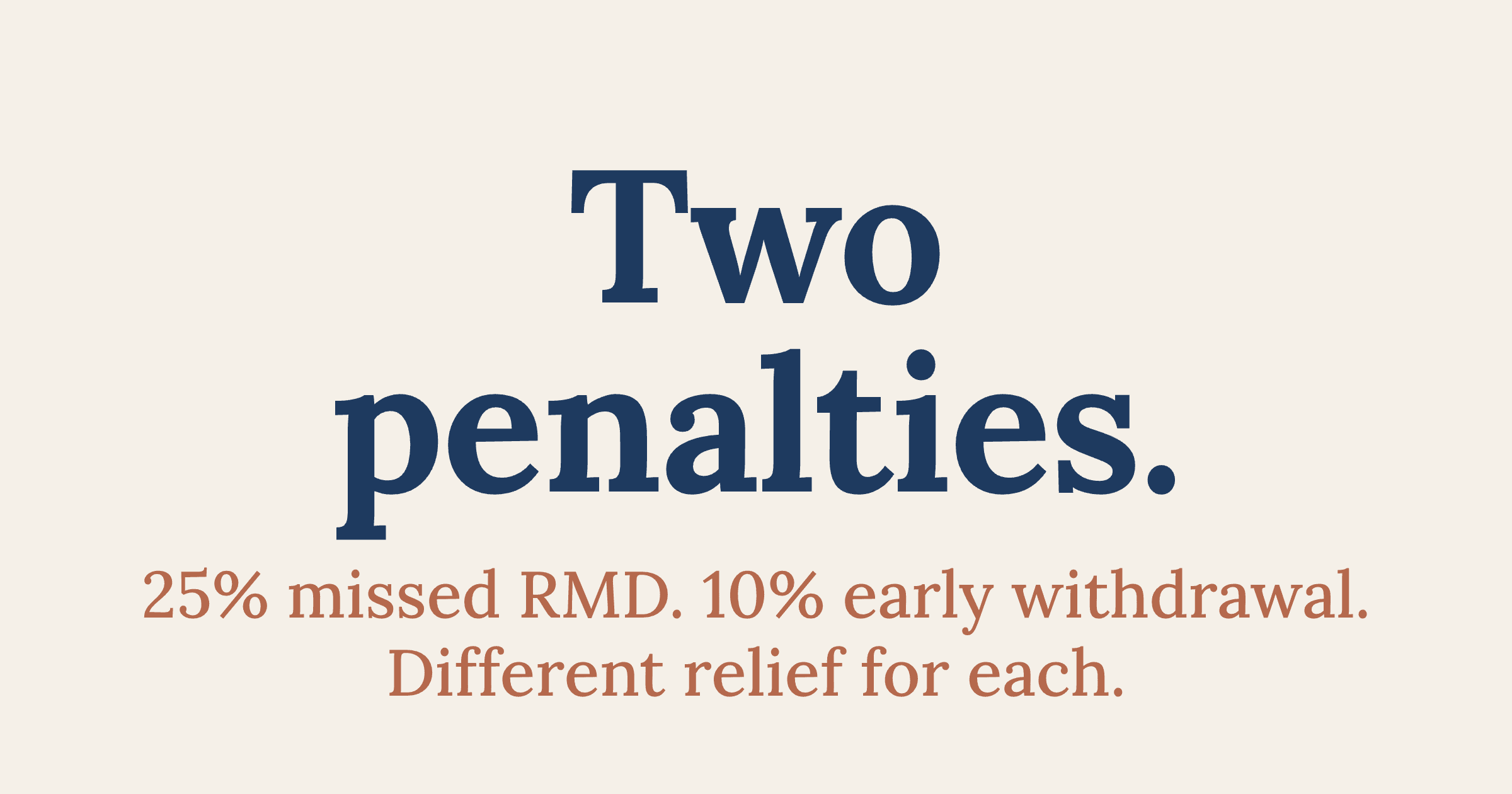
These are two different penalties, and they have two different escape routes. The missed-RMD penalty (25% of the shortfall) can be waived for reasonable cause. The early-withdrawal penalty (10% of the distribution, for taking money out before age 59½) cannot — it only goes away if you fit one of the exceptions written into the law. Both run through Form 5329, which is why they get tangled together in searches.
Sorting out which tax you are actually facing takes one question: was the problem money you failed to take out, or money you took out too soon?
Calculate Your RMDFailed to take money out: the missed-RMD penalty
If you were required to take a minimum distribution and took less than the full amount, the IRS assesses an excise tax on the shortfall: 25%, reduced to 10% if you fix the miss within the correction window (generally by the end of the second year after the miss, and before the IRS assesses the tax).
This penalty has a genuine waiver. Take the late distribution, file Form 5329 Part IX for the year of the miss, write "RC" next to line 54, and attach a short statement showing reasonable error and prompt correction. The IRS grants these regularly. What qualifies is covered in Form 5329 reasonable cause, and the process overview lives at IRS waiver for a missed RMD.
Took money out too soon: the 10% additional tax
If you took a distribution from an IRA or retirement plan before age 59½, the default is a 10% additional tax on top of ordinary income tax. There is no reasonable-cause waiver here. Relief comes only from the statutory exceptions, claimed in Form 5329 Part I with a two-digit code: disability, certain medical expenses, higher education costs, a first home purchase, substantially equal periodic payments, terminal illness, and a handful of others.
One exception matters enormously for beneficiaries: death, exception code 04. Distributions from an inherited IRA are never subject to the 10% early-withdrawal tax, no matter how young the beneficiary is. A 45-year-old draining an inherited IRA under the 10-year rule owes income tax, but not the extra 10%. If a custodian's 1099-R codes the distribution in a way that suggests otherwise, Form 5329 Part I is where you set it straight.
One caveat for young surviving spouses: the exception protects the account only while it stays inherited. Roll it into your own IRA and withdrawals before 59½ are penalized like any other early distribution.
Which one applies to you
- Age 73 or older (or holding an inherited IRA with annual RMDs) and the money never came out? Missed-RMD penalty. Waivable for reasonable cause. Take the distribution, then file Part IX.
- Under 59½ and the money came out of your own account? The 10% additional tax, unless a Part I exception code fits your facts.
- Under 59½ and the money came out of an account you inherited? No early-withdrawal penalty at all. Code 04.
- Both situations in the same year? File both parts of the same Form 5329.
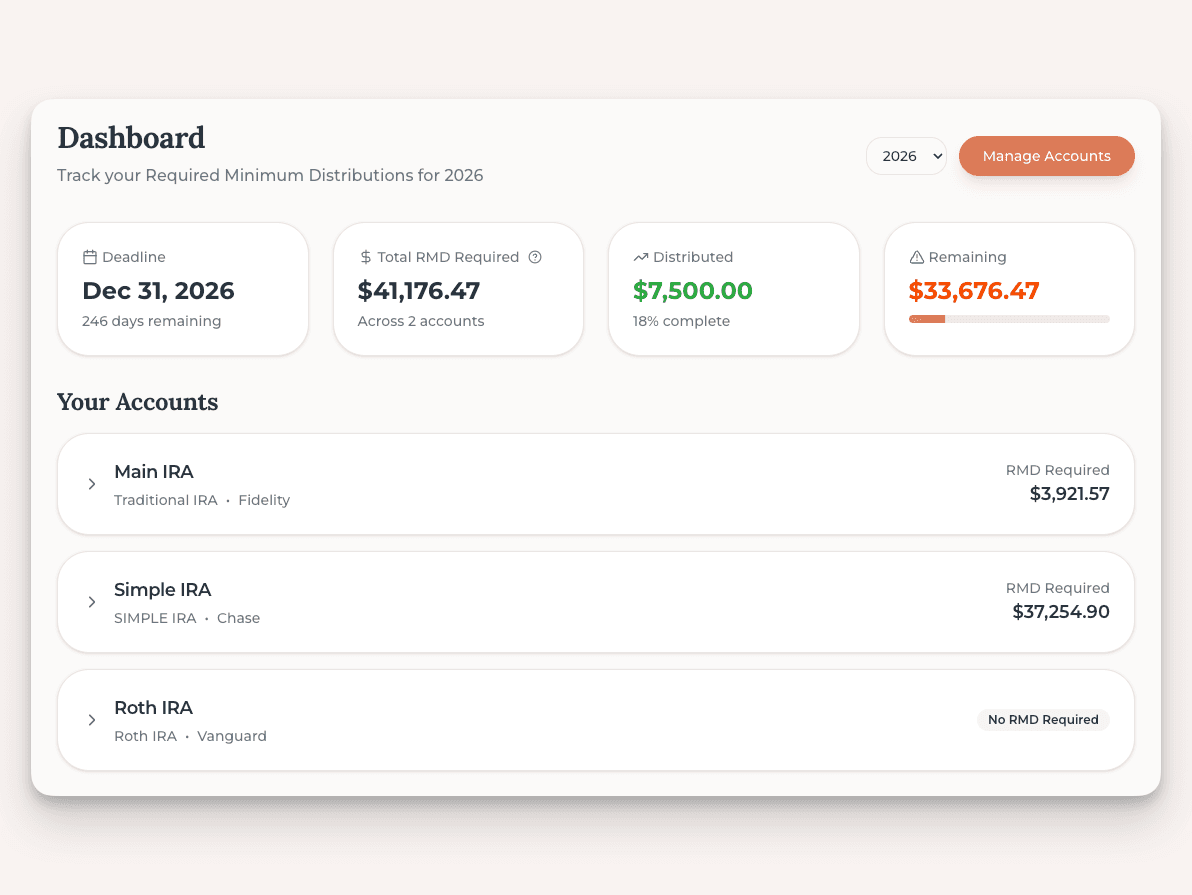
The missed-RMD side is preventable with a number and a deadline — the RMD overview explains the rules, the deadlines and penalties hub covers what happens when they slip, and how SimpleRMD works shows the tracking layer.
This article is for informational purposes only and does not constitute tax, legal, or financial advice. IRS rules and tax laws are subject to change. Consult a qualified tax professional or financial advisor for guidance specific to your situation. SimpleRMD is a calculation and tracking tool — not a financial advisory service.
Sources: IRS.gov (Form 5329 Instructions (2025), Topic no. 558, Additional tax on early distributions, Retirement plan and IRA required minimum distributions FAQs). Rules confirmed current as of July 2026.