

The exception codes on Form 5329 are short numeric codes you enter in Part I, line 2, to tell the IRS why a pre-59½ distribution from a retirement account should not be subject to the 10% additional tax on early distributions. The 2025 form lists codes 01 through 23, plus code 99 for situations where more than one exception applies.
Two things to know up front before the code list. First, Part I is for the early-distribution additional tax — the rule that applies if you took a distribution before age 59½ without an exception. Most Required Minimum Distribution (RMD) filers are 73 or older and never use Part I. The page covers that distinction because the most common search confusion is filers landing on "exception codes" when their actual issue is a missed RMD, which uses Part IX and a different waiver method (the "RC" notation, covered separately).
Second, the IRS expanded the code list under the SECURE 2.0 Act of 2022. Codes 19, 20, 22, and 23 cover provisions that did not exist on the form before 2023, and a lot of older tax-software guidance still references the pre-2023 list. The codes below are from the official 2025 instructions.
Calculate Your RMDThe current exception codes (Part I, line 2)
01. Separation from service at 55+. Distribution from an employer retirement plan (not an IRA) after you separated from service in or after the year you reached age 55. Age 50 applies for qualified public safety employees and private sector firefighters. Employer plans only.
02. Substantially equal periodic payments (SEPP). Distributions made under IRC §72(t)(2)(A)(iv) as a series of substantially equal periodic payments over your life expectancy, or the joint expectancies of you and a beneficiary. IRA and employer plans.
03. Total and permanent disability. Documented by a physician under the same standard the Social Security Administration uses.
04. Death. Distribution to a beneficiary after the original account owner's death. The most common Part I exception for inherited IRA beneficiaries who are under 59½ — see the worked example below.
05. Medical expenses (employer plan). Up to the amount of unreimbursed medical expenses that exceeded 7.5% of AGI. Employer plans only. IRAs use a similar but separately-tracked rule.
06. Qualified Domestic Relations Order (QDRO). Distributions to an alternate payee under a court order in a divorce. Employer plans only.
07. Health insurance for unemployed. IRA distributions used to pay health insurance premiums during a period of unemployment. IRAs only.
08. Higher-education expenses. IRA distributions used to pay qualified higher-education expenses for you, your spouse, or a child or grandchild. IRAs only.
09. First-time homebuyer. IRA distributions of up to $10,000 (lifetime cap) toward a first home. IRAs only.
10. IRS levy. Distributions taken because the IRS levied the account.
11. Qualified reservist distribution. Distributions to military reservists called to active duty for 180+ days.
12. Incorrectly coded distribution. Use when a 1099-R from the custodian incorrectly shows the distribution as early (box 7 code 1, J, or S) but you were actually 59½ or older at the time.
13. Section 457(b) plan distribution. Distributions from a §457(b) governmental plan that did not come in as a rollover from a non-457 plan. (Non-457-source rollovers brought into a 457 retain their original early-distribution status.)
14, 15, 16, 17, 18. Narrow legacy and federal-employee exceptions: pre-March-1986 phased retirement separations, §404(k) stock dividends, pre-August-1982 annuity contract investments, federal phased-retirement annuity payments, and §414(w) automatic-contribution-arrangement permissible withdrawals. Rarely used by general IRA or 401(k) filers.
19. Qualified birth or adoption. Up to $5,000 per child within 12 months of birth or adoption. Originally added by the SECURE Act of 2019.
20. Terminal illness. Distribution after a physician certifies a condition expected to result in death within 84 months. SECURE 2.0 §326. No statutory dollar cap.
21. Corrective distribution of excess-contribution earnings. The earnings on excess IRA contributions, when withdrawn with the excess before the return due date.
22. Domestic abuse victim. Up to $10,000 or 50% of the vested balance, whichever is less, within 12 months of the abuse. SECURE 2.0 §314.
23. Eligible emergency personal expense. Up to $1,000 per year for unforeseeable or immediate financial needs. SECURE 2.0 §115.
99. Multiple exceptions. Use when more than one exception applies and attach a statement explaining the breakdown.
Why most RMD filers don't use these codes
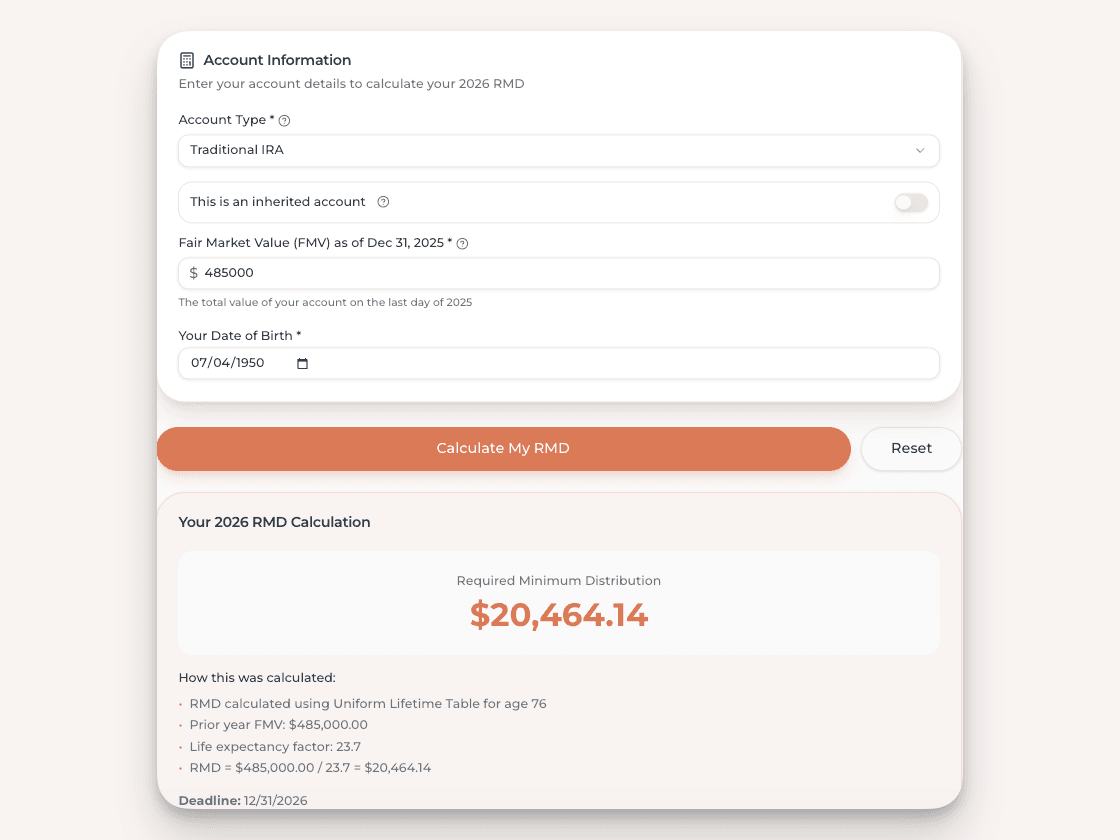
Part I and the exception codes deal with the 10% additional tax on early distributions — the tax that applies when you take money out of a retirement account before age 59½. The required minimum distribution age is 73 (rising to 75 in 2033 under SECURE 2.0 §107). By the time you are taking RMDs, you are well past the early-distribution-penalty window, and Part I is not the right part of the form for you.
Missed-RMD filers use Part IX instead. Part IX handles the 25% additional tax on excess accumulation — the penalty for not taking the full required amount by the deadline. SECURE 2.0 §302 reduced the rate from 50% to 25%, and a further reduction to 10% applies if you take the missed distribution within the correction window (roughly two tax years after the year the RMD was due). The waiver method is also different. Instead of selecting a numbered code, you write "RC" (reasonable cause) on the relevant line 54 and attach a written explanation. The line-by-line walkthrough is in Missed RMD: How to Fill Out Form 5329 Part IX.
The exception code list does matter for one RMD-adjacent group: inherited IRA beneficiaries who are under 59½ and take a distribution from the inherited account. The inherited account's distributions are not technically "early" under the Code, because the original owner's death triggers an automatic exception. But the custodian's 1099-R may still show box 7 code 1 (early distribution, no known exception) by default, and Form 5329 Part I is where the beneficiary claims code 04 (death) to clear the 10% additional tax.
A worked example: code 04 on an inherited IRA
Maria, age 48, inherited a Traditional IRA from her father in 2024. As a non-spouse, non-EDB beneficiary, she is on the 10-year clock and is taking annual distributions in years 1–9 because her father was past his required beginning date when he died. In 2025 she takes a $12,000 distribution.
Her 1099-R from the custodian shows the gross distribution of $12,000 in box 1, $12,000 in box 2a (taxable amount), and code 4 in box 7 (death). When her custodian's coding is correct, no Form 5329 is needed — the box 7 death code tells the IRS the distribution is exempt from the 10% additional tax.
But custodians sometimes default to code 1 (early distribution, no known exception) when the beneficiary is under 59½, even on a properly retitled inherited account. If Maria's 1099-R shows code 1 in box 7 instead of code 4, the IRS system will assess the 10% additional tax unless she files Form 5329 Part I claiming an exception. Part I, line 2, exception code: 04. Line 1: $12,000. Line 2: $12,000 (full amount excepted). Line 3: $0. That clears the assessment.
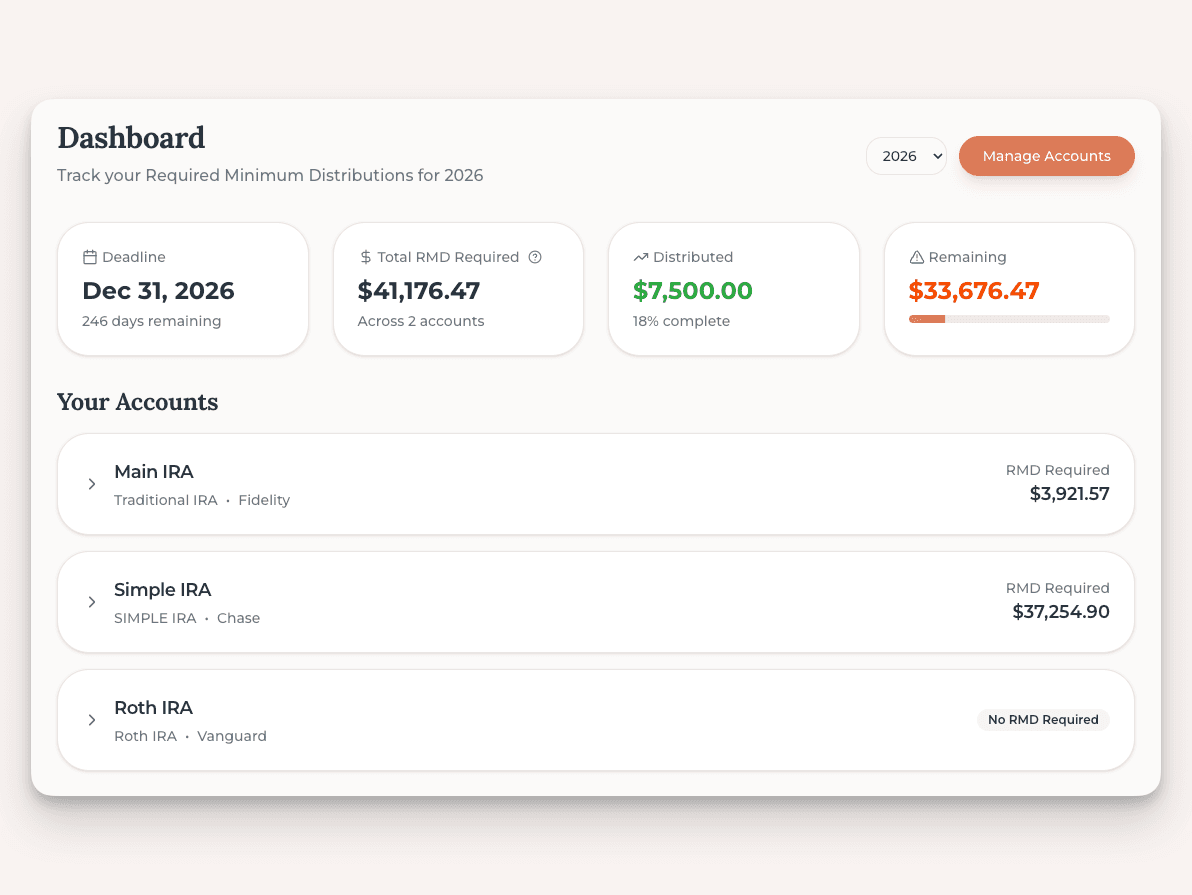
For the SimpleRMD calculator, account tracking, and the dashboard that surfaces this 1099-R coding check at year-end, see how SimpleRMD works or visit the main RMD overview.
This article is for informational purposes only and does not constitute tax, legal, or financial advice. IRS rules and tax laws are subject to change. Consult a qualified tax professional or financial advisor for guidance specific to your situation. SimpleRMD is a calculation and tracking tool — not a financial advisory service.
Sources: IRS.gov (Form 5329 Instructions (2025), About Form 5329, Publication 590-B). SECURE Act of 2019 (Pub. L. 116-94). SECURE 2.0 Act of 2022 (Pub. L. 117-328), Sections 107, 115, 302, 314, 326. IRC §72(t). Rules confirmed current as of May 2026.