

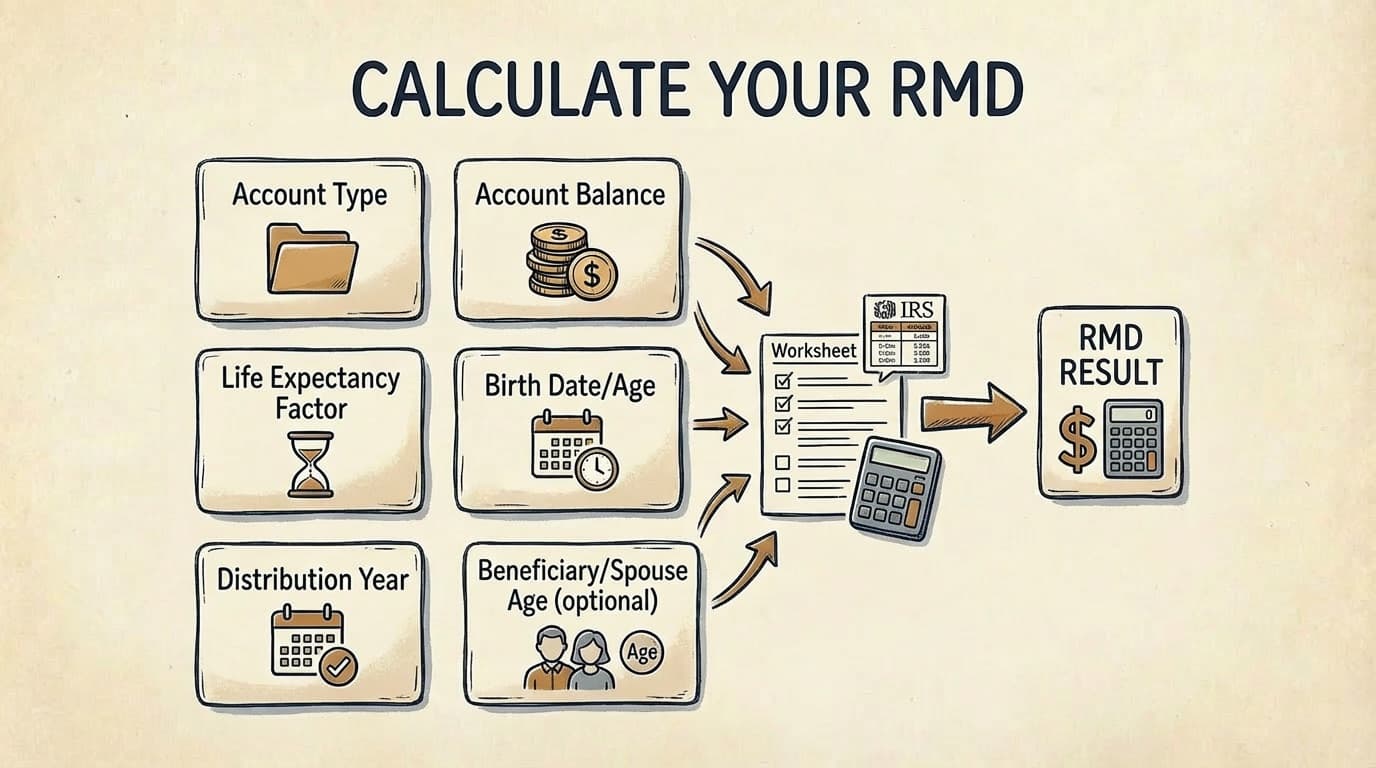
In short: For a standard RMD, you need three things: your account balance as of December 31 of the prior year, your age (or your age and your spouse's age, if your spouse is your sole beneficiary and more than 10 years younger), and your account type. For an inherited IRA, you'll also need the original owner's date of death and whether they had already started taking RMDs.
On this page
- Standard RMD: What You'll Need
- Where to Find Each Input
- If You Have Multiple Accounts
- Inherited IRA: Additional Inputs
- Worked Example: Gathering Margaret's Inputs
- Common Input Mistakes
- Ready to Run the Numbers?
Calculating a Required Minimum Distribution isn't complicated math. It's one division problem. The part that slows people down is gathering the right inputs — and being sure they're the right numbers from the right dates.
This page walks through exactly what you'll need before you sit down with a calculator. Everything is organized by account type, and each item includes where to find it. If you're calculating an inherited IRA RMD, there's a separate section below — the inputs are different.
Once you have everything, the SimpleRMD calculator does the rest. It's free, no account required.
What you'll need to calculate your RMD — checklist infographic showing the required inputs flowing into the RMD calculation.
Standard RMD: What You'll Need
For a Traditional IRA, SEP IRA, SIMPLE IRA, or employer plan (401(k), 403(b)), the RMD formula requires just a few pieces of information. Here's the complete list:
| Input | What It Means | Where to Find It |
|---|---|---|
| Account balance (Dec. 31 of prior year) | The fair market value of your account on the last day of the previous calendar year | Year-end statement from your custodian, or log into your account in January |
| Your date of birth | Used to determine your age on December 31 of the current year | — |
| Account type | Traditional IRA, SEP IRA, SIMPLE IRA, 401(k), 403(b), etc. | Your account statement or custodian's website |
| Sole beneficiary's date of birth (only if applicable) | Required only if your sole primary beneficiary is your spouse and they are more than 10 years younger than you — this qualifies you for the Joint Life Table, which produces a smaller RMD | Beneficiary designation on file with your custodian |
| Beneficiary designation current? (recommended) | Not required for the calculation, but worth confirming — an outdated designation is one of the most common estate-planning oversights | Custodian website or a phone call to confirm what's on file |
That's it. Four items at most for the calculation itself — and for most people, it's three. (Checking your beneficiary designation isn't required to run the numbers, but while you're gathering documents, it's worth the extra minute.)
Why the December 31 Balance Matters
The IRS requires that your RMD be calculated using your account balance as of December 31 of the prior year — not the current value, not the average, and not the balance on the day you take the distribution. This is the single most important number in the calculation.
If you're calculating your 2026 RMD, you need your December 31, 2025 balance.
Your custodian reports this number to the IRS on Form 5498, typically filed by May 31. You don't need to wait for that form — it's a confirmation, not a requirement. The balance appears on your year-end account statement and is usually available online by mid-January.
Which IRS Table Applies to You?
The calculator handles this automatically, but here's how it works behind the scenes:
| Your Situation | IRS Table Used |
|---|---|
| Most account owners | Uniform Lifetime Table (Table III) |
| Sole beneficiary is a spouse 10+ years younger | Joint Life & Last Survivor Table (Table II) — produces a smaller RMD |
| Beneficiary of an inherited IRA | Single Life Expectancy Table (Table I) — see inherited section below |
For more on how the tables work: RMD tables explained
Where to Find Each Input
Most of this information is in places you already have access to. Here's a quick reference:
Year-end account balance: Log into your custodian's website (Fidelity, Schwab, Vanguard, etc.) and look for your December 31 statement or "year-end summary." Many custodians make this available by the second week of January. If you can't find it online, call your custodian and ask for the fair market value as of December 31.
Your age: The IRS uses your age as of December 31 of the distribution year — not your age today, and not your age when you take the withdrawal. If you turn 77 on any day in 2026, you use age 77 for your 2026 RMD.
Account type: This determines two things — which IRS table to use and whether you can aggregate distributions across accounts. If you're unsure whether your account is a Traditional IRA, SEP IRA, or something else, check the account title on your statement. It will say.
Spouse's date of birth: Only needed in one specific scenario — your spouse is your sole primary beneficiary and they are more than 10 years younger than you. If this applies, you qualify for the Joint Life & Last Survivor Table, which uses both ages and produces a smaller required distribution. If you're unsure whether your beneficiary designation is current, now is a good time to check.
If You Have Multiple Accounts
If you own more than one retirement account, you'll need the December 31 balance for each one. The RMD must be calculated separately for every account. Whether you can combine withdrawals into a single distribution depends on the account type:
| Account Type | Calculate Separately? | Can Aggregate Withdrawals? |
|---|---|---|
| Multiple Traditional IRAs | Yes | Yes — take the combined total from any one IRA |
| Multiple 401(k)s | Yes | No — each plan requires its own withdrawal |
| Multiple 403(b)s | Yes | Yes — can aggregate with other 403(b)s, but not with IRAs |
So if you have three IRAs at different brokerages, you'll need all three December 31 balances. SimpleRMD can calculate each one and show you the combined total — try it here.
For more on how aggregation works: RMD rules by account type
Inherited IRA: Additional Inputs
If you inherited an IRA, the calculation uses a different table and requires additional information. Here's the complete input list:
| Input | What It Means | Where to Find It |
|---|---|---|
| Inherited IRA balance (Dec. 31 of prior year) | Fair market value of the inherited account on the last day of the previous year | Year-end statement from custodian |
| Your date of birth | Used to look up your initial life expectancy factor | — |
| Original owner's date of death | Determines whether the 10-year rule applies and when the clock started | Death certificate, custodian records, or estate documents |
| Whether the original owner had started RMDs | Critical — this single fact determines your entire distribution schedule. Did they die before or after their Required Beginning Date (April 1 of the year after turning 73)? | Ask the custodian — they'll know. Or check whether the owner was 73+ at death |
| Your relationship to the original owner | Spouse, adult child, minor child, disabled, chronically ill, or other — determines your beneficiary classification | Beneficiary designation on file |
| Year you received the inherited IRA | Needed to determine where you are in the 10-year timeline or life expectancy schedule | Estate settlement records or custodian transfer confirmation |
This is more information than a standard RMD requires, and the inherited inputs are the ones people most often don't have handy. If you're working from incomplete information — especially around the original owner's RMD status — the custodian that holds the inherited IRA is usually the best first call. They can typically confirm the owner's age at death and whether distributions had begun.
Inherited IRA? Whether the original owner had started their own RMDs is the make-or-break input. If you don't know, call the custodian before you calculate anything.
For the full inherited IRA walkthrough: Inherited IRA RMD rules · The 10-year rule explained
Worked Example: Gathering Margaret's Inputs
Margaret is 76 years old and has one Traditional IRA at Fidelity. She wants to calculate her 2026 RMD. Here's what she gathers:
| Input | Margaret's Info | Where She Found It |
|---|---|---|
| Account balance (Dec. 31, 2025) | $350,000 | Fidelity year-end statement (available online Jan. 8) |
| Date of birth | March 14, 1950 | — |
| Age on Dec. 31, 2026 | 76 | — |
| Account type | Traditional IRA | Statement header |
| Sole beneficiary is spouse 10+ years younger? | No | Beneficiary designation on file |
Margaret enters these into the SimpleRMD calculator. It identifies the Uniform Lifetime Table, looks up her factor at age 76 (23.7), and returns her RMD: $14,768.
The whole process takes about two minutes — once you have the inputs.
Common Input Mistakes
Using the wrong balance date. We've seen people use the current balance, the balance on the day they take the withdrawal, or a mid-year statement. All produce the wrong number. It must be December 31 of the prior year — no exceptions.
Forgetting to account for all accounts. If you have IRAs at multiple brokerages, each one needs its own December 31 balance. Missing one means your total RMD will be too low. If it's been a few years since you consolidated, this is worth double-checking.
Using the wrong age. The IRS uses your age as of December 31 of the distribution year. If you're 75 in January but turn 76 in October, your RMD factor is based on age 76. This is a one-line mistake that changes the result.
Not knowing whether the original owner had started RMDs. For inherited IRAs, this single fact determines your entire distribution schedule. We've seen beneficiaries go two or three years before realizing annual RMDs were required — and by then, the penalty exposure had stacked up. If you're not sure, ask the custodian. They'll know.
Assuming your custodian provides the inputs automatically. Some do. Many don't. And even when a custodian estimates your RMD, the number may not account for accounts held elsewhere or for the Joint Life Table if you qualify. The safest approach is to verify the inputs yourself.
Trying to aggregate an inherited IRA with your own. Inherited IRAs and your own IRAs are completely separate buckets for RMD purposes. You cannot combine an inherited IRA distribution with your personal IRA RMD — even if both accounts are at the same custodian. (You can aggregate multiple inherited IRAs from the same person, but that's a different situation. See: Inherited IRA RMD rules)
Ready to Run the Numbers?
If you've gathered everything on this page, you're ready.
- Run the SimpleRMD calculator — free, no account required
- Inherited IRA? Use this calculator
- Want to see the math? How your RMD is calculated
- How SimpleRMD works
Tired of re-gathering this information every year? With a SimpleRMD account, your inputs are saved across years — no annual scavenger hunt.
This article is for informational purposes only and does not constitute tax, legal, or financial advice. IRS rules and tax laws are subject to change. Consult a qualified tax professional or financial advisor for guidance specific to your situation. SimpleRMD is a calculation and tracking tool — not a financial advisory service.
Sources: IRS.gov (Publication 590-B · PDF, Retirement Topics: RMDs). Rules confirmed current as of February 2026 per IRS Pub 590-B (2025).