

The 5-year rule for inherited IRAs requires the entire account to be distributed by December 31 of the fifth year after the original owner's death. No annual Required Minimum Distribution applies during the 5-year window. The beneficiary has full flexibility on when to take money out, as long as the balance reaches zero by the deadline.
The rule applies in a narrow set of cases. For most beneficiaries inheriting after 2019, the 10-year rule replaced it.
Try the Free Inherited IRA RMD CalculatorWho falls under the 5-year rule today
The 5-year rule applies when both conditions are met: the original IRA owner died before reaching their required beginning date, and the beneficiary is a non-designated beneficiary. A non-designated beneficiary is a non-person — an estate, a charity, or a trust that does not qualify as a see-through trust under IRS rules.
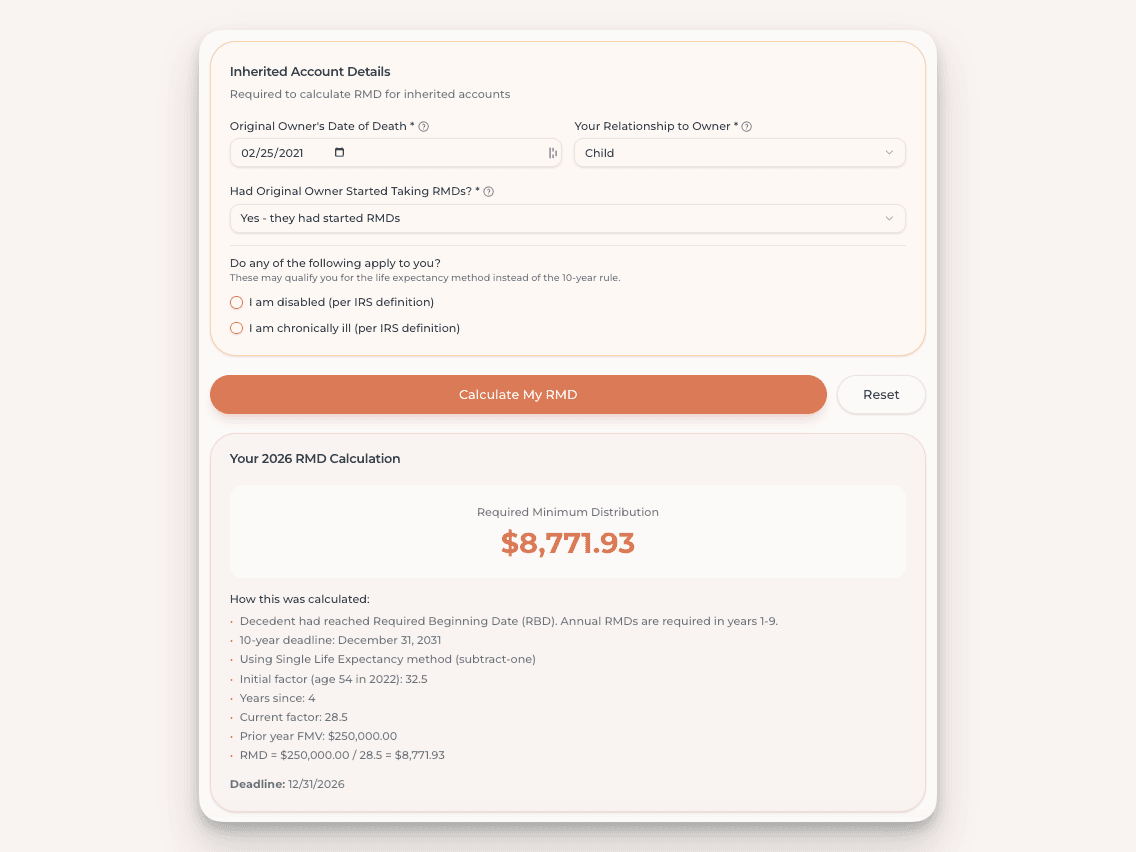
If the original owner had already reached their required beginning date when they died, non-designated beneficiaries do not get the 5-year option. They instead use the deceased's remaining life expectancy as the distribution schedule — sometimes called the ghost-life-expectancy rule. The account is drawn down over the years the deceased would have had remaining on the IRS Single Life Table.
Designated beneficiaries, meaning actual people named on the beneficiary form, almost never use the 5-year rule under current law. They either qualify as eligible designated beneficiaries with lifetime stretch options, or they fall under the 10-year rule.
How the 5-year deadline counts
The clock starts the year after the original owner dies. If the owner died in 2024, the year-of-death does not count toward the five years — distributions can begin in 2024 if the beneficiary chooses, but the deadline is December 31, 2029. The full balance must be out of the account by that date.
No annual minimum is imposed along the way. A beneficiary can take nothing in years one through four and clean out the account on the final day, or spread withdrawals evenly across the runway, or take it all in a single distribution. The choice is governed by the beneficiary's tax planning, not by an annual RMD.
The 5-year rule applies only when the original owner died before their required beginning date. An owner who dies in their first RMD year — before April 1 of the following year — has died pre-RBD, so no year-of-death RMD is owed. If the owner had passed their required beginning date, the 5-year rule is off the table for non-designated beneficiaries; the ghost-life-expectancy schedule takes its place.

Two other 5-year clocks worth not confusing
Two related 5-year periods come up in inherited-IRA conversations and they are not the same rule.
The first is the 5-year clock on Roth earnings. An inherited Roth IRA's earnings are tax-free only after the original owner has had a Roth IRA open for at least five tax years. That clock is anchored to the original owner and does not restart at inheritance. It governs the tax treatment of distributions, not the deadline for emptying the account.
The second is the Roth conversion 5-year clock. Each Roth conversion the original owner did has its own 5-year clock for purposes of the 10% penalty on conversion principal — which does not apply to inherited Roth IRAs anyway, because inherited-IRA distributions are exempt from the early-withdrawal penalty regardless of age.
For the broader inherited-IRA framework see the inherited-IRA pillar hub. The main RMD hub covers RMD rules across all account types. How It Works walks through what SimpleRMD does at each step. For the related question of what happens when an estate inherits the IRA by default, see what happens when an IRA has no beneficiary.
This article is for informational purposes only and does not constitute tax, legal, or financial advice. IRS rules and tax laws are subject to change. Consult a qualified tax professional or financial advisor for guidance specific to your situation. SimpleRMD is a calculation and tracking tool — not a financial advisory service.
Sources: IRS Final Regulations T.D. 10001 (July 2024). IRS.gov (Publication 590-B, "Beneficiaries"). IRS Notices 2022-53, 2023-54, 2024-35. SECURE Act of 2019 (Pub. L. 116-94). SECURE 2.0 Act of 2022 (Pub. L. 117-328). Rules confirmed current as of May 2026.