

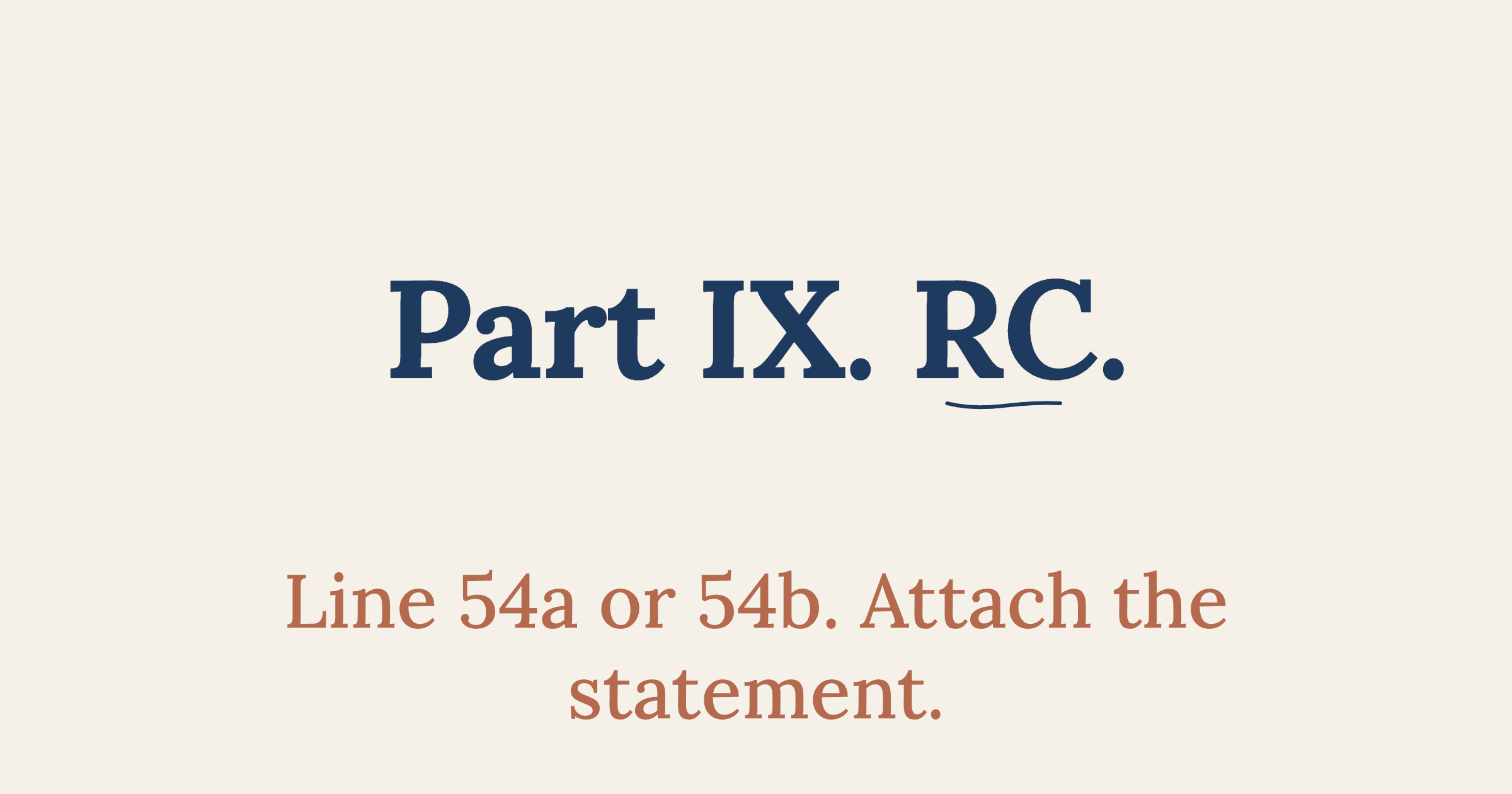
Part IX of Form 5329 handles the additional tax on a missed Required Minimum Distribution (RMD), and it's also where the waiver request gets made. The form was restructured for tax years 2023 and later to split IRA and employer-plan amounts into separate lines. The "RC" notation on line 54 is what flags the waiver request to the IRS.
The mechanics are mostly arithmetic. The piece that catches people is the reasonable-cause statement that must be attached to the return.
Calculate Your RMDLines 52a and 52b — what was required
Line 52a is the total RMD you were required to take from Traditional IRAs, including inherited Traditional IRAs. If you had RMDs from multiple IRA accounts, add them together for this line. The IRA aggregation rule means you only had to take the total from any combination of IRAs, but line 52a captures the full required amount across all of them.
Line 52b is the total RMD you were required to take from employer plans — 401(k), 403(b), governmental 457(b), or TSP. 401(k) plans do not aggregate with each other or with IRAs, so each 401(k) plan's RMD must be calculated and satisfied separately. 403(b) plans aggregate among each other (similar to IRAs) but not with 401(k)s. Whatever the per-plan rules are, line 52b captures the total required across all employer plans combined.
If your missed RMD only affects one of these categories, the other line is zero. A worked example: Jim, 75, had a $14,000 RMD from his Traditional IRA and a $9,000 RMD from a 401(k) he never rolled over. He took the IRA RMD on time but forgot the 401(k) RMD. Line 52a = $14,000, line 52b = $9,000.
Lines 53a, 53b, and 54 — the shortfall
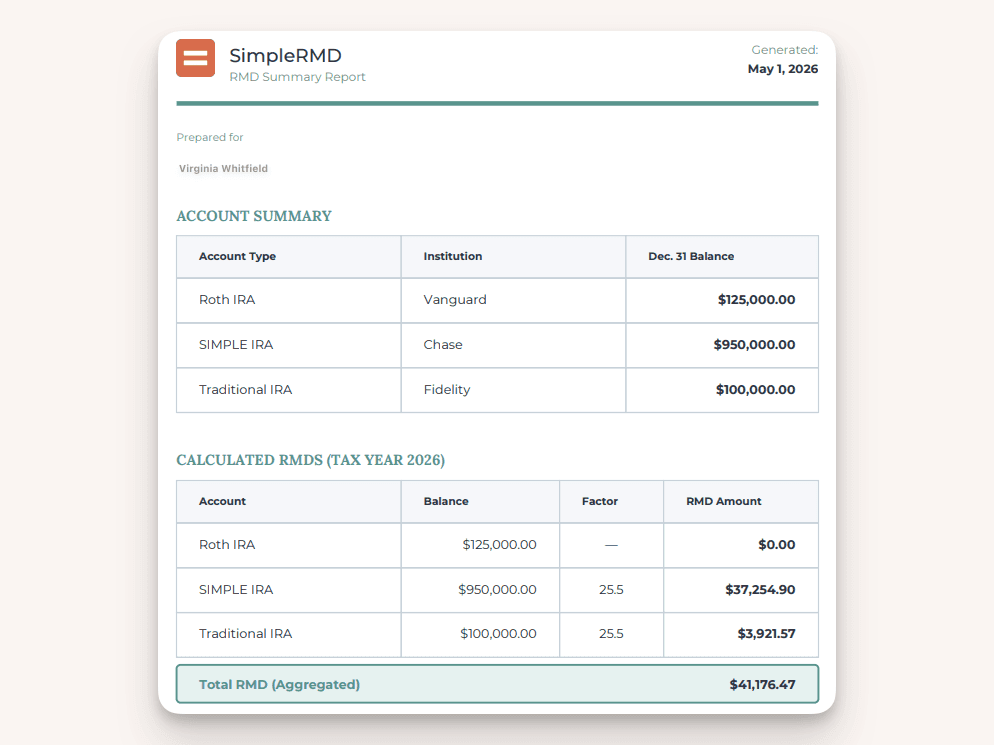
Line 53a is the amount you actually distributed from IRAs during the year. Line 53b is the amount you actually distributed from employer plans. These come from your 1099-R forms.
Line 54a is line 52a minus line 53a — the IRA shortfall. Line 54b is line 52b minus line 53b — the employer-plan shortfall. If you took the full required amount from a category, the corresponding line 54 is zero. If you took more than required, line 54 is still zero (you can't bank an over-distribution for a later year).
Continuing Jim's example. He took the $14,000 IRA RMD, so line 53a = $14,000 and line 54a = $0. He took zero from the 401(k), so line 53b = $0 and line 54b = $9,000. That $9,000 is the shortfall he needs to address before this form goes to the IRS.
The correction step happens off-form. Jim needs to take the missed $9,000 distribution from the 401(k) as soon as he discovers the miss, ideally before filing Form 5329. The IRS expects to see that the shortfall has been remedied.
The 'RC' waiver request
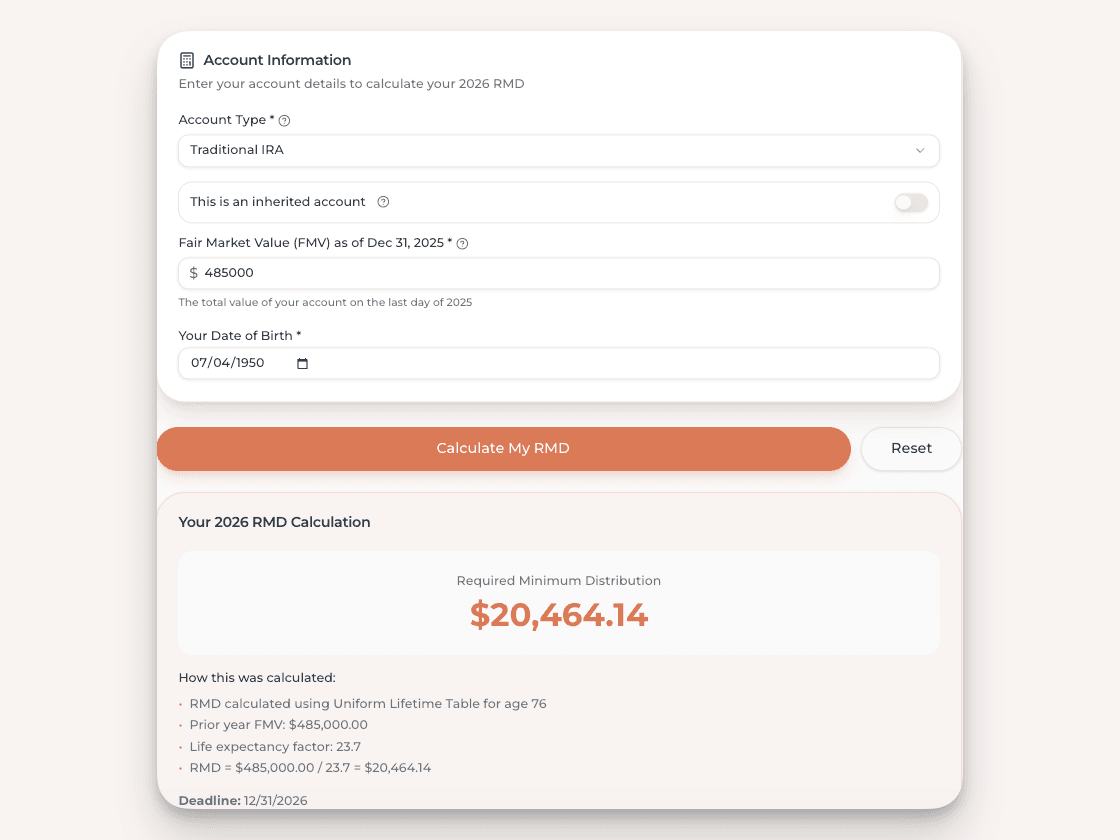
To request a waiver of the additional tax for reasonable cause, write "RC" followed by the shortfall amount in parentheses on the relevant line 54. Then subtract that amount from the shortfall and enter the result on the line itself. If you're requesting a full waiver, the result is zero.
Using Jim's $9,000 employer-plan shortfall, line 54b would read: RC ($9,000) with 0 as the final entry on the line. Line 55 (additional tax at 25%, or 10% if the missed RMD is corrected within the SECURE 2.0 two-year window) is calculated only on any remaining amount that isn't being waived. For a full waiver request, line 55 is zero.
Attach a written statement to the return explaining the missed RMD. The statement should cover: the year the RMD was missed, the amount, when the miss was discovered, why it happened (the reasonable error), the steps taken to fix it, and the date the corrective distribution was completed. Keep the statement factual and short — one page is sufficient.
For the broader penalty-and-waiver context including reasonable-cause examples and the IRS approval timeline, see IRS waiver for a missed RMD. For the calculator, account tracking, and deadline reminders that prevent the next miss, see How SimpleRMD works or visit the main RMD overview.
This article is for informational purposes only and does not constitute tax, legal, or financial advice. IRS rules and tax laws are subject to change. Consult a qualified tax professional or financial advisor for guidance specific to your situation. SimpleRMD is a calculation and tracking tool — not a financial advisory service.
Sources: IRS.gov (Form 5329 Instructions (2025), Publication 590-B, Correcting RMD failures). SECURE 2.0 Act of 2022 (Pub. L. 117-328), Section 302 (excise tax reduction from 50% to 25%, further reduced to 10% with timely correction). Rules confirmed current as of May 2026.