

Rules current as of September 2026. Informational only; not tax, legal, or investment advice.
If you owe a required minimum distribution for 2026, from your own IRA or plan or from an account you inherited, the deadline is December 31. The penalty for a shortfall is 25% of the amount you didn't take. Most of the mistakes we see aren't math mistakes. They come from having more than one account, using the wrong balance, or requesting the money too late for the custodian to process it.
This is the checklist we'd hand a friend. It runs in calendar order. A printable two-page version, with a worksheet that gives each account its own line, is at the bottom.
Do these now: September and October
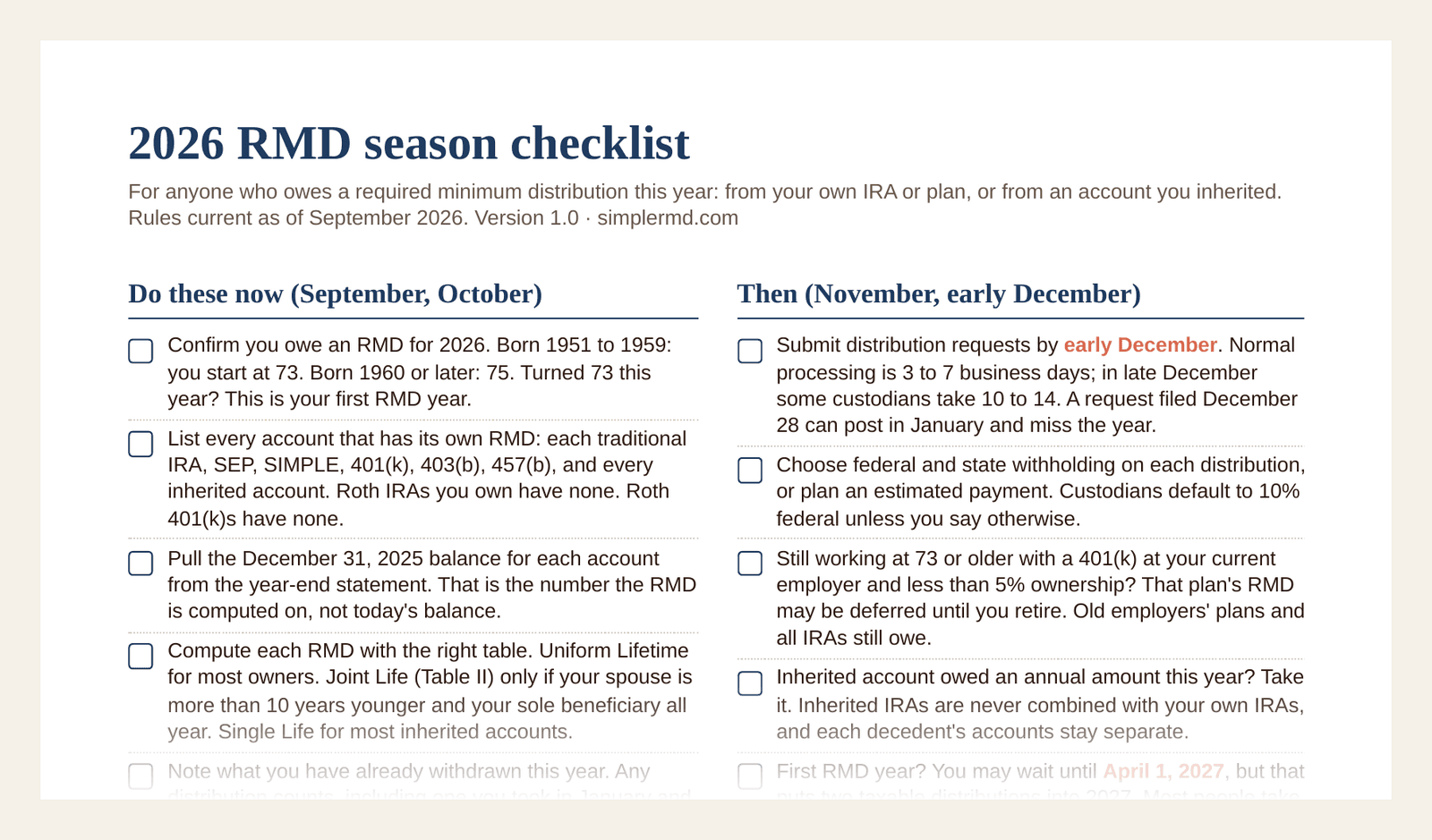
Confirm you owe an RMD for 2026. Born 1951 through 1959: your first RMD year is the year you turn 73. Born 1960 or later: 75. If you turned 73 this year, this is your first RMD year and you have a choice about timing (see below). Born in 1959? The statute is unsettled for your birth year; the IRS has proposed 73, and that's what every calculator we've tested assumes.
List every account that has its own RMD. Each traditional IRA, SEP, SIMPLE, 401(k), 403(b), and 457(b), and every inherited account. Roth IRAs you own have no RMD. Roth 401(k)s no longer have one either. Write the list down; the worksheet below has a line for each.
Pull the December 31, 2025 balance for each account. That's the number the 2026 RMD is computed on. Not today's balance, not the balance on the day you withdraw. It's on the year-end statement. If the market is up this year and you use today's number, you'll overstate the RMD; if it's down, you'll understate it, and the shortfall is what the 25% applies to.
Compute each RMD with the right table. Uniform Lifetime for most owners. Joint Life (Table II) only if your spouse is more than ten years younger than you and was your sole beneficiary for the whole year; the factor is larger and the RMD smaller. Single Life for most inherited accounts. Use your age on December 31, 2026, not your age today.
Note what you've already withdrawn this year. Any distribution counts toward the RMD, including one you took in January and forgot about. A Roth conversion does not count; see below.
Decide on qualified charitable distributions. If you're 70½ or older, you can send up to $111,000 per person in 2026 directly from an IRA to a charity. A QCD counts toward your RMD and never lands in your taxable income. It has to go straight from the custodian to the charity, and it has to be requested before you take the rest of the RMD, because the first dollars out of the account are treated as the RMD.
Planning a Roth conversion? The RMD comes out first. You cannot convert the RMD amount; only money above it is eligible. Custodians will generally block a conversion until the year's RMD is satisfied, but not all of them check.
Then: November and early December
Submit distribution requests by early December. Normal processing is three to seven business days. In the last two weeks of December, some custodians run ten to fourteen. A request filed December 28 can post in January and miss the year entirely. Put the requests in by about December 11 and you have room for a rejected form or a missing signature.
Choose withholding on each distribution. Federal and state, or plan an estimated payment. Custodians default to 10% federal unless you tell them otherwise, which is usually too little for someone with other income.
Still working at 73 or older? If you have a 401(k) at your current employer and own less than 5% of the company, that plan's RMD may be deferred until you retire. Plans from old employers and every IRA still owe this year.
Inherited account with an annual amount due? Take it. Inherited IRAs are never combined with your own IRAs, and accounts inherited from different people stay separate from each other.
First RMD year? You may wait until April 1, 2027. If you do, you'll take two RMDs in 2027 (the delayed 2026 one plus the regular 2027 one), both taxable that year. Most people take the first one by December 31 to avoid the stacked income.
Get written confirmation of each distribution and file it with the year-end statement. Your 1099-R arrives in January. It won't say which dollars were a QCD; that's on you to track for your return.
Missed one in a prior year? File Form 5329 with that year's return. The 25% excise tax drops to 10% if you correct it within two years, and the IRS often waives it entirely for reasonable cause. It's a January problem, not a reason to panic in December.
The deadline is December 31, 2026 for every RMD except a first-year RMD (April 1, 2027) and an inherited account whose ten-year window closes this year. Shortfalls are taxed at 25% of the amount not taken.
The mistakes we see most
Computing on today's balance instead of last December 31.
Using the Uniform table when the spouse is more than ten years younger. That overstates the RMD; three of the 21 free calculators we tested this summer never ask about the spouse at all.
Taking one IRA's RMD from a 401(k), or the other way around. IRAs can cover each other; plans can't.
Assuming an inherited IRA can be satisfied from your own IRA. It can't.
Trusting a calculator page that still says "age 72." The start age changed in 2023, and seven of the 21 calculator pages we tested still carry the old text.
Requesting the distribution in the last week of December.
Which accounts can be combined
This is the rule that trips up people with several accounts, and the reason the worksheet has one line per account.
Traditional IRAs, SEPs, and SIMPLEs: add up the RMDs and take the total from any one of them, or split it however you like.
403(b)s: same, but only with other 403(b)s.
Each 401(k) and each 457(b): its own RMD, taken from that plan only. An IRA withdrawal doesn't cover it.
Inherited accounts: never combined with your own, and each decedent's accounts are separate from each other.
So if you have three IRAs and one 401(k), that's two obligations. Two IRAs and two 401(k)s is three.
Uniform Lifetime factors, ages 72 to 90
Divide the December 31, 2025 balance by the factor for your age on December 31, 2026. Source: 26 CFR §1.401(a)(9)-9, Table III.
| Age | 72 | 73 | 74 | 75 | 76 | 77 | 78 | 79 | 80 | 81 |
|---|---|---|---|---|---|---|---|---|---|---|
| Factor | 27.4 | 26.5 | 25.5 | 24.6 | 23.7 | 22.9 | 22.0 | 21.1 | 20.2 | 19.4 |
| Age | 82 | 83 | 84 | 85 | 86 | 87 | 88 | 89 | 90 |
|---|---|---|---|---|---|---|---|---|---|
| Factor | 18.5 | 17.7 | 16.8 | 16.0 | 15.2 | 14.4 | 13.7 | 12.9 | 12.2 |
A $500,000 IRA at age 75: $500,000 ÷ 24.6 = $20,325.20. If your sole beneficiary is a spouse more than ten years younger, use Table II (Joint Life) instead. The factor depends on both ages and is always larger.
Inherited accounts, briefly
Non-spouse beneficiaries of owners who died in 2020 or later generally have ten years to empty the account. If the owner died on or after their required beginning date, annual amounts are also due in years one through nine, computed on the Single Life table. Spouses and other eligible designated beneficiaries have different options. The worksheet's inherited section has a column for the date the account must be empty; fill it in, because that date doesn't move.
The printable version
Two pages, printable. Everything above on page one, and on page two a worksheet with one line per account, the factor table, and a distribution log for confirmation numbers. Get the PDF by email, along with three short follow-ups between now and December on the balance rule, the spouse table, and multi-account handling. Reply "unsubscribe" to any of them and that's the end of it.
Want the factor and the RMD filled in for you? The SimpleRMD calculator shows the table, the factor, and the regulation behind every result, so you can check it against the worksheet.
Rules cited: IRC §401(a)(9); 26 CFR §1.401(a)(9)-9 (life expectancy tables); IRS Publication 590-B. Your situation may differ; confirm with a qualified professional. Version 1.0, September 2026.