

Published September 9, 2026. Test dates August 15–18, 2026; on-camera verification August 20–21. Dated screenshots, verification video, and the verdict dataset are linked at the end of this study.
We built SimpleRMD because we needed it ourselves. This study exists for the same reason: millions of people trust free calculators with a number that carries a 25% IRS penalty if it's wrong, and no one has ever independently checked those calculators. Our goal is not to declare a winner. It's to bring transparency to a corner of retirement planning that has never had any — and to help every tool in this study, including ours, get better. We tested our own calculator with the same scenarios, under the same standard, and we publish our results alongside everyone else's. We shared every company's results with them before publication and we will publish corrections prominently if any finding is shown to be wrong. If this study makes even one other calculator more accurate, it worked.
Disclosure: SimpleRMD sells a paid RMD calculation and tracking tool. That means we have a commercial interest in this subject, and you should read this study knowing that. To offset it: our methodology and every input and output are published in full so anyone can re-run every test; our own calculator was tested under identical conditions and its results — including anything we got wrong — appear in the same tables; and every company named here received its results in advance with an invitation to respond.
The short version
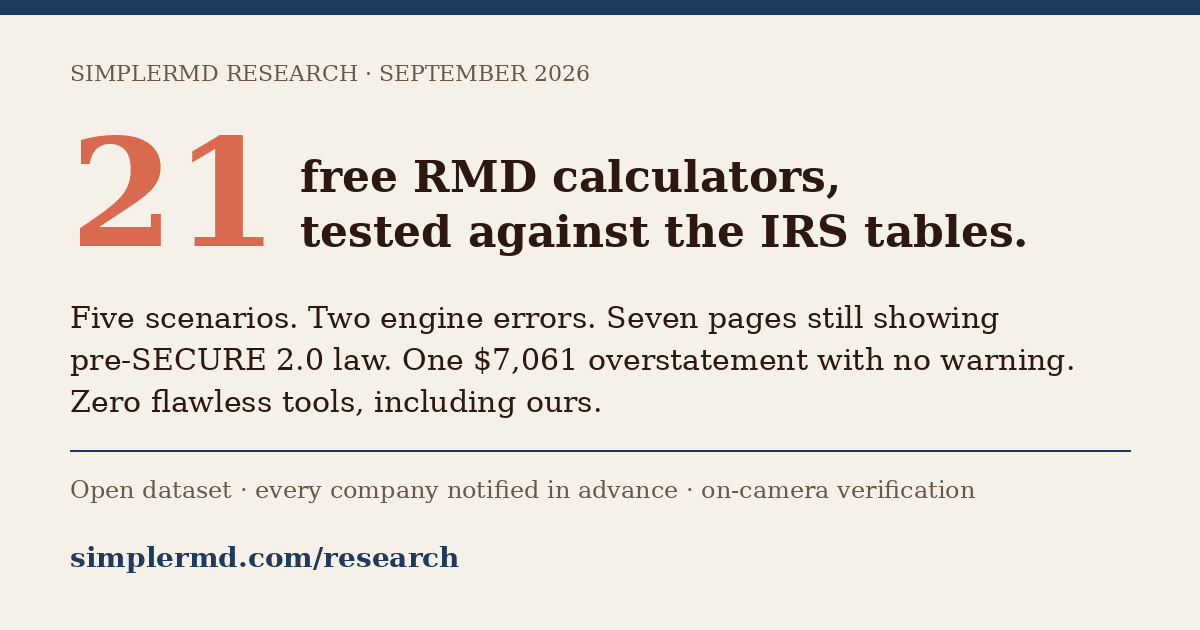
We ran five scenarios — a plain-vanilla control, the 1959 birth-year question the law itself has not settled, a spouse more than ten years younger, an inherited IRA under the 2024 final regulations, and a three-account aggregation case — through every publicly available RMD calculator that met a pre-registered inclusion rule. Twenty-one tools, tested August 15–18, 2026, plus one engine-vendor reference implementation.
Five things stood out:
- Every tool passed the control. Twenty-one for twenty-one on a 76-year-old with one IRA. The story of this category is not "calculators can't do arithmetic."
- On the unsettled 1959 question, no tool returned the literal statutory age of 75. Eleven tools were silent or could not accept the scenario; ten resolved it to 73 — the IRS's proposed resolution — and stated it flatly. Only one tool anywhere (calculator.net) hedged with "if there are no policy changes." Only two (MassMutual and SmartAsset) stated the April 1, 2033 required beginning date, and both stated it correctly.
- Sixteen of twenty-one tools handled the young-spouse scenario exactly. Three declined it and said so. This rule is widely believed to be a common failure point; as tested, it mostly isn't. One tool returned a figure inconsistent with Table II — see Finding 01; the company changed its calculation logic after we shared the result, and our September 8 re-test confirmed the fix.
- The 2024 inherited-IRA regulations are where the category splits. Of the nine dedicated inherited-IRA tools tested, seven returned the exact required amount, one returned $0.00 (see Finding 02), and one returned the amount but not the deadline.
- Only one tool in the entire set — SmartAsset — is structured to handle multiple accounts correctly (IRAs pooled, each 401(k) separate). Every other tool is single-account by design; where we pushed each account through separately, the per-account arithmetic was exact in every case.
Your own number takes about a minute. We tested our calculator under the same five scenarios, published where it fell short, and fixed both gaps before this study went live. Run your RMD and you'll see the IRS table and rule behind the result.
Methodology
Inclusion. The full inclusion rule, its amendment record, and the eight pre-registered search queries publish with the study. In brief: a tool is included if it appears in organic page-one results for any pre-registered query (captured, dated, signed-out; capture PDFs published), is operated by a government agency or regulator, is ours, displays a shared calculation engine, or is nominated by a reader after publication. Depth follows the registered tier rule: full-tier tools get all five scenarios; standard and census-tier tools get scenarios 0–2. "Not tested — outside tier" is a fact about the study, never a finding about a tool.
The five scenarios (exact inputs; identical for every tool; growth set to 0% wherever a rate field exists, deviations recorded per tool):
| # | Scenario | Inputs | Correct answer | Source |
|---|---|---|---|---|
| 0 | Control | DOB 4/10/1950 (76); $800,000 IRA; spouse same age | $33,755.27 (÷23.7) | Uniform Lifetime, 26 CFR §1.401(a)(9)-9 |
| 1 | Born 1959 | DOB 3/15/1959; $500,000 IRA | Start 73 / first year 2032 / RBD 4/1/2033 | REG-103529-23 (proposed); see grading note |
| 2 | Young spouse | DOB 5/10/1953 (73); spouse 8/20/1971 (55), sole beneficiary; $1,000,000 | $30,674.85 (÷32.6, Table II) | 26 CFR §1.401(a)(9)-9 Table II |
| 3 | Inherited, non-spouse, owner died 9/2021 after RBD | Beneficiary DOB 2/2/1974; $400,000 at 12/31/2025 | $11,730.21 in 2026 (÷34.1) and full depletion by 12/31/2031 | T.D. 10001; Single Life 48=38.1−4 |
| 4 | Aggregation | DOB 7/4/1951 (75); IRAs $300,000 + $200,000; 401(k) $250,000 | IRAs $12,195.12 + $8,130.08 (combinable); 401(k) $10,162.60 (separate) | ÷24.6; IRS aggregation rules |
Every factor above was confirmed against the current text of 26 CFR §1.401(a)(9)-9 on August 18, 2026 (evidence: dated capture with the relevant cells highlighted).
Scenario 1 grading note — read this before the table. The statute as written contains two overlapping conditions for people born in 1959 (IRC §401(a)(9)(C)(v), as amended by SECURE 2.0 §107). The final regulations of July 19, 2024 deliberately reserved the question (§1.401(a)(9)-2(b)(2)(v), 89 FR 58886); proposed regulations issued the same day would resolve it to age 73 (89 FR 58644), and that proposal has not been finalized as of this study's test dates. Accordingly: a tool reporting 73 is consistent with the IRS's proposed resolution; a tool reporting 75 reflects the literal statutory text, which the IRS has proposed to resolve to 73. We grade Scenario 1 as divergence, never error. The unresolved ambiguity is itself the finding.
Classification vocabulary. Pass · Coverage gap (the tool does not offer the input — a design-scope fact, not a miscalculation) · Error (the tool accepts the input and returns a figure inconsistent with the cited IRS source) · Partial (Scenario 3 only: amount or deadline, not both) · Divergence (Scenario 1 only) · Not tested — outside tier. These are never blurred. Rounding differences under $1.00 are recorded as notes, not findings. What a page's text says and what its calculator returns are separate findings with separate evidence, reported only with their own proof.
Evidence. Every run is screenshotted (inputs and result) with the tool name, scenario, and date in the filename. JavaScript-rendered calculators defeat public archiving services, so the study's evidence record is dated screenshots plus continuous-take video of the verification runs; both publish with the study. Test dates: August 15–18, 2026. Machine-run results were verified on camera August 20–21, 2026 — every published error finding rests on the on-camera run.
Results — Scenario 0, the control ($33,755.27)
Twenty-one for twenty-one. Alphabetical; the engine-vendor reference implementation is listed for completeness.
| Tool | Returned | Result |
|---|---|---|
| AARP | $33,755.27 | Pass |
| BancFirst | $33,755.27 | Pass |
| Bonvenu Bank | $33,755.27 | Pass |
| calculator.net | $33,755.27 | Pass |
| Commonwealth Financial Network | $33,755.27 | Pass |
| Empower | $33,755 | Pass (whole-dollar display) |
| Fidelity | $33,755.27 | Pass |
| FINRA | $33,755.27 | Pass |
| Investor.gov | $33,755.27 | Pass |
| Lincoln Investment | $33,755.27 | Pass |
| MassMutual | $33,755 | Pass (whole-dollar display) |
| Merrill | $33,755 | Pass (whole-dollar display) |
| MissionSquare | $33,756 | Pass (rounds up; +$0.73, noted) |
| Pacific Life | $33,755 | Pass |
| Red River Bank | $33,755.27 | Pass |
| Charles Schwab | $33,755.27 | Pass |
| SimpleRMD | $33,755.27 | Pass |
| SmartAsset | $33,755 | Pass (whole-dollar display) |
| Vanguard | $33,755.27 | Pass |
| Voya | $33,755.27 | Pass |
| Dinkytown.net (KJE reference) | $33,755.27 | Pass |
Results — Scenario 1, born March 1959
No tool returned 75. The split is "73, asserted" versus "silent."
| Tool | As tested | Classification |
|---|---|---|
| AARP | $0.00; no start-age statement; projection chart begins 2032 | Coverage gap (silent) |
| BancFirst | $0.00; silent (current-year build) | Coverage gap (silent) |
| Bonvenu Bank | $0.00; silent; chart begins 2032 | Coverage gap (silent) |
| calculator.net | "your RMD will begin in 2032, when you turn 73 — if there are no policy changes" | Pass — the only hedge observed in the study |
| Commonwealth Financial Network | $0.00; silent; chart begins at age 73 | Coverage gap (silent) |
| Empower | "$18,868" for 2032 | Pass (73/2032, asserted flatly) |
| Fidelity | "$18,867.92 is the RMD amount you're required to take in 2032" | Pass (73/2032; exact at 0% growth) |
| FINRA | Age menu begins at 73; the scenario cannot be entered | Coverage gap (inexpressible) |
| Investor.gov | Age menu begins at 73; the scenario cannot be entered | Coverage gap (inexpressible) |
| Lincoln Investment | $0.00; silent. Page text separately states start age 72 (see page-text items) | Coverage gap (silent) |
| MassMutual | "$18,868 by April 1, 2033" | Pass — states the RBD, correctly |
| Merrill | "$25,285 by December 31, 2032"; age at next RMD 73; factor 26.5 | Pass (amount reflects the tool's 5% default-growth floor, disclosed) |
| MissionSquare | "In 2032 your estimated RMD is $23,874"; age selector 73 | Pass (amount reflects 4% default growth) |
| Pacific Life | "$0 for the calendar year of 2026"; silent. Page text asserts blanket 73 | Coverage gap (silent) |
| Red River Bank | $0.00; silent; chart begins 2032 | Coverage gap (silent) |
| Charles Schwab | "starting at the age of 73 will be $26,764.51" | Pass — 73 stated in the result sentence (amount reflects a built-in 6% growth assumption with no rate control on the form) |
| SimpleRMD | $0.00 — "Age 67 is below the RMD starting age of 73 for your birth year (1959)" | Pass — states the cohort resolution explicitly |
| SmartAsset | "First RMD(s) due by April 1, 2033" — $18,879 | Pass — states the RBD, correctly |
| Vanguard | Projection table begins 2032 / age 73 / factor 26.5 | Pass (1% slider floor, disclosed deviation) |
| Voya | $0.00; silent; chart begins 2032. Page text separately reproduces both statutory conditions verbatim, unresolved | Coverage gap (silent) |
| Dinkytown.net (KJE reference) | $0.00; silent | Coverage gap (silent) |
Observations, not verdicts: ten tools resolve the 1959 cohort to 73; none flags to the user that the law is not final; one adds a hedge; two state the required beginning date. Voya's page reproduces the statutory conflict itself — both conditions, verbatim, unresolved — which is the clearest public artifact of why this scenario exists.
Results — Scenario 2, spouse more than ten years younger ($30,674.85)
| Tool | Returned | Classification |
|---|---|---|
| AARP | $30,674.85 | Pass |
| BancFirst | $30,674.85 | Pass |
| Bonvenu Bank | $30,674.85 | Pass |
| calculator.net | $30,674.85 ("distribution period 32.6") | Pass |
| Commonwealth Financial Network | $30,674.85 | Pass |
| Empower | $30,675 | Pass |
| Fidelity | $30,674.85 | Pass |
| FINRA | $37,735.85 | Coverage gap — disclosed (Uniform-only; page directs Joint Life users to Pub 590-B) |
| Investor.gov | $37,735.85 | Coverage gap — disclosed (same class) |
| Lincoln Investment | $30,674.85 | Pass |
| MassMutual | $29,940 as tested Aug 17 (verified on camera Aug 20 — see Finding 01) | Error (implied divisor 33.4 = Table II ages 73/54) — corrected before publication; re-tested Sep 8 |
| Merrill | $30,675 (factor 32.6 shown) | Pass |
| MissionSquare | $30,675 | Pass |
| Pacific Life | $30,675 | Pass |
| Red River Bank | $30,674.85 | Pass |
| Charles Schwab | $30,674.85 | Pass |
| SimpleRMD | $37,735.85 | Coverage gap — our own tool (see "Our own results") |
| SmartAsset | (no spouse input) | Coverage gap — disclosed ("certain users may need to use a different IRS table") |
| Vanguard | $30,674.85 (factor 32.6 shown) | Pass |
| Voya | $30,674.85 | Pass |
| Dinkytown.net (KJE reference) | $30,674.85 | Pass |
Sixteen of twenty-one handled the Joint Life table exactly. Three declined the input and said so. One is ours (below). One returned a figure inconsistent with Table II (Finding 01).
Results — Scenario 3, inherited IRA under the 2024 final regulations
Full credit requires both halves: the $11,730.21 annual amount for 2026 and the December 31, 2031 depletion deadline.
Dedicated inherited-IRA tools:
| Tool | 2026 amount | Depletion statement | Classification |
|---|---|---|---|
| E*TRADE (SS&C/WealthMSI) | $11,730 | none on result page | Partial — amount only |
| Fidelity Inherited (Convergent) | $11,730.21 | "December 31, 2031" explicit | Pass |
| Lincoln Investment Beneficiary RMD | $11,730.21 | chart depletes at beneficiary age 57 (=2031) | Pass |
| Pacific Life Inherited (CalcXML) | $11,730.21 | year-by-year table ends 2031 at $0.00 | Pass |
| Charles Schwab Inherited (Convergent) | $11,730.21 (34.1 shown) | "i.e., December 31, 2031" explicit | Pass |
| SimpleRMD Inherited | $11,730.21 | "10-year deadline: December 31, 2031" | Pass |
| Vanguard Inherited | $11,730.21 | rule stated; specific year not computed | Pass (with note) |
| Commonwealth Beneficiary RMD | $0.00 as tested Aug 18 (verified on camera Aug 20 — see Finding 02) | even $80k/yr over final 5 years | Error (version drift; see finding) |
| Dinkytown.net Beneficiary RMD (KJE reference) | $11,730.21 | (reference run) | Pass |
Full-tier tools with no inherited mode (each probed for hidden paths before recording): calculator.net, Empower, MassMutual, Merrill, MissionSquare, SmartAsset — coverage gap. Schwab, Fidelity, and Vanguard's standard tools route the user to their dedicated inherited calculators, which we tested (above).
Guidance census item (not a calculator; reported in the guidance lane): the Convergent "Beneficiary Distribution Options" tool deployed by Schwab and Fidelity classified our Scenario 3 beneficiary correctly — "Category 2: Annual RMDs with 10-Year Deadline," non-EDB, both requirements stated including depletion "on or before December 31, 2031," citing the July 18, 2024 final regulations.
Results — Scenario 4, three accounts
The IRS lets you total IRA RMDs and take them from any IRA, but each 401(k)'s RMD must come from that plan. This scenario asks whether a tool's structure can express that.
| Tool | As tested | Classification |
|---|---|---|
| SmartAsset | Separate fields: Total IRA + 401(k) #1 + 401(k) #2. Returned "IRA(s) $20,325" and "401(k) #1 $10,163" as separate obligations | Pass — the only structural pass in the study |
| All others (full tier) | Single-account tools. Run per account: exact to the cent on Schwab, Fidelity, Vanguard, SimpleRMD, calculator.net, Lincoln, Commonwealth ($12,195.12 / $8,130.08 / $10,162.60); whole-dollar on Empower, Merrill, MassMutual; MissionSquare accepts one pooled total | Coverage gap (each probed for a multi-account path) |
Page-copy note: calculator.net and SmartAsset both explain the combinable-vs-separate rule correctly in their accompanying text; most tools are silent.
Our own results — SimpleRMD, same standard
Scenario 0: pass. Scenario 1: pass (the result states "the RMD starting age of 73 for your birth year (1959)"). Scenario 3 (inherited mode): pass. Scenario 4: coverage gap — single-account, like nearly everyone else. And two findings about our own tool, both verified on camera:
Self-finding A — Scenario 2: coverage gap. Our calculator offers no spouse date-of-birth field on any path (every control was probed on camera, August 21, to the same standard we applied to every other tool). For this scenario it returns the Uniform-table figure of $37,735.85 — an overstatement of $7,061.00 against Table II for a household whose named sole beneficiary is a spouse more than ten years younger.
Self-finding B — inherited mode: no original-owner date-of-birth input. Our inherited mode answered the test scenario exactly ($11,730.21, with the December 31, 2031 deadline). But it determines whether the owner died past the required beginning date by asking the user a yes/no question — "Had Original Owner Started Taking RMDs?" — a behavioral proxy for a date the law defines from the owner's birthdate, which the form never collects. Without it, the tool cannot verify that answer, cannot apply the rule allowing a beneficiary to use the owner's longer life expectancy where favorable, and cannot detect eligible designated beneficiaries who are within ten years of the owner's age — although its own relationship menu offers "Sibling" and "Parent." Our inherited-IRA article even tells readers to have "the original owner's date of birth" on hand; the form has nowhere to enter it.
What we changed. As of September 4, 2026, the standard calculator accepts a spouse date of birth with a sole-beneficiary confirmation and applies Table II where the spouse is more than ten years younger (our Scenario 2 inputs now return $30,674.85), and the inherited mode accepts the original owner's date of birth, derives the required beginning date from it, and applies the longer-of-two life expectancies rule. The inherited-IRA article was reconciled to the form. Both changes were live on September 4, 2026. We publish these with the same prominence as every other finding in this study.
The two error findings (verified on camera)
Finding 01 — MassMutual. As tested August 17–18, 2026, and re-verified in a single continuous on-camera session on August 20, 2026 (all eleven controlled runs reproduced): paired inputs that are identical under the IRS tables returned different amounts, consistent with the calculator computing ages as of the run date rather than the age attained in the distribution year — affecting the spouse factor, the owner factor (understating RMDs for owners 74+ before their birthday), and the displayed deadline (a 20-day birth-date change moved the stated deadline a full year). In each pair, the understated figure went to the person whose birthday had not yet passed. Controlled pairs, screenshots, and video in the study record. Notice sent August 24, 2026. MassMutual responded September 4 and the calculator was re-tested September 8 — see Company responses; the defect was no longer present.
Finding 02 — Commonwealth Financial Network / Advisor360°. As tested August 18, 2026, and re-verified on camera August 20, 2026 (both sites in one continuous take): the Beneficiary RMD calculator hosted at content.commonwealth.com returned $0.00 for our inherited-IRA scenario, and its report page states no minimum distributions are required for this beneficiary; its loading screen displays "Financial Calculators ©1998-2022 KJE Computer Solutions, Inc." KJE's current version of the same calculator, run the same day with identical inputs, returned $11,730.21, as did Lincoln Investment's current-build deployment. Under the study's reference-implementation rule this is version drift by the licensee, not an engine defect. Notice sent August 24, 2026; see Company responses.
Page-text items (text ≠ engine; each with its own evidence)
- Lincoln Investment: calculator pages state distributions "start when you turn age 72" and cite the "SECURE Act of 2019 and CARES Act of 2020"; the engine's math is current.
- BancFirst: page headline says withdrawals "begin when you are age 72," directly above the engine vendor's own table resolving 1951–1959 to 73 and 1960+ to 75 — stale site copy and current vendor content on one page.
- Red River Bank: "starting the year you turn age 72" in page copy above a current-math calculator (the sentence is the bank's; the iframe content is the vendor's).
- Empower: FAQ states the starting age as "currently age 73" with no mention that people born 1960 or later start at 75.
- Fidelity: landing copy: "At age 73, you need to begin taking money…" — same omission.
- MissionSquare: disclaimer describes the transition by calendar year ("age 73 from 2023 and 75 from 2033") rather than by birth cohort; its footnote lists no 1960+ rule. The engine's behavior for our 1959 scenario was nonetheless correct.
- Pacific Life (CalcXML pages): "you may be subject to an additional 50% tax penalty" — superseded in 2023 (25%, reducible to 10%).
- Voya: reproduces both statutory Scenario-1 conditions verbatim without resolution.
- Current and clean, for balance: Merrill ("Starting at age 73… up to 25%"), calculator.net, SmartAsset (full cohort table and penalty amounts current), Vanguard inherited (cites the 2023–2024 IRS notices by name).
Company responses
Every company named in a finding received its results on August 24, 2026, with a response window of 5 business days (results-sharing and courtesy letters; closed August 31, 2026) or 10 business days (error and page-text letters; closes September 8, 2026). Responses are summarized below; non-responses are noted.
SmartAsset responded on September 2, 2026, after the 5-business-day window had closed but before publication. A senior public relations manager confirmed the accuracy of the audit inputs described in our letter and offered to answer further questions. The company did not dispute any finding. The S2 coverage-gap and S4 structural-pass entries above stand as tested.
No response by publication (5-business-day letters, window closed August 31, 2026): Charles Schwab, Vanguard, E*TRADE, Voya, AARP, Bonvenu, calculator.net, Merrill, and KJE Computer Solutions (Dinkytown) did not respond to a request for comment by publication. Courtesy copies to the SEC and FINRA drew no response.
MassMutual responded on September 4, 2026, through its media relations office. The company said that following our outreach it "reviewed the calculator and refined the calculation logic." It asked that this report note that its online calculators are subject to internal actuarial review and an annual testing process, and that all results display its standard disclosures (which state, among other things, that the calculator is a self-help tool and that MassMutual assumes no liability for reliance on it). The company did not dispute the finding, did not say what was changed, and did not say when the change went live. We re-tested the calculator on September 8, 2026, in a continuous on-camera session, using birthdates that fall after the run date so that the August defect would show if it were still present. All four runs returned the correct figure: the Table II amount for a spouse whose 55th birthday had not yet occurred ($30,675, where the August build returned $29,940), the age-76 Uniform factor for an owner whose birthday had not yet occurred ($4,219, where the August build returned $4,065), and a required beginning date of April 1, 2027 for an owner turning 73 late in the year (where the August build stated April 1, 2028). Finding 01 is reported as corrected before publication. The August results stand as tested and remain in the record above.
Commonwealth Financial Network, Lincoln Investment, BancFirst, Red River Bank, Pacific Life, Empower, Fidelity, and MissionSquare: did not respond to a request for comment by publication (10-business-day windows closed September 8, 2026).
Exclusions (with reasons)
TurboTax and H&R Block embedded tools (login/purchase required); Boldin (no public RMD calculator — noted as an observation); non-US tools; article/table pages that are not calculators (including the Convergent "options" tool above, reported in the guidance lane); sponsored-only search listings. Any tool a reader nominates after publication will be tested on the identical scenarios and appended, with the nomination date shown.
Check your own RMD against the same tables. Every result on the SimpleRMD calculator shows the life-expectancy table, the factor, and the regulation it came from, so you can verify it yourself.
Advisors: if you hand calculators to clients, we're doing thirty-minute conversations this fall about how RMD tracking actually works in practice, and what breaks in December. Pick a time.
Nominate a calculator we missed
Any tool a reader nominates will be tested on the identical five scenarios and appended to this study, with the nomination date shown.
The 2026 RMD Season Checklist
The checklist is ready. What to do and when from now through December 31, the mistakes that cost 25%, the factor table, and a one-line-per-account worksheet. Read the checklist, or get the printable PDF by email.
Evidence record: the verdict dataset is published as rmd-calculator-audit-v1.csv (80 rows; README and column definitions) under a CC BY 4.0 license. The dated screenshot archive and the continuous-take verification video (August 20–21 and September 8, 2026) are available on request at trigg@simplermd.com.
Changelog
- September 9, 2026 — Study published. Verdict dataset (rmd-calculator-audit-v1.csv, CC BY 4.0) and README posted alongside it.
- September 8, 2026 — MassMutual calculator re-tested in a continuous on-camera session following the company's September 4 response. Finding 01 is reported as corrected before publication; the August results remain in the tables as tested.
- September 4, 2026 — SimpleRMD calculator updated in response to self-findings A and B: the standard calculator now accepts a spouse date of birth and applies Table II where the spouse is more than ten years younger; the inherited mode now collects the original owner's date of birth and derives the required beginning date from it. August test results for our own tool remain in the tables as tested.
Corrections policy
Errors identified in this study will be corrected within 48 hours and noted in a dated changelog on this page.
This study reports test observations as of the dates shown. It is not a recommendation of any calculator or a statement about any company's current tools, which may have been updated since testing. Nothing here is tax advice; consult IRS Publication 590-B and a qualified professional for your own situation.