

Published November 17, 2026. Pages captured September 26 – October 28, 2026; flagged pages re-checked November 13, 2026. The page-by-page data, scoring rubric and dated evidence files are linked at the end of this study.
SECURE 2.0 changed the rules on required minimum distributions starting January 1, 2023. The age for a first RMD went from 72 to 73, and to 75 for anyone born in 1960 or later. The penalty for missing one dropped from 50% to 25%. The charitable distribution limit started rising with inflation.
Almost three years later, we wanted to know whether the institutions people ask about RMDs had caught up. So we read their public pages: 185 pages from 30 financial institutions, captured and saved between September 26 and October 28, 2026, and scored against the current rules. In September we tested 21 RMD calculators (Study One, covered by The Daily Upside and Yahoo Finance). This study looks at the text around them.
Disclosure: SimpleRMD makes an RMD calculation and tracking tool, so we have a commercial interest in this subject. To offset it, every page we scored, the rule we scored it against, and a dated copy of what it said are published with this study. Every institution with a flagged page was told what we found on October 30 and given until November 12 to respond or update the page.
The short version
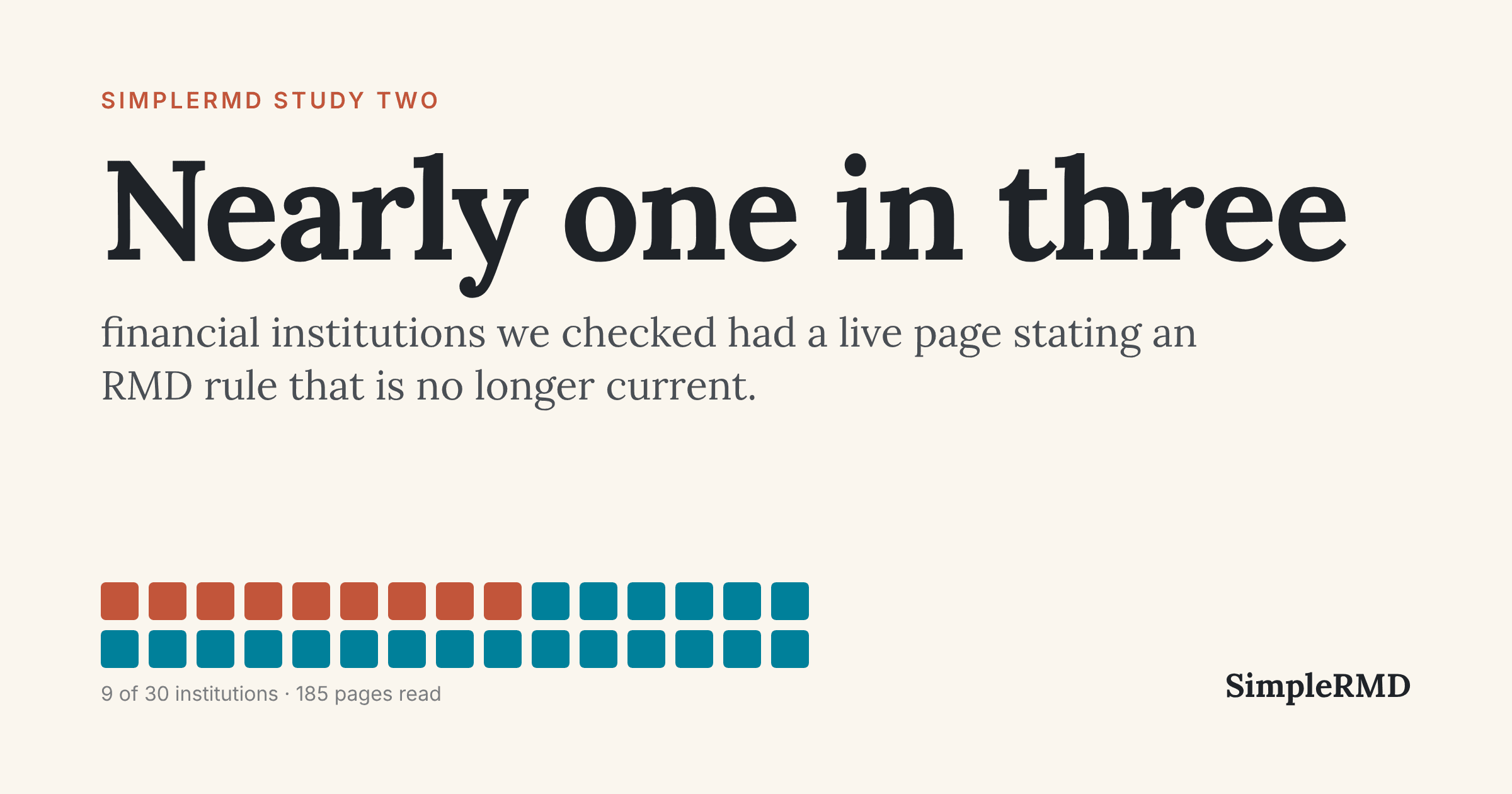
- 9 of the 30 institutions had at least one live page stating a superseded rule as current. Start at 72. Start at 70½. A 50% penalty. A $108,000 charitable limit for 2026. Counting pre-2023 PDFs that are still posted and prior-year figures with no update, 15 of the 30 had at least one problem page.
- The large custodians were clean. None of the six custodian brands we checked (Schwab, Fidelity, Vanguard, Merrill, E*TRADE, T. Rowe Price) had a live page stating an old rule as current. The problems were concentrated at recordkeepers, broker-dealers and banks.
- The errors live in pages nobody owns. Of the 26 problem pages in the sample, 6 were help text on calculator pages, 10 were PDFs, and 10 were older articles and product pages. Five of the 14 wrong pages carry a 2026 copyright line in the footer.
- On several calculator pages, the calculator was right and the sentence above it was wrong. The software had been updated to 73. The page text still said 72.
- Three institutions were told about the same sentence in August, and again on October 30. On November 13 it was still on all three pages.
- Fewer than half the pages that give a start age mention 75. Of 103 pages that state one, 47 give both ages by birth year. Another 32 say 73 and stop. That's correct for people born 1951 through 1959; a reader born in 1960 or later would take it as their age too, and it isn't. We count these as incomplete, not wrong.
We wrote to 24 organizations on October 30. By November 13, four had fixed or taken down a page and one had responded.
What we checked
Sample. 30 institutions chosen before any page was read: the 20 that host the calculators in Study One, plus 10 large retirement-plan recordkeepers and broker-dealers. For each, we collected the public pages a person would find when looking up RMD rules on that site: RMD explainers, calculator pages, inherited-IRA pages, charitable-giving pages, and PDF guides linked from them. 185 pages in all.
Capture. Each page was saved as a dated screenshot plus its full text, between September 26 and October 28, 2026. Pages that loaded behind a bot wall or failed to capture were captured again by hand.
Scoring. Each page was scored on four rules, against the law in effect on the capture date:
| Rule | Current answer | Source |
|---|---|---|
| Start age | 73 if born 1951–1959; 75 if born 1960 or later | IRC §401(a)(9)(C)(v), SECURE 2.0 §107 |
| Missed-RMD penalty | 25%, or 10% if corrected in the correction window | IRC §4974(a), (e), SECURE 2.0 §302 |
| Inherited IRA, owner died after required beginning date | Annual RMDs in years 1–9, account empty by end of year 10 | Treas. Reg. §1.401(a)(9)-5(d) (July 2024) |
| Charitable distribution (QCD) limit, 2026 | $111,000 per IRA owner | IRC §408(d)(8) as amended by SECURE 2.0 §307 |
Each page got one status:
- Current: states at least one rule correctly and nothing wrong.
- Incomplete: says 73 with no mention of 75. Not wrong today, and not counted in the headline.
- Wrong: states a superseded rule as current: 72, 70½, 50%, or a $100,000 or $108,000 limit in the present tense.
- Stale document: a dated PDF or notice from 2016 to 2021 that is still posted and states an old rule. Its date is on it, so a careful reader can tell. We count it separately from wrong.
- Outdated figure: gives an earlier year's QCD limit, labeled with that year, and no 2026 figure.
- No rule stated, removed, blocked, off-topic: excluded from the rates.
124 of the 185 pages stated at least one rule. All rates below use those 124.
Checking. Every page scored wrong, stale or outdated was checked a second time by a person against the saved copy and the live page, with the exact sentence recorded. Where a page also stated the correct rule somewhere else, we noted it.
Results
| Status | Pages | Share of rule-stating pages |
|---|---|---|
| Current | 65 | 52% |
| Incomplete (73 only) | 33 | 27% |
| Wrong | 14 | 11% |
| Stale document | 9 | 7% |
| Outdated figure | 3 | 2% |
| Rule-stating pages | 124 | Shares may not sum to 100% due to rounding. |
| No rule stated | 44 | |
| Removed, blocked or off-topic | 17 | |
| All pages | 185 |
Figure 1. Status of the 124 pages that stated an RMD rule.
Which old rules. Among the 26 problem pages, start age 72 appeared on 16, start age 70½ on 5, the 50% penalty on 4, and an old QCD limit on 4 (some pages had more than one). No page we read got the inherited-IRA annual-RMD rule wrong; most pages that discussed inherited IRAs described it correctly or didn't address it.
By institution
| Institution | Type | Pages | Wrong | Stale doc | Outdated | Incomplete | Current | After our notice |
|---|---|---|---|---|---|---|---|---|
| AARP | Publisher | 6 | 2 | 0 | 0 | 2 | 1 | No change |
| BancFirst | Bank | 2 | 2 | 0 | 0 | 0 | 0 | No change |
| Bonvenu Bank | Bank | 1 | 0 | 0 | 0 | 0 | 1 | — |
| calculator.net | Publisher | 2 | 0 | 0 | 0 | 0 | 2 | — |
| Charles Schwab | Custodian | 7 | 0 | 0 | 0 | 4 | 2 | — |
| Commonwealth Financial Network | Broker-dealer | 5 | 2 | 2 | 1 | 0 | 0 | No change (1 page no longer live after site migration) |
| Empower | Recordkeeper | 7 | 1 | 0 | 0 | 1 | 5 | No change |
| Fidelity | Custodian | 12 | 0 | 0 | 0 | 4 | 3 | — |
| FINRA | Regulator | 3 | 0 | 0 | 0 | 1 | 0 | — |
| Investor.gov (SEC) | Regulator | 3 | 0 | 0 | 0 | 0 | 1 | — |
| Lincoln Investment | Broker-dealer | 5 | 2 | 0 | 0 | 1 | 2 | No change |
| MassMutual | Insurer | 7 | 0 | 0 | 0 | 0 | 3 | — |
| Merrill | Custodian | 9 | 0 | 1 | 0 | 4 | 2 | No change |
| MissionSquare | Recordkeeper | 5 | 0 | 0 | 0 | 1 | 1 | — |
| Pacific Life | Insurer | 12 | 0 | 0 | 1 | 0 | 5 | No change |
| Red River Bank | Bank | 1 | 1 | 0 | 0 | 0 | 0 | No change |
| SmartAsset | Publisher | 7 | 0 | 0 | 0 | 2 | 5 | — |
| Vanguard | Custodian | 6 | 0 | 0 | 0 | 2 | 3 | — |
| Voya | Recordkeeper | 9 | 0 | 0 | 0 | 1 | 5 | — |
| E\*TRADE (Morgan Stanley) | Custodian | 5 | 0 | 0 | 0 | 0 | 3 | — |
| TIAA | Recordkeeper | 12 | 0 | 2 | 0 | 0 | 8 | No change |
| Principal | Recordkeeper | 5 | 1 | 0 | 0 | 1 | 1 | No change |
| T. Rowe Price | Custodian | 6 | 0 | 0 | 1 | 1 | 2 | No change |
| John Hancock | Recordkeeper | 9 | 2 | 0 | 0 | 3 | 2 | 2 pages removed |
| Nationwide | Recordkeeper | 6 | 0 | 0 | 0 | 0 | 3 | — |
| Ameriprise | Broker-dealer | 8 | 0 | 0 | 0 | 0 | 4 | — |
| Edward Jones | Broker-dealer | 7 | 0 | 1 | 0 | 3 | 0 | No change |
| Raymond James | Broker-dealer | 8 | 0 | 2 | 0 | 0 | 1 | No change |
| LPL Financial | Broker-dealer | 6 | 0 | 0 | 0 | 1 | 0 | — |
| Transamerica | Recordkeeper | 4 | 1 | 1 | 0 | 1 | 0 | No change |
Page counts include pages that stated no rule or were removed; the full page list with every status is in the download.
By type of institution
| Type | Institutions | With a wrong page | Rule-stating pages | Problem pages |
|---|---|---|---|---|
| Recordkeeper | 8 | 4 | 41 | 8 |
| Broker-dealer | 6 | 2 | 22 | 10 |
| Custodian | 6 | 0 | 32 | 2 |
| Bank | 3 | 2 | 4 | 3 |
| Publisher | 3 | 1 | 14 | 2 |
| Insurer | 2 | 0 | 9 | 1 |
| Regulator | 2 | 0 | 2 | 0 |
Figure 2. Institutions with a wrong page, by type.
The two regulators (FINRA and the SEC's Investor.gov) had no problem pages. Neither did the custodians' main RMD pages: the two custodian problems were an archived 2016 PDF and a 2024 QCD figure with no 2026 update.
What the errors have in common
Figure 3. Where the 26 problem pages sat.
The calculator got updated. The page around it didn't. Six of the 14 wrong pages are calculator pages at four institutions (BancFirst, Commonwealth, Lincoln Investment, Red River Bank). On three of them, the calculator itself returned the current answer. BancFirst's tool, for example, reported an RMD age of 73, while the sentence above it read: "Your minimum account withdrawals begin when you are age 72." The sentence was still there on November 13. Several of these pages carry nearly identical wording, and four state that the calculator "has been updated for the SECURE Act of 2019 and CARES Act of 2020," the law before SECURE 2.0. That pattern points to licensed calculator software whose engine was updated while its description text, or the institution's own copy, was not.
PDFs don't get edited. 10 of the 26 problem pages are PDFs: plan guides, FAQ sheets and forms. Several are dated 2016 to 2020 and say so. They are still posted, still linked, and still rank. A reader who lands on one from a search has no reason to think the firm stopped standing behind it.
The copyright line says 2026. Five of the 14 wrong pages show "© 2026" in the footer. Copyright lines update automatically every January, so they say nothing about when the page text was last reviewed. A reader checking the bottom of the page for a date will be misled. The only dates worth trusting are an "updated" or "reviewed" date on the content itself.
Being told once wasn't enough. In August, ahead of Study One, we wrote to BancFirst, Lincoln Investment and Red River Bank about these exact calculator sentences. When we captured the pages again on September 26, all three were unchanged. Pacific Life, told about a 50% penalty sentence at the same time, had removed it. We wrote to all three again on October 30. On November 13, all three sentences were unchanged.
What the errors cost a reader
Most of these errors push people to act earlier than the law requires, not later. A reader who believes RMDs start at 72, or at 73 when they were born in 1960, will take taxable withdrawals a year or more before they have to. That costs tax-deferred growth and may cost tax, but it won't trigger a penalty. The 50% figure overstates the penalty, which mostly adds fear. The old QCD limits understate how much a donor can give tax-free in 2026, by as much as $11,000.
The error that would cost a penalty is the one we expected to find and mostly didn't: telling a beneficiary they can skip annual RMDs on an inherited IRA. No page in the sample said that.
Pages found separately
We also checked 10 pages at 10 organizations identified by DFX Intelligence as likely to carry stale RMD statements: two independent advisory firms, a senior-living operator, two community foundations, a planned-giving page, a self-directed IRA custodian, two member associations and a credit union. These pages were found because they looked stale, so they are not part of any rate above. Nine of the ten stated an old rule; the tenth stated none.
| Organization | Type | What the page said | Status |
|---|---|---|---|
| Rodgers & Associates | RIA | start age 72; 50% penalty | Wrong; updated after notice (now 25% penalty, $111,000 QCD) |
| Keen Wealth Advisors | RIA | 50% penalty | Wrong |
| Kendal Corporation | Senior living | QCD limit $100,000 | Wrong; page no longer live |
| Oregon Community Foundation | Community foundation | QCD limit $100,000 | Wrong |
| Hawaii Community Foundation | Community foundation | $108,000 "in 2025," no 2026 figure | Outdated figure |
| The Entrust Group | Self-directed IRA custodian | 50% penalty | Wrong |
| NARFE | Member association | start age 72 (2020 TSP guide) | Stale document |
| MOAA | Member association | start age 72 (calculator page) | Wrong |
| Eglin Federal Credit Union | Credit union | start age 72 | Wrong; updated after notice (age-72 sentence removed) |
| Metropolitan Opera | Planned giving | no rule stated | — |
Three of the nine with an old rule changed after our notice. The other six were unchanged on November 13.
Company responses
We sent each organization its own findings on October 30, 2026, with the page address, the exact sentence, the current rule and its source, and an invitation to correct us or send a statement by November 12. We sent a reminder on November 9.
John Hancock responded: "We have taken down the two retirement references you mentioned and feel the information in the annuities form PDF wasn't complete and that the form is accurate." Both articles were gone when we checked on November 13. On the form, John Hancock was right; see "Corrections before publication" below.
The other 23 organizations did not respond by the deadline. Rodgers & Associates and Eglin Federal Credit Union updated their pages without responding.
Pages updated after our notice are reported as updated, and their old wording is not quoted here.
Corrections before publication
Three pages we had scored wrong were rescored after we read each sentence in full, against the copy saved at capture:
- John Hancock RMD request form (PDF). We quoted "minimum distributions are required after reaching age 70½." The full sentence begins "For individuals born before July 1, 1949," and the form goes on to give age 72 and age 73 for later birth dates. That schedule is correct; the form doesn't mention age 75 for people born in 1960 or later, so we now score it incomplete. John Hancock raised this in its response.
- TIAA "Learn about RMDs" page. It says "up to a 50% excise tax*," with the footnote "*25% in tax years after 12/29/2022," and gives every RMD age by birth date, including 75. Both footnotes were on the page when we captured it. We now score it current.
We then re-read every other page flagged for 70½ or 50% for the same kind of qualifier and found none. That re-read caught one classification error in the other direction:
- Transamerica RMD calculator guide (PDF). It states the 70½ rule as current, but it also says it "was last updated January 2017." Under our rules a dated pre-2023 document still posted is a stale document, not a wrong page, so we moved it.
Together these moved TIAA out of the count of institutions with a wrong page (10 to 9) and reduced wrong pages from 17 to 14.
What to do if you're reading an RMD page
- If it says 72, 70½ or 50%, it's out of date.
- If it says 73 and you were born in 1960 or later, your age is 75.
- Look for an "updated" or "reviewed" date on the article itself. Ignore the copyright line.
- The IRS's RMD FAQ is current and short.
Downloads
- Every page we scored: institution, URL, capture date, status, the rule, and the exact sentence (CSV).
- Dated captures of every flagged page, plus the extracted text of every page (ZIP, 39 MB).
- Scoring rules and answer key (PDF).
Limits
This is a snapshot. Pages change, and some changed during the study; we report the state on the capture date and, for flagged pages, on November 13. We read public pages only, not what clients see after logging in. A page scored current may still have gaps we didn't score. The sample is 30 institutions, so the type breakdown is indicative, not a ranking.
Corrections policy: errors on this page will be corrected within 48 hours and noted in a dated changelog.