

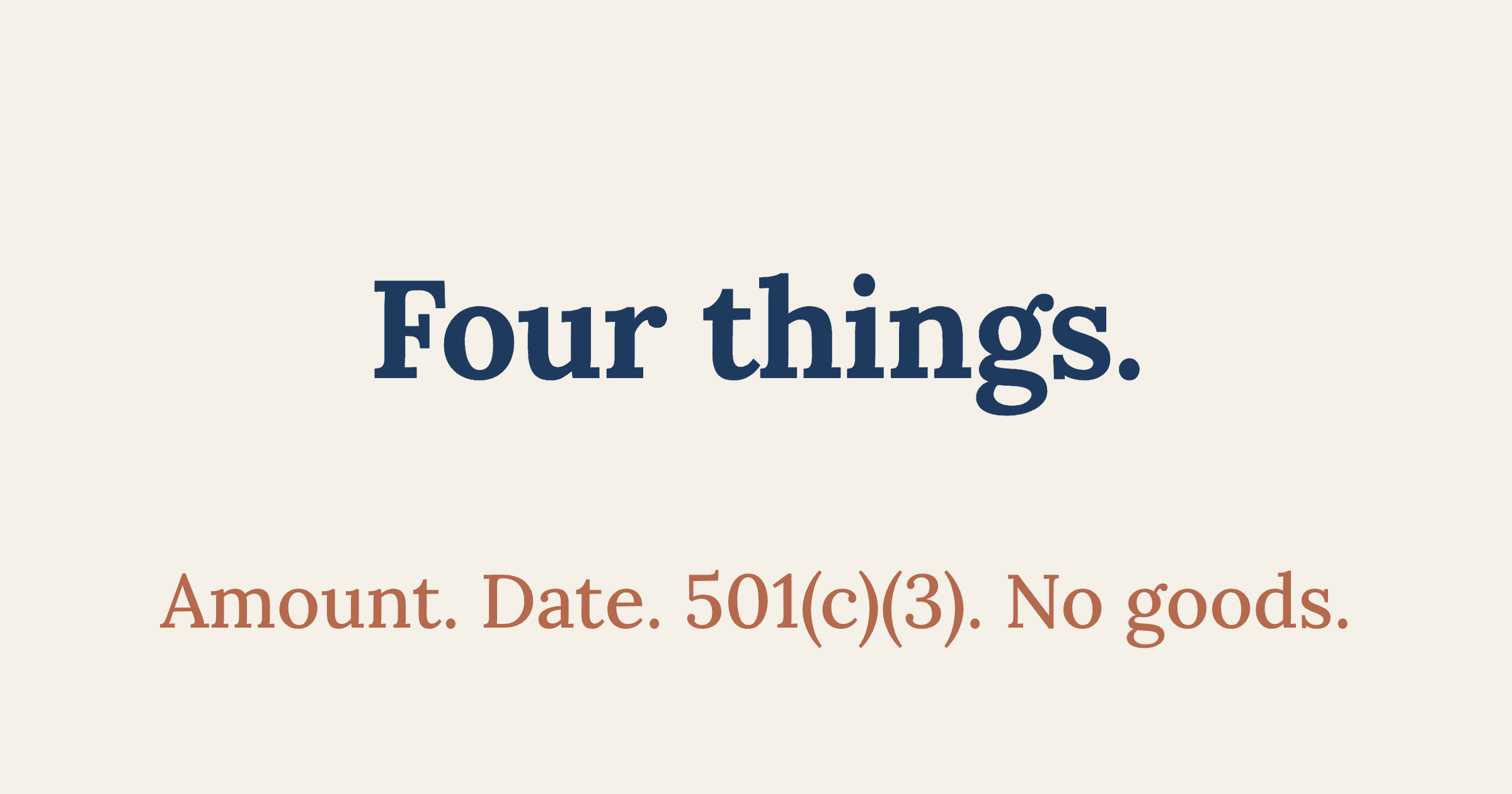
Four elements. Your Qualified Charitable Distribution (QCD) acknowledgement letter from the charity must include the exact dollar amount received, the date received, confirmation that the organization is a qualified 501(c)(3), and a statement that no goods or services were provided in return. The letter must be obtained on or before the date you file your tax return for the year of the distribution.
The fourth element, the no-goods-or-services statement, is the one most often missing. It's also the one that can disqualify the QCD if the IRS audits the return. A charity's standard receipt template often doesn't include it. Ask for it explicitly.
Calculate Your RMDThe four required elements
Amount. The letter must state the exact dollar amount the charity received from your IRA. A range, a "donation" notation, or a description that omits the figure will not satisfy the requirement.
Date. The date the charity received the funds. For a QCD, this is the date the IRA custodian's check cleared at the charity, not the date the custodian cut the check. Some charities note both dates; the funded date is the one that matters.
501(c)(3) status. The letter should confirm the organization is recognized as a tax-exempt public charity under section 501(c)(3) of the Internal Revenue Code. Many charities include language like "your contribution is tax-deductible to the extent allowed by law" — that wording confirms 501(c)(3) status indirectly but is acceptable.
No goods or services. The letter must state that no goods or services were provided in return for the gift. If the charity provided something (a meal, a ticket, a calendar), the QCD is disqualified for the portion of the gift that represents the value of what was received, and the letter must specify the fair-market value of anything provided. For a clean QCD, ask the charity to confirm explicitly that no goods or services were provided.
Timing and the $250 threshold
The acknowledgement must be in your hands before you file your tax return. The IRS calls this the "contemporaneous" requirement — the letter must exist by the earlier of the return-filing date or the original due date (including extensions). A letter obtained after the return is filed cannot retroactively support the QCD if the return is audited.
The $250 threshold comes from IRC §170(f)(8), which requires contemporaneous written acknowledgement for any single charitable contribution of $250 or more. In practice, almost every QCD exceeds $250, so the rule applies to virtually all QCDs. Even if a single QCD is below $250, keeping the letter is good practice — the standard documentation requirement still applies to support the exclusion from income on Form 1040.
If you make multiple QCDs to the same charity during the year, each one needs its own acknowledgement, or one letter that itemizes each gift with its individual date and amount. A single year-end summary that only shows a total does not satisfy the requirement.
What to do if the letter is missing or incomplete
Request a replacement before filing. If you discover a missing or incomplete letter while preparing your return, ask the charity to issue a corrected acknowledgement. Most charities will reissue without question if you specify the four required elements. Document the request and the response in your tax file.
If the return-filing deadline is close, file Form 4868 for an extension to October 15 and use the extra time to obtain the letter. The extension preserves the contemporaneous timing — as long as the letter is in hand before the return is filed under the extension, the requirement is satisfied.
If the letter cannot be obtained and the QCD has been claimed, the QCD portion of the distribution becomes taxable income. The charitable amount may still be deductible on Schedule A if you itemize, but that's a different (and usually less favorable) tax treatment than the QCD exclusion.
For the reporting walkthrough that uses the letter as documentation, see How to report a QCD on your tax return. For the broader RMD-and-taxes framework, see the RMD Taxes overview or How SimpleRMD works.
This article is for informational purposes only and does not constitute tax, legal, or financial advice. IRS rules and tax laws are subject to change. Consult a qualified tax professional or financial advisor for guidance specific to your situation. SimpleRMD is a calculation and tracking tool — not a financial advisory service.
Sources: IRS.gov (Publication 590-B, Publication 1771: Charitable Contributions Substantiation, Topic 506: Charitable Contributions). IRC §170(f)(8). IRC §408(d)(8). Rules confirmed current as of May 2026.